Polishers and prophylaxis: why polishing works in stages
179 instruments for polishing and prophylaxis. Why a fine polisher achieves nothing on a coarse surface, and which polisher suits composite or ceramic.

Wird geladen …
2'413 items in stock, ready to ship in 48 hours.
179 instruments for polishing and prophylaxis. Why a fine polisher achieves nothing on a coarse surface, and which polisher suits composite or ceramic.

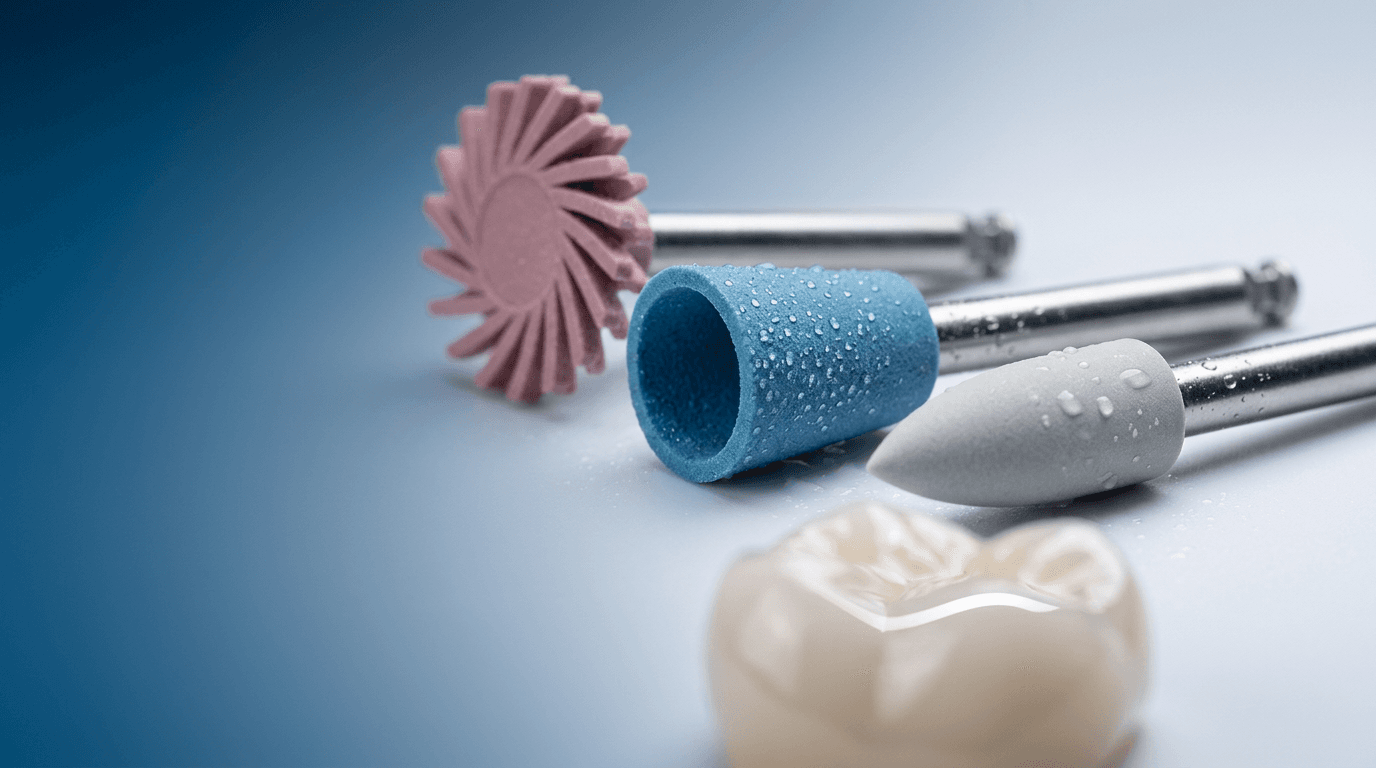
Polishing is the step most often cut short, and the one where cutting corners pays off least. A rough surface collects plaque, discolours and irritates the soft tissue. Which polisher is right for the job comes down to three details: step, material and maximum speed.
A polisher does not remove material, it smooths. To do so, its grit has to be finer than the scratch it is meant to remove and coarser than the surface it leaves behind. If you go straight from a medium diamond grit to high gloss, you polish over the scratches: the surface shines, but the scratches remain underneath and show up as discolouration lines after a few weeks. Which grit leaves which scratch is explained in Understanding the instrument code.
How many stages you need depends on the system and on the initial roughness, not on a rule. This is exactly where the lines in the range differ:
| Line | Stages | ISO grit | Items | Max. speed |
|---|---|---|---|---|
| cerdia | 3 | 514, 524, 534 | 33 | 12,000 min⁻¹ |
| amago | 3 | 503, 513, 533 | 17 | 12,000 min⁻¹ |
| neopall | 2 | 514, 524 | 16 | 15,000 min⁻¹ |
| megapol | 2 | 524, 534 | 14 | 10,000 min⁻¹ |
According to its product description, cerdia is a three-stage system for ceramics, with pre-polishing, polishing and high gloss without additional polishing paste. neopall and megapol manage with two stages. So anyone who hears that polishing always takes three steps is looking at a three-stage system and generalising from it.
What matters is not the number of stages but the gap between them. A two-stage sequence works if the finishing step has already left a fine surface. If the restoration comes out of the preparation with a coarse diamond grit, the first step is missing, and two stages are not enough.
All maximum speeds are 15,000 min⁻¹ or lower, and that is the most important difference from grinding. Polishers work slowly. A polisher at turbine speed does not polish, it burns the surface and itself.
| Group | Items | Max. speed | Intended for |
|---|---|---|---|
| Polishers | 147 | up to 15,000 min⁻¹ | Composite, metal, resin |
| Ceramic grinders | 28 | 15,000 min⁻¹ | Ceramics and zirconia |
| Prophylaxis | 17 | 4,500 to 12,000 min⁻¹ | Tooth cleaning, natural surface |
| Brushes | 15 | 10,000 min⁻¹ | Access areas, fissures, interdental spaces |
| Mandrels | 14 | not specified | Holders for unmounted discs |
The material decides because the bond of the polishing agent has to match the hardness. A polisher for composite sits in a soft carrier so that it adapts to the shape. The same carrier gives way on zirconia before the grit can bite, and then polishes nothing. That is why the ceramic grinders form a group of their own, with 28 items and a harder bond. For ceramics in the laboratory, see Working with all-ceramics, and for zirconia, Diamonds for zirconia.
The group comprises 13 shapes. Three of them have names: Cup and Cup Long with 13 items each, and swing with 11. The other ten appear in the catalogue only with their ISO shape number.
The choice depends on the surface, not on preference. A cup adapts to curved surfaces and reaches the transition to the gingiva. A lens or disc works flat and keeps an edge. A point reaches fissures and approximal surfaces that a disc cannot get to. If you do everything with one shape, you round off edges that should stay sharp.
| Shank | ISO | Handpiece | Items |
|---|---|---|---|
| RA | 204 | Contra-angle | 65 |
| Unmounted | 900 | On mandrel | 50 |
| HP | 104 | Straight handpiece | 24 |
| FG | 314 | Turbine | 8 |
The contra-angle leads with 65 of 147 items, because that is where polishing on the patient takes place: low speed, good access, control over the contact pressure.
The 50 unmounted items explain why the mandrels form a group of their own. Unmounted saves on consumables, because you only replace the disc. In return, concentricity depends on the mandrel, and a worn mandrel makes the disc wobble. A wobbling disc does not polish evenly, it chatters.
The eight items with a turbine shank do not contradict the speed rule: a turbine can be throttled back with the foot control, but it then works with little torque.
| Line | Items | Max. speed |
|---|---|---|
| prophycups | 8 | 10,000 min⁻¹ |
| prophypol | 5 | 12,000 min⁻¹ |
| prophycups snap-on | 2 | 4,500 min⁻¹ |
| prophycups screw-on | 2 | 4,500 min⁻¹ |
The 4,500 min⁻¹ of the snap-on and screw-on cups is the lowest limit in the entire range, and for good reason. At high speed, a rubber cup flings the polishing paste away instead of carrying it, and it heats up.
The surface decides between cup and brush. The cup adapts to smooth surfaces and reaches the sulcus margin. The brush gets into fissures and access areas that the cup bridges over. All 15 brushes in the range run at up to 10,000 min⁻¹.
Polish wet. When dry, the temperature at the contact surface rises immediately, and two things are damaged in the process: the surface and the polisher.
With composite, the margin is particularly narrow. Resin softens from about 60 degrees and then smears instead of smoothing. What you see afterwards is not a polish but a smeared surface that turns dull after a few weeks.
With ceramics and zirconia, the liquid mainly protects the polisher. The bond tolerates heat less well than the grit, and an overheated carrier loses its grit.
A polisher works through the grit in its carrier. Under pressure, the carrier deforms, the grit sinks in and no longer bites. At the same time, friction increases, the carrier softens and the polisher smears. What is then left on the surface is carrier material, not gloss.
The opposite is right: light contact, low speed, longer dwell time, a circular movement without a fixed direction. With composite, also use water, because resin softens from about 60 degrees and then smears instead of smoothing.
A high-gloss surface reproduces an outline, it does not merely reflect light. If you can make out an edge mirrored in the surface under the operating light, the surface is finished. As long as you only see a diffuse sheen, there are still scratches in it.
With restorations, a second criterion counts for more than the eye: the probe. A finished surface does not catch the probe. Where it catches, the transition is not smooth, and that is exactly where the marginal gap will later begin.
A polisher is a medical device and follows the manufacturer's instructions for use, including on how often it may be reused. This information is given with the product, not in a general rule.
Two things apply regardless. First: polishing residue and polishing paste that dry on are very hard to remove and clog the surface. Clean immediately after use. Second: a clogged polisher no longer works through the grit but through the carrier. It smears, and the result looks like gloss without being gloss. The complete reprocessing chain is described in Reprocessing instruments correctly.
You will find the polishers under Polishers, Ceramic grinders, Prophylaxis and Brushes, and the holders under Mandrels. How polishers and brushes are reprocessed is described in Reprocessing instruments correctly.
The system decides, not a rule. cerdia and amago are three-stage systems, neopall and megapol manage with two stages. What matters is the gap between the stages: two are enough if the finishing step has already left a fine surface. If the restoration comes out of the preparation with a coarse diamond grit, the first step is missing.
Wet. When dry, the temperature at the contact surface rises immediately. Composite softens from about 60 degrees and then smears, and with ceramics the overheated carrier loses its grit.
This is stated in the instructions for use of the respective product, not in a general rule. Regardless of this: clean immediately after use, because dried-on polishing paste clogs the surface, and a clogged polisher smears instead of smoothing.
Much more slowly than when grinding. The limits are between 4,500 and 15,000 min⁻¹, and as low as 4,500 min⁻¹ for the snap-on and screw-on prophylaxis cups. A polisher at turbine speed does not polish, it burns the surface and itself.
Too much pressure. Under pressure, the carrier deforms, the grit sinks in and no longer bites, friction increases and the carrier softens. What is then left on the surface is carrier material. The right approach is light contact, low speed and a longer dwell time.
No. The carrier for composite is soft so that it adapts to the shape. On zirconia it gives way before the grit can bite, and then polishes nothing. Ceramics and zirconia belong to the ceramic grinders group, 28 items with a harder bond.
The cup adapts to smooth surfaces and reaches the sulcus margin. The brush gets into fissures and access areas that the cup bridges over. Use both together, not one instead of the other.
By the reflection, not by the shine. A finished surface reproduces an outline, not just a diffuse sheen. With restorations, the probe also counts: where it catches, the transition is not smooth, and that is exactly where the marginal gap will later begin.
Yes. Resin softens from about 60 degrees and then smears instead of smoothing. The heat comes from friction and rises with pressure and speed, which are exactly the two things that should stay low when polishing anyway.
Unmounted is cheaper in terms of consumables, because only the disc is replaced. In return, concentricity depends on the mandrel, and a worn mandrel makes the disc wobble. A wobbling disc does not polish evenly, it chatters. 50 of the 147 polishers are unmounted.

Anwendung
Bone cutters in oral surgery: shapes, shanks and heat
66 surgical round burs from 1.0 to 5.0 mm and 32 cutters for sectioning. Why a bone cutter cuts laterally and how to avoid heat damage.

Anwendung
Endodontics: creating access and preparing the canal
From the access cavity to the root filling: which rotary instruments make root canal treatment safe and efficient.

Anwendung
IPR: safely removing interproximal enamel and adhesive residue
Aligner therapy needs space. How to achieve controlled interproximal enamel reduction and remove adhesive residue after brackets without leaving traces.