Anwendung06 July 20267 min readby rotatec
Interproximal Enamel Reduction: Instruments, Steps
Controlled interproximal enamel reduction: IPR files of 0.18 and 0.24 mm in 4 grits, a 6-step protocol, and enamel-safe removal of adhesive residue.

Wird geladen …
2'413 items in stock, ready to ship in 48 hours.
Controlled interproximal enamel reduction: IPR files of 0.18 and 0.24 mm in 4 grits, a 6-step protocol, and enamel-safe removal of adhesive residue.
Interproximal enamel reduction (IPR) creates space between the teeth in cases of mild crowding, without extraction. It is controlled when enamel is removed step by step from coarse to fine with measurement checks, and the surface is then smoothed, polished and fluoridated. After removal of brackets or aligner attachments, fine-bladed carbide instruments remove adhesive residue without damaging the enamel.
ASR, IPR (interproximal reduction) and stripping denote the same procedure: the controlled removal of enamel on the proximal surfaces. It creates space for tooth movement in aligner and fixed appliance therapy. Further indications are tooth size discrepancies between the upper and lower jaw and the reshaping of triangular crowns to reduce black triangles at the gingival margin.
The amount removed per contact point is set by the treatment plan and limited by the individual proximal enamel thickness. It is documented for each surface before starting and checked with a gauge after each pass. As a basic rule, sufficient enamel always remains so that no dentine is exposed. A blanket figure does not replace planning for the individual tooth, because enamel thickness varies considerably between anterior and posterior teeth.
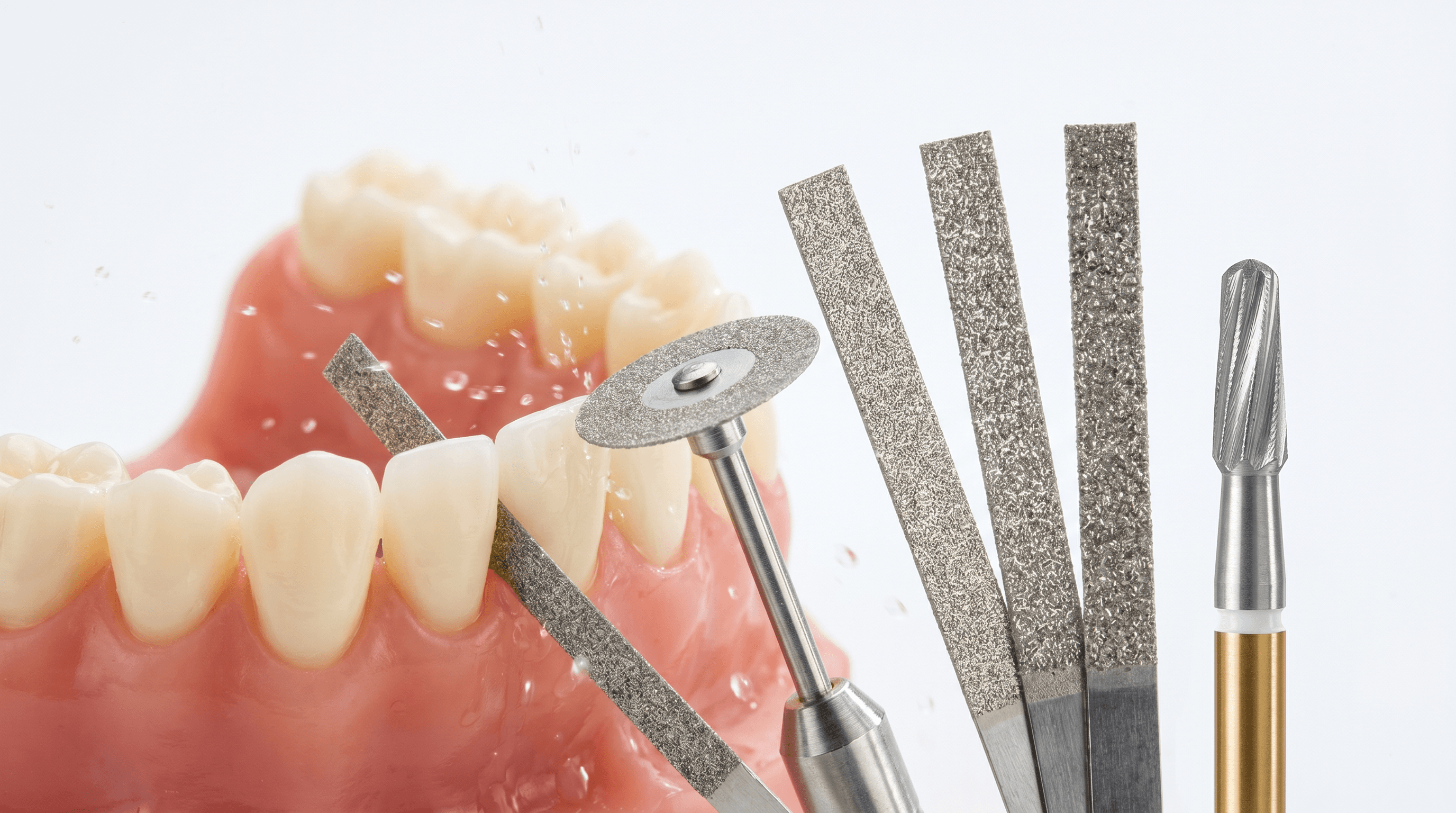
Diamond-coated strips, discs and flat, slender diamond instruments are suitable for IPR; the choice depends on access and on the planned amount.
The table assigns the instrument types to their typical use.
| Instrument type | Drive | Use | Note |
|---|---|---|---|
| Diamond-coated hand strip | manual | anterior, small removal | easy to control, slow |
| proxofile IPR file | FG shank | anterior and posterior | single- or double-sided |
| Very thin diamond disc | FGXL shank | larger removal | protect soft tissue |
| Polishing strip | manual | finishing | smooths the scoring |
In our range these are mainly the proxofile IPR files from the group clinical diamond burs, 8 items in total, 6 pieces each. Also listed for IPR is the very thin rhodia disc ZR943 with 8.0 or 10.0 mm diameter, maximum speed 45,000 min⁻¹.
The table compares the single-sided and double-sided proxofile.
| Feature | Single-sided (ES) | Double-sided (DS) |
|---|---|---|
| Thickness | 0.18 mm | 0.24 mm |
| Diamond coating | one side | both sides |
| Removal | one proximal surface | both contact surfaces at once |
| Shank, overall length | FG, 19 mm | FG, 19 mm |
| Working length | 9.0 mm | 9.0 mm |
The table shows the four grits with ISO code and item numbers from coarse to fine.
| Grit | ISO code | Double-sided | Single-sided |
|---|---|---|---|
| coarse | 534 | P4DS.314.016x006 | P4ES.314.016x006 |
| medium | 524 | P1DS.314.016x006 | P1ES.314.016x006 |
| fine | 514 | P2DS.314.016x006 | P2ES.314.016x006 |
| extra fine | 504 | P3DS.314.016x006 | P3ES.314.016x006 |
What the grit codes mean is explained in the article ISO 6360: grit and shank.
A fixed protocol makes interproximal enamel reduction reproducible and prevents excessive removal.
The table shows the six steps with the relevant note.
| Step | Procedure | Note |
|---|---|---|
| 1. Baseline | assess contact points, set removal per surface | according to treatment plan |
| 2. Protection | protect papilla and adjacent tooth | light pressure |
| 3. Reducing | start coarse or medium, then finer | grit 534 or 524 |
| 4. Measuring | check gap width with a gauge | after each pass |
| 5. Contouring | restore proximal convexity | no edges, no steps |
| 6. Finishing | smooth, polish, fluoridate | plaque-resistant surface |
Each finer stage removes the scoring of the previous one. This is why removal always ends with 514 or 504 and never with the starting grit.
The risks of IPR almost always arise from excessive removal, excessive heat or a rough residual surface.
The table shows the main risks with cause and prevention.
| Risk | Cause | Prevention |
|---|---|---|
| Scoring, plaque accumulation | finishing with coarse grit | fine grit 504, polishing |
| Exposed dentine | removal beyond the enamel thickness | planning per surface, gauge |
| Step at the contact point | instrument tilted | recontour the convexity |
| Injured papilla | unprotected soft tissue | protection, light pressure |
| Heat at the pulp | blunt instrument, pressure | cooling, timely replacement |
Instruments with declining cutting performance are replaced, because a blunt instrument tempts the user to apply more pressure and generates more heat.
Adhesive residue after brackets or aligner attachments is removed most gently with fine-bladed carbide instruments, because they remove resin and barely grip the harder enamel. Diamond instruments are too aggressive for this.
The table shows the instruments from the groups carbide burs and finishing burs for this step.
| Instrument | Shape, blade pattern | Shank | Diameter |
|---|---|---|---|
| H22AGK adhesive remover | cone round, ISO 006 | FG and RA | 1.6 mm |
| H22ALGK adhesive remover | cone, non-cutting tip, 006 | FG | 1.6 mm |
| H23RK adhesive remover | cone round, cross-cut 007 | FG and RA | 1.6 mm |
| H379 finishing bur | egg, medium 072 | FG and RA | 1.4, 1.8 and 2.3 mm |
Work under direct vision and with light that distinguishes the matt adhesive from the glossy enamel. The FG versions are approved up to 450,000 min⁻¹, the H379 with 2.3 mm up to 300,000 min⁻¹, the RA versions up to 100,000 min⁻¹.
After IPR and adhesive removal, polishing is mandatory, because rough enamel surfaces retain plaque. Polishers from the prophylaxis range smooth the treated surfaces in several stages with light pressure, supplemented proximally by polishing strips. Finally, fluoride is applied to support remineralisation of the enamel.
All instruments are Swiss Made to ISO 13485, in stock and ready to ship within 48 hours. Register as a professional customer and find the right grit in the shop.
The main risks are excessive removal into the dentine, rough surfaces with plaque accumulation and steps at the contact point. In addition there is injury to the papilla and heat from blunt rotary instruments. Planning per surface, measurement checks and polishing to a smooth surface reduce these risks considerably.
Diamond-coated hand strips, thin diamond discs and IPR files with FG shank are common. Files are available coated on one side to protect the adjacent tooth, or on both sides for two surfaces in one pass. Polishing strips and polishers follow for finishing.
The orthodontic treatment plan sets this for each surface. The upper limit is the individual enamel thickness, because dentine must not be exposed. Measurements are taken with a gauge after each pass.
There is no technical difference; all three terms describe proximal enamel removal. ASR is the German abbreviation, IPR stands for interproximal reduction, stripping is the older English term. In aligner planning, IPR is the usual term.
The GOZ has no separate fee number for interproximal enamel reduction. In practice it is usually charged as an analogous service under § 6 (1) GOZ. The current commentaries of the dental chambers apply.
With carbide adhesive removers or finishing burs, followed by multi-stage polishing. Their fine blade pattern removes composite and barely affects enamel. Residue can be recognised after drying by its more matt surface.
Yes, because every diamond grit leaves scoring on which plaque accumulates. Polishing continues until the surface is uniformly glossy, proximally with polishing strips. Fluoride is then applied.
Anwendung
Tangential preparation, chamfer or shoulder?
Tangential preparation, chamfer or shoulder: which preparation margin suits each material, and which of 187 diamond burs in 8 shapes produce it.
Anwendung
Crown preparation: procedure and instrument sequence
Crown preparation in 5 steps: which diamond shape and grit for each step, depth marking from 0.5 to 0.9 mm and maximum permissible speed of up to 450,000 min⁻¹.
Anwendung
Polishers and prophylaxis: why polishing works in stages
179 instruments for polishing and prophylaxis. Why a fine polisher achieves nothing on a coarse surface, and which polisher suits composite or ceramic.