
Diamonds for zirconia: the right instruments (rhodia)
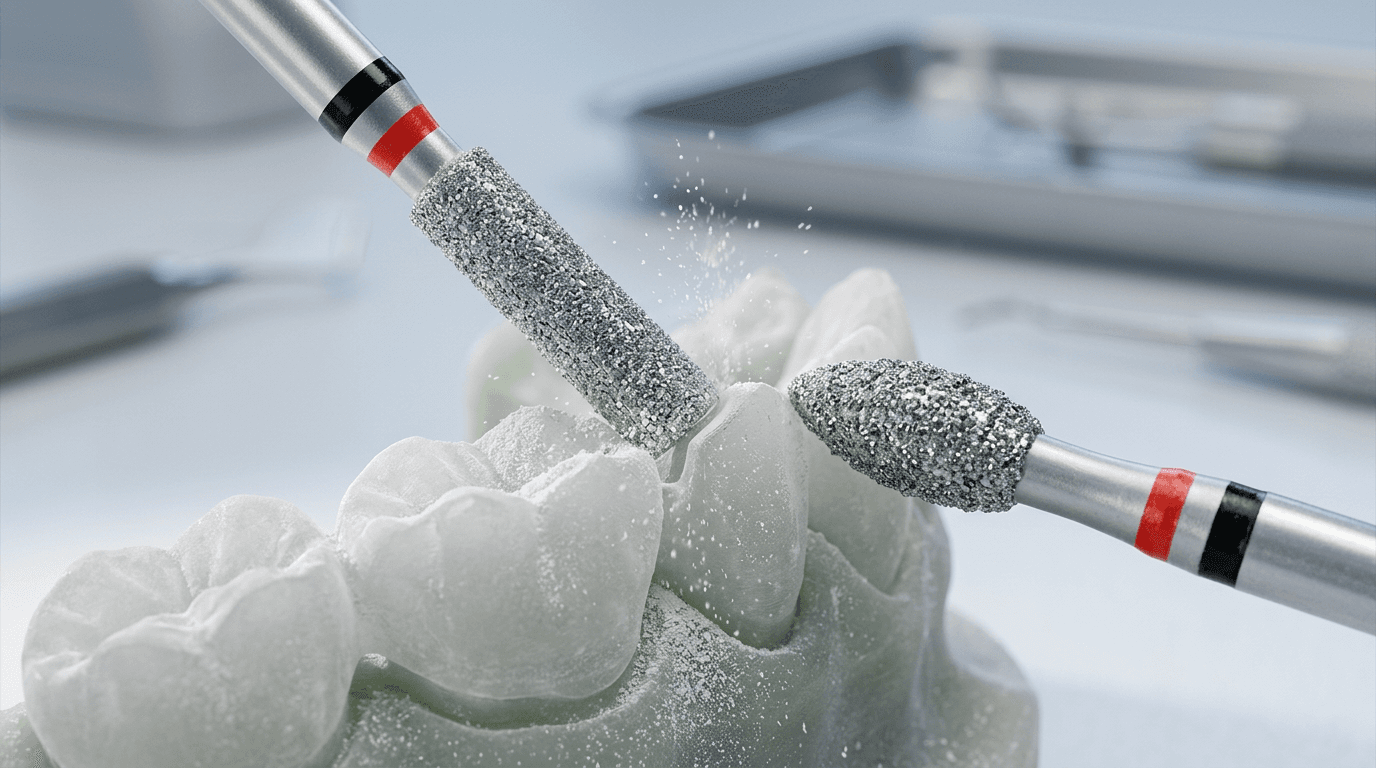
Zirconium oxide has become established as a material for crowns and bridges. It is aesthetic, biocompatible and very strong. It is precisely this strength that makes it demanding to work with: zirconia is hard and at the same time sensitive to localised overheating. With the rhodia line, rotatec offers diamond instruments designed for hard all-ceramic materials. You will find the entire series in the shop under Diamond burs for zirconia.
Why zirconia needs special instruments
Zirconium oxide is considerably harder than enamel and veneering ceramic. A standard diamond bur quickly loses its diamond coating on it. It then only works under pressure and generates heat instead of removing material. This creates a vicious circle: more pressure, more heat, faster wear and, in the worst case, microcracks in the restoration.
A sure sign that the instrument is no longer up to the material: you have to press harder to achieve any removal at all.
What rhodia does differently
rhodia diamond instruments carry an increased diamond concentration on the working part. More grit in contact means significantly higher material removal and a longer service life, even on zirconia. The matrix bond holds the grit securely and prevents it from breaking out, and the individual diamond grains cut with little vibration.
The series comprises 19 shapes in three dedicated grits:
- rhodia Coarse for material removal
- rhodia Fine for finishing the preparation margin
- rhodia Extra Fine for smooth transitions before polishing
The instruments are available with an FG shank in standard length as well as with long and extra long shanks, usually in packs of 6. Our article Understanding the instrument code: ISO 6360, grit and shank explains how grit and shank are designated according to the standard.
What rhodia is designed for
rhodia has been developed for crown and crown stump preparation on hard materials:
- Adjusting and correcting zirconia and all-ceramic restorations
- Opening and removing zirconium oxide crowns
- Preparing high-performance ceramics in the practice and laboratory
For enamel, dentine and composite, the higher diamond concentration offers no advantage; the standard range remains the right choice there. As soon as zirconia or high-performance ceramics regularly feature on the treatment plan, it is worth looking at the cost per preparation rather than per instrument: an instrument that completes a zirconia crown without being changed is more economical than several standard instruments used up in the process. Our overview The right rotary instrument for each material shows which material calls for which instrument.
How to work zirconia gently
- Cooling: work continuously with sufficient water spray; this protects the restoration, the tooth and the instrument
- Contact pressure: do not apply excessive pressure, as it leads to undesirable heating and can damage the instrument
- Movement: keep the instrument moving constantly and guide it over the surface, not with the tip, so that no localised heating occurs
- No levering: do not withdraw the instrument at too acute an angle, to avoid leverage and breakage
- Speed: never exceed the maximum speed stated on the label; the recommended operating speeds for each head diameter are given in the Application and reprocessing recommendations for burs
- Sequence: remove material with a coarse grit, then finish with rhodia Fine or Extra Fine, as coarse grits leave deep scratches in zirconia
- Inspection: check for damage and wear before each use; do not continue to use worn or blunt instruments
After adjustment: polishing
A smooth, polished zirconia surface is gentle on the opposing tooth and is aesthetically convincing. After finishing, multi-stage polishing is therefore recommended: first pre-polish, then bring to a high gloss. Suitable polishers for ceramics work without additional polishing paste, and the colour coding indicates the polishing stage. Read more about working lithium disilicate and zirconia in Working all-ceramics: lithium disilicate and zirconia.
In the laboratory
Major corrections to the framework should be carried out in the laboratory wherever possible. There, sintered diamond grinders handle the grinding, separating and finishing of zirconia frameworks, because the diamond grit is embedded throughout the bronze matrix and fresh grit is exposed as the instrument wears. For the milling unit, rhodia is also available with an HP shank in milling technology, in the shapes cone, rounded and cylinder, pointed, for use with water spray.
Reprocessing
rhodia instruments can be reused several times with validated reprocessing. Clean them immediately after the procedure, as zirconia dust quickly clogs the spaces in the diamond coating. The complete procedure is set out in the Application and reprocessing recommendations for burs, and our article Reprocessing instruments: hygiene and service life summarises the key points.
From our range
The rhodia series comprises 130 articles in 19 shapes and three grits, complemented by sintered diamond grinders and polishers for the practice and laboratory. All are Swiss Made in accordance with ISO 13485, available from stock and ready for dispatch within 48 hours.
How to find the right instrument quickly: the shop can be grouped by shape, shank type, diameter, application, material and grit.
Register as a professional customer and discover the rhodia series in the shop.
Sources
- ISO 7711-1:2021, Dentistry: Diamond rotary instruments, Part 1: General requirements (https://www.iso.org/standard/76056.html)
- ISO 6360: Dentistry, Number coding system for rotary instruments
- rotatec Anwendungs- und Aufbereitungsempfehlung Bohrer