
The right rotary instrument for each material in the dental laboratory
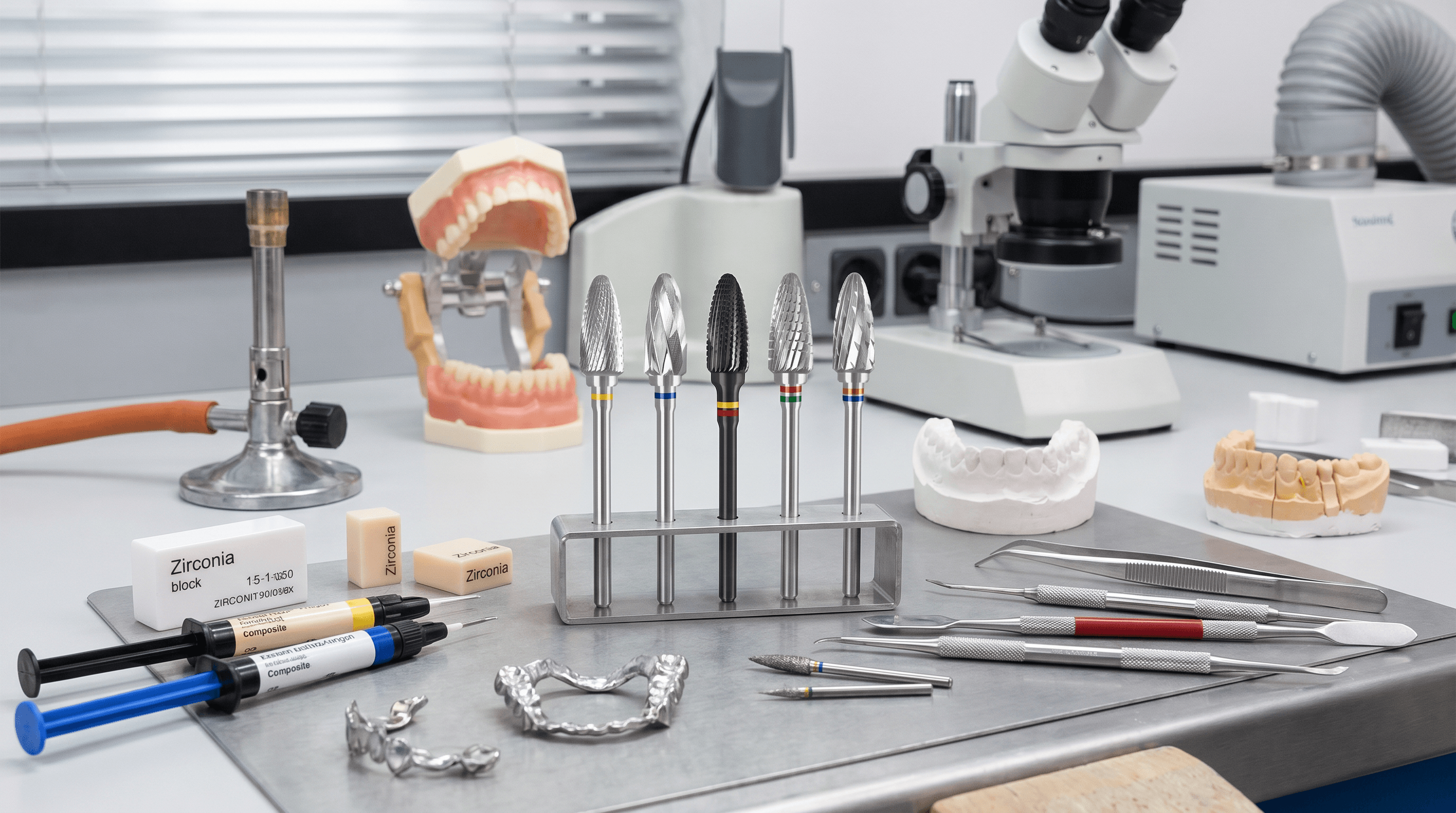
In the dental laboratory, the right rotary instrument determines efficiency, surface quality and service life. Every material places its own demands on geometry and cutting edge.
Plaster and model material
Coarsely toothed tungsten carbide burs are suitable for plaster, as they remove material quickly and without clogging. Good chip removal is essential.
Acrylic
Denture and temporary acrylic tends to smear. Cross-cut tungsten carbide burs with good chip removal and moderate speeds prevent heat and clogging of the material.
Metal and non-precious alloys
Non-precious metal alloys are hard and place heavy demands on the instrument. Tungsten carbide burs with robust toothing and separating discs with a long service life are the first choice here. For precious metals, more finely toothed instruments are suitable.
Ceramic and zirconia
Ceramic is ground, not cut. Diamond grinders and ceramic-bonded grinding bodies remove material in a controlled manner, followed by a matched polish. For zirconia, the same rules apply as intraorally: cool, fine, low in micro-cracks.
Separating
For separating frameworks and channels, separating discs are used, either diamond-coated depending on the material (ceramic, zirconia) or as tungsten carbide or separating discs (metal).
Choosing the right instrument saves time and money
The right instrument for each material works gently, lasts longer and reduces the cost per workpiece. A clear allocation in the laboratory, for example via the figure number, keeps workflows efficient.
Register as a trade customer and discover the laboratory range in the shop.
From our range
The right tool for every material: for zirconia and ceramics we offer diamond grinders and ceramic grinders for the lab, for metal and acrylics carbide cutters in various toothings, for high gloss the polishers. All Swiss Made to ISO 13485, in stock and ready to ship within 48 hours.
Register as a professional and find the right tool in the shop.
That makes finding the right instrument fast: our shop can be filtered and grouped by material and application as well as many further specifications (shank, size, grit, toothing, pack size).
Sources
- ISO 6360-3:2005 – Number coding system for rotary instruments – Part 3: burs and cutters
- ISO 1797:2017 – Dentistry – Shanks for rotary and oscillating instruments
- rotatec Produktkatalog und Gebrauchsanweisung (IFU), rotatec GmbH