Wird geladen …

EURLogin
Wird geladen …
2'414 items in stock, ready to ship in 48 hours.


2 applications · 14 items
Prophylaxis instruments clean and polish tooth surfaces during professional mechanical plaque removal. Together with prophylaxis paste, rotating cups and polishers remove plaque, deposits and discolouration.
Skin-friendly materials and defined hardness grades allow gentle, efficient work on the patient. For the RA shank on the contra-angle handpiece, in shapes for smooth surfaces and interproximal areas.
Direct from the Swiss manufacturer in Appenzell. Swiss made to ISO 13485, CE-MDR, stock items ready to ship within 48 hours.


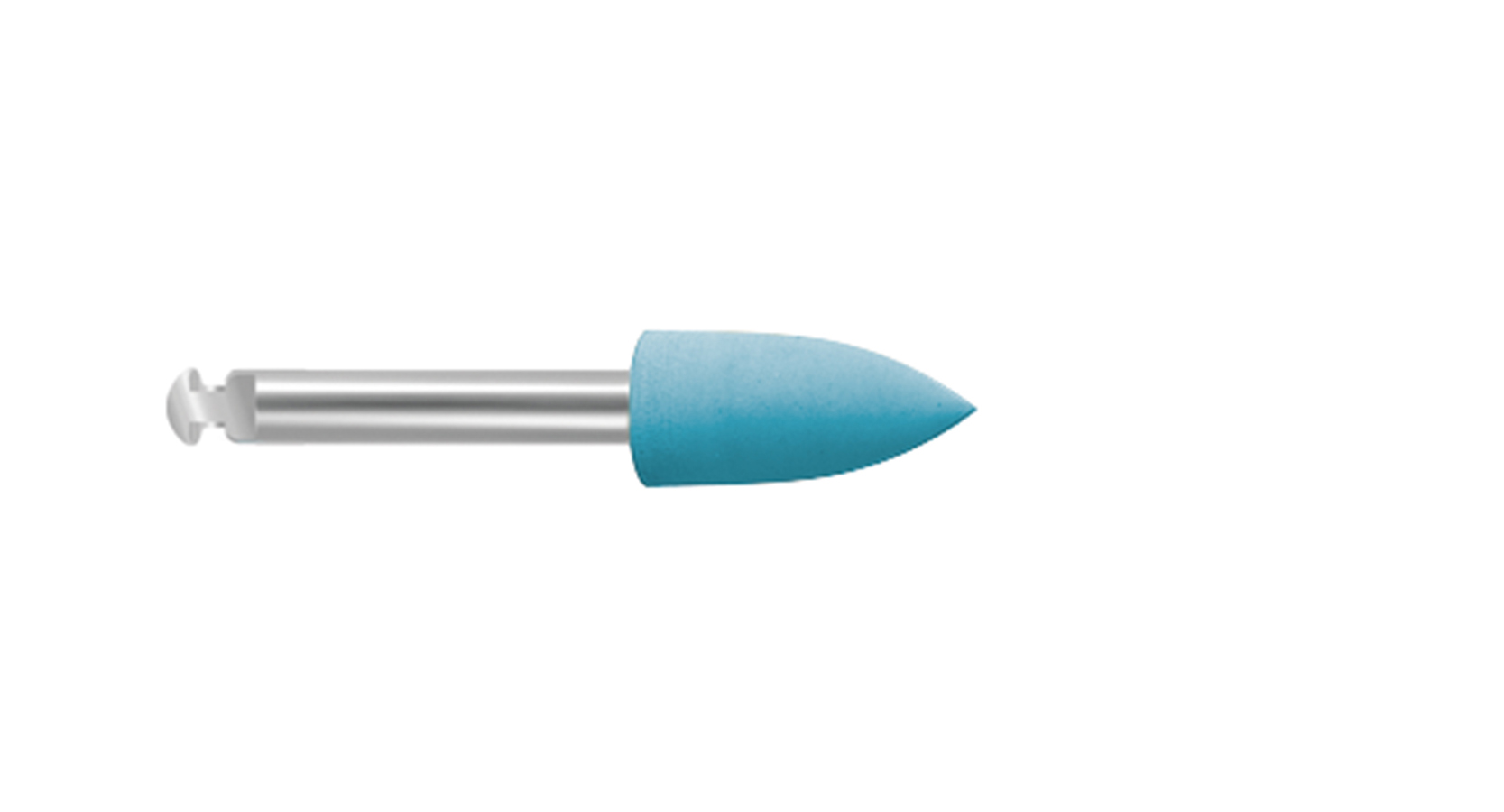
The shape determines access, the hardness grade determines how gentle the work is. Smooth surfaces call for something different than fissures or the interproximal space.
| Area | Instrument | Note |
|---|---|---|
| Buccal and lingual smooth surfaces | Polishing cup, soft | With prophylaxis paste, light pressure |
| Fissures and pits | Brush | Paste otherwise does not reach the base |
| Interproximal space | Narrow cup, strips | Protect the adjacent tooth |
| Cervical area | Soft cup | Exposed dentine is sensitive to abrasion |
| Restoration surfaces | Polisher instead of paste | Paste can roughen composite |
Because the abrasion should reach the tooth, not the gingiva. A soft cup adapts to the curvature and works across the surface, a hard one works at a point.
This matters at an exposed cervical margin: dentine is considerably softer than enamel and can be measurably abraded with a coarse paste and a hard cup. When in doubt, start softer.
In the low range of the contra-angle handpiece, with light pressure and intermittently. The cup should deform, not grind.
That depends on the type. Many cups are intended for single use, others can be reprocessed. The specification is given with each item.
The RA shank for the contra-angle handpiece. Prophylaxis is carried out at low speed, which is what the contra-angle handpiece is designed for.
High speed generates heat and flings the paste away instead of distributing it. Increase contact time rather than speed.
The paste determines the abrasiveness, the instrument the distribution. Without paste a cup barely cleans, with too coarse a paste it damages.
For restorations it is better to reach for polishers, which already contain the abrasive. For fissures and hard-to-reach spots we offer brushes.
Only with a suitable paste. Coarse prophylaxis paste can roughen composite. For restorations, abrasive-impregnated polishers are the better choice.