Anwendung22 October 20269 min readby rotatec
Bone cutters in oral surgery: shapes, shanks and heat
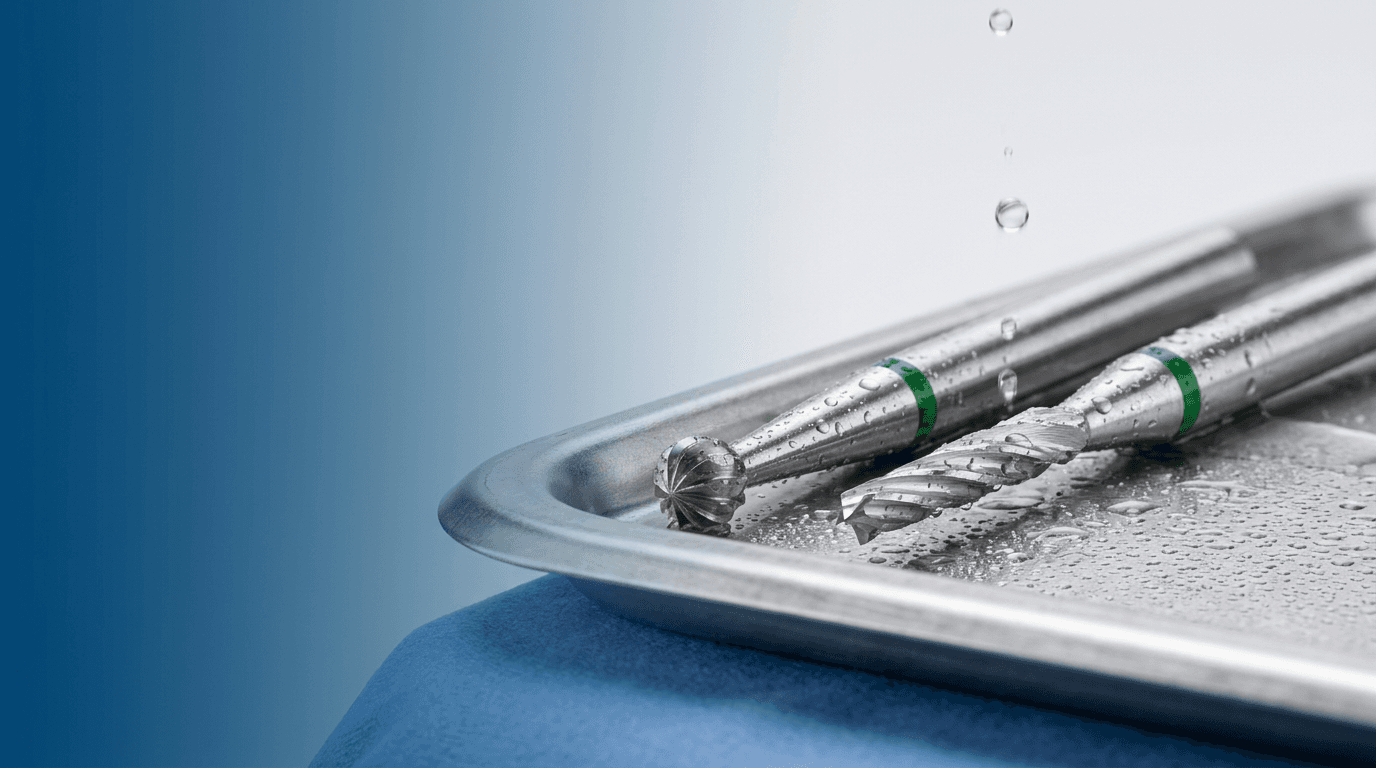
66 surgical round burs from 1.0 to 5.0 mm and 32 cutters for sectioning. Why a bone cutter cuts laterally and how to avoid heat damage.

Wird geladen …
2'413 items in stock, ready to ship in 48 hours.
66 surgical round burs from 1.0 to 5.0 mm and 32 cutters for sectioning. Why a bone cutter cuts laterally and how to avoid heat damage.
A bone cutter follows a different rule from any instrument in the cavity: not the fastest one wins, but the one that cuts cleanly at low speed with ample cooling. Bone is tough, it is alive, and it does not forgive heat. The surgery group comprises 98 articles, including 66 surgical round burs and 32 cutters for sectioning and smoothing. Which one fits is decided by three factors: task, drive and maximum speed.
| Type | ISO shape | Task |
|---|---|---|
| Round bur, surgical | 001 | Opening the cortex, starting a drill hole, enucleating cysts |
| Lindemann bur | 408, 409, 410 | Osteotomy, cutting lengthwise, sectioning bone blocks |
| Cylinder cutter with transverse cut | 415 | Smoothing surfaces, breaking edges |
| Trephine bur | 196, 199 | Harvesting bone cores, retrieving implants |
With 66 of 98 articles, the round head is the most common shape. That reflects daily practice: opening and clearing out happen more often than sectioning.
The material picture is clear: 93 articles are tungsten carbide. Five are diamond-coated on a stainless steel shank and cover smoothing, where a cutting edge would be too coarse.
A round bur removes material at its head. A Lindemann bur carries coarsely cut spiral fluting over the entire working part and therefore cuts at the tip as well as laterally. That is exactly what makes it the instrument for a line: it guides the cut through the bone like a saw, with little pressure and a large chip space.
The large chip space is not a side effect but the purpose. Bone chips are moist and sticky. An instrument with narrow chip spaces clogs within seconds and then rubs instead of cutting.
The transverse-cut cutter is the opposite design: many short blades, small chip space, little removal per revolution, but a smooth surface. It is used after sectioning, not for sectioning.
Above a critical temperature, bone tissue dies. The literature gives the threshold at around 47 degrees Celsius for one minute, and it is reached sooner than expected.
Three factors decide, and all three are in your hands.
Speed is the first. The limits in the catalogue are maximum values for the instrument, not a recommendation for bone. For osteotomy you work far below them, in the range of a few thousand revolutions, with correspondingly high torque from the surgical motor.
Cooling is the second. Sterile saline, plenty of it, and right where the instrument cuts. Cooling that runs past the shank and does not reach the cutting site is no cooling at all.
Pressure is the third. Work with light pressure and let the instrument do the work: a sharp cutter cuts by itself, it needs to be guided, not pushed. High pressure generates heat and forces the fluid out of the cut. Work in intervals instead of continuous contact: cut, lift off, rinse.
Important: A bone cutter must never be used for levering, neither to loosen a piece of bone nor to luxate a tooth. The instrument is built for cutting forces, not for bending. Tungsten carbide is hard but brittle: under lateral load the cutter breaks at the neck or in the working part, and the fragment remains in the surgical site. Elevators and chisels are made for loosening.
One more point that is easily overlooked. A blunt instrument generates considerably more heat than a sharp one at the same speed. Bone cutters have a limited service life, and in surgery this is not a question of economy but of healing.
At the same speed, the peripheral velocity rises with the diameter. That is why the permissible speed falls as the head gets larger. For the surgical round burs of the H141 series, the catalogue states:
| Head diameter | Maximum speed |
|---|---|
| 1.0 to 3.5 mm | 100,000 min⁻¹ |
| 4.0 mm | 80,000 to 100,000 min⁻¹ |
| 5.0 mm | 60,000 min⁻¹ |
These values mark the line above which the instrument itself is at risk. They are not a working range for bone.
Within the carbide instruments, the ISO number at positions ten to twelve distinguishes the toothing. The surgery group carries six versions, named in the catalogue as follows:
| Code | Version | Articles |
|---|---|---|
| 291 | Surgery, medium, straight | 40 |
| 298 | Surgery, medium, cross | 35 |
| 297 | Surgery, medium, saw | 8 |
| 336 | Surgery, coarse | 4 |
| 296 | Surgery, medium, transverse cut | 3 |
| 295 | Surgery, medium | 3 |
Straight toothing predominates. Cross toothing follows close behind, and it has its own advantage: two intersecting cuts break the chip short, so the instrument does not catch and runs more smoothly. Saw toothing is the most aggressive of the three and removes material fastest.
There is no single right geometry. Which one suits best depends on the hand and the procedure, and that is why the catalogue carries all four.
The 98 articles are spread across eight shank types, and the distribution reveals where they are used.
| Shank | ISO | Drive | Articles |
|---|---|---|---|
| HP | 104 | Straight handpiece, 2.35 mm | 39 |
| RAL | 205 | Contra-angle, long | 22 |
| FGs | 316 | Turbine, short | 10 |
| RAXL | 206 | Contra-angle, extra long | 8 |
| RA | 204 | Contra-angle | 7 |
| HPL | 105 | Straight handpiece, long | 7 |
| FG | 314 | Turbine | 4 |
| FGXL | 315 | Turbine, extra long | 1 |
The straight HP shank predominates because the surgical motor works with reduction gearing and high torque. The long RAL and RAXL versions exist because space is lacking in the posterior maxilla: there, shank length decides whether you can reach the site at all.
With 15 of 98 articles, the turbine shank remains the exception. For bone, the turbine is the wrong drive: too fast, too little torque, and compressed air has no place in an open bone site. How to read the numbers on the shank is explained in Understanding the instrument code.
A surgical round bur removes material at a single point and can be placed precisely. It is the instrument for access, for clearing out and for everything that requires control over a few millimetres. The distinction from the excavator is covered in Round burs and excavators.
A Lindemann bur lays a line. As soon as you section along a path, it is the right tool. Running the same line with a round bur means more passes, more heat and a frayed cut edge.
Surgical instruments are reusable as intended, but not indefinitely. Three things end their usability, and only one of them is use.
Dried blood and bone chips are the first. What dries on after the procedure is hard to remove even in the ultrasonic bath, and what remains in the chip spaces prevents chip evacuation at the next use. Pre-cleaning belongs directly after the procedure, not after the break.
Corrosion is the second. Chloride-containing cleaners and excessive soaking times attack the steel, and an attacked blade back chips sooner.
Mechanical damage is the third, and it usually happens not on the patient but in the tray. Instruments lying loosely on top of each other knock off each other's cutting edges. The complete chain from pre-cleaning to sterilisation is described in Reprocessing instruments correctly.
You will find the instruments of this group under Surgery, and their classification by type under Dental burs.
Well below the instrument's maximum speed. For osteotomy you work in the range of a few thousand revolutions per minute, with high torque from the surgical motor and ample cooling. The values in the catalogue, such as 100,000 min⁻¹ for the small round burs, are upper limits for the instrument and not a working recommendation for bone.
Speed too high, too little torque, and compressed air does not belong in an open bone site. That is why only 15 of the 98 articles in the surgery group carry a turbine shank. Bone needs torque, not speed.
The round bur opens and clears out, at a single point and under control. The Lindemann bur sections along a path, because it cuts laterally over the entire length of the working part. Running an osteotomy with a round bur means more passes, more heat and a frayed edge.
The literature cites a threshold of around 47 degrees Celsius for about one minute. It is reached sooner than expected, especially with high pressure, blunt blades or cooling that does not reach the cutting site.
There is no fixed number. You recognise the end of its service life by the force required: as soon as you have to push, the blade is blunt, and a blunt blade generates considerably more heat at the same speed. In surgery this is not a question of economy but of healing.
HP with ISO 104 is the straight 2.35 mm shank and the most common in the group, with 39 articles. For the posterior maxilla there are the long contra-angle shanks RAL 205 and RAXL 206, because there the shank length decides whether you can reach the site.
Bone chips are moist and sticky. Instruments with narrow chip spaces fill up within seconds and then rub instead of cutting. That is why Lindemann burs have long blades with a large chip space. Rinsing in intervals is part of it: cut, lift off, rinse.

Anwendung
Endodontics: creating access and preparing the canal
From the access cavity to the root filling: which rotary instruments make root canal treatment safe and efficient.

Anwendung
IPR: safely removing interproximal enamel and adhesive residue
Aligner therapy needs space. How to achieve controlled interproximal enamel reduction and remove adhesive residue after brackets without leaving traces.
Anwendung
Working with all-ceramics: cutting, adjusting and polishing lithium disilicate and zirconia
Every ceramic material has its own rules. How to work with lithium disilicate and zirconia in a material-appropriate way and bring them to a high gloss.