Anwendung06 July 20269 min readby rotatec
Access cavity: instruments and Gates burs
Access cavity step by step: trepanning by material, canal orifices, Gates burs in 6 sizes from 0.5 to 1.5 mm and typical mistakes made during access.

Wird geladen …
2'413 items in stock, ready to ship in 48 hours.
Access cavity step by step: trepanning by material, canal orifices, Gates burs in 6 sizes from 0.5 to 1.5 mm and typical mistakes made during access.
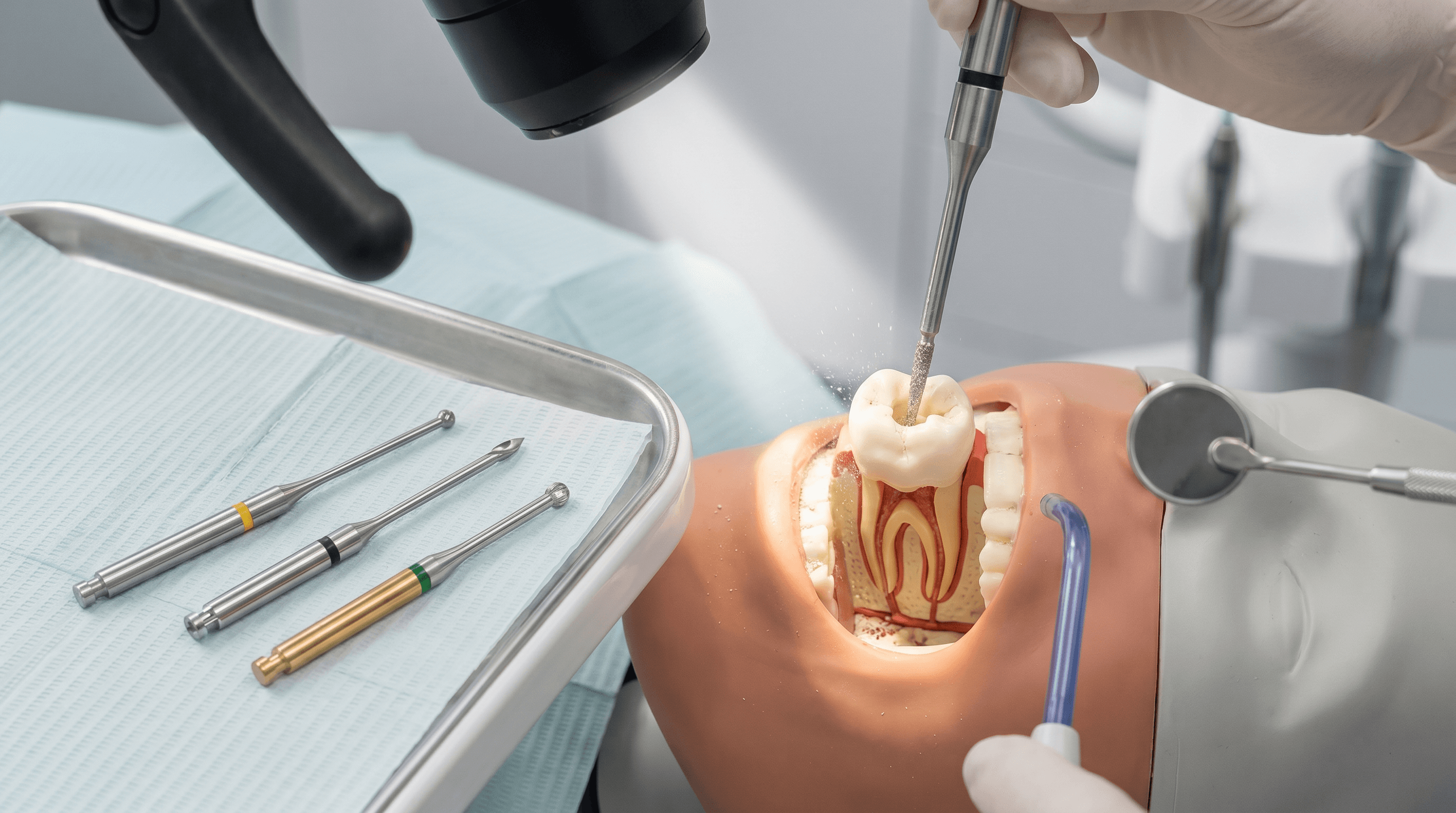
The access cavity is the straight-line path through the crown and the pulp chamber roof to the canal orifices, and it determines whether all canals are found and prepared without deflection. It is created in three steps: trepanning with a diamond, complete removal of the pulp chamber roof, and exposing the canal orifices with a small round bur in the contra-angle. Gates burs then widen the straight, coronal part of the canal before the files take over.
The primary access cavity opens the pulp cavity; the secondary access cavity straightens the path into each individual canal. In the primary phase, enamel or the restoration is cut through and the pulp chamber roof is removed until the entire pulp chamber floor is visible. In the secondary phase, dentine overhangs and dentine shoulders at the canal orifice are removed so that a file glides into the apical third without bending.
The table shows both phases with aim, instrument and shank.
| Phase | Aim | Instrument | Shank |
|---|---|---|---|
| Primary: trepanning | open enamel, dentine or crown | diamond, pear 390 | FG, 19 mm |
| Primary: roof removal | remove the pulp chamber roof completely | round diamond 801L | FGXL, 25 mm |
| Secondary: canal orifices | expose and funnel the orifices | pulp bur H191 | RA, 22 mm |
| Secondary: coronal enlargement | straight-line access to the canal | Gates bur H180 | RA, 22 mm |
For trepanning, you choose the instrument according to the material that has to be cut through first. Enamel and dentine are opened with a diamond from the clinical diamond burs range, zirconia with a diamond with increased diamond concentration, and a metal crown with a carbide instrument with cross-groove. After passing through the restoration, switch to a fresh instrument for the dentine, because a diamond worn on ceramic mainly generates heat in dentine.
The table assigns an instrument from the range to each material.
| Material | Instrument | Shank, Ø | Note |
|---|---|---|---|
| Enamel, dentine, composite | pear 390 in 4 grits | FG, 1.6 mm | 6390 coarse to 390EF extra fine |
| Lithium disilicate, veneering ceramic | pear 6390, grit 534 | FG, 1.6 mm | plenty of water spray |
| Deep cavity in a molar | 6389, round-end taper with neck | FGXL, 1.4 to 1.8 mm | grit 534 |
| Zirconia | rhodia pear ZR2390, 544R | FGL, 1.4 mm | overall length 21 mm |
| Titanium, non-precious alloy, stainless steel | carbide H4TR, cross-groove | FG, 1.2 and 1.4 mm | from the crown cutter group |
The rhodia pear belongs to the diamond burs for zirconia series and is designated there for trepanning. All turbine instruments in the table are approved for up to 450,000 min⁻¹.
All canal orifices become visible when no dentine projection obscures the view of the pulp chamber floor any longer. A round diamond with a long shank follows the contour of the roof from the inside outwards. With an overall length of 25 mm, the FGXL shank is 6 mm longer than the FG standard, so the working part reaches the pulp chamber floor even in tall molars.
The pulp chamber floor is darker than the cavity walls, and the canal orifices lie at the transitions between floor and wall. In the maxillary molar, for example tooth 26, the second mesiobuccal canal (MB2) is easily overlooked. It lies mesiopalatal to the first mesiobuccal orifice, usually on the line towards the palatal canal.
Calcified orifices are exposed with the pulp bur H191. It is made of stainless steel, has an RA shank and is available in six sizes from 0.9 to 1.8 mm. Long round burs of version 001L with 0.6 to 2.9 mm from the round burs and excavators group are also suitable. When the round bur is the right choice for caries is explained in the article Round burs and excavators compared.
The Gates bur, technically the Gates-Glidden bur, widens the straight coronal part of the canal into a funnel shape, creating straight-line access for the files. Its short, flame-shaped working part sits on a long, thin neck and carries a non-cutting guide tip. The predetermined breaking point is close to the shank so that a fractured instrument can be retrieved from the canal.
The table shows the six sizes of the Gates-Glidden H180 from the carbide burs group, all with RA shank.
| Item | Gates no. | ISO size | Diameter |
|---|---|---|---|
| H180.204.005x006 | 1 | 005 | 0.5 mm |
| H180.204.007x006 | 2 | 007 | 0.7 mm |
| H180.204.009x006 | 3 | 009 | 0.9 mm |
| H180.204.011x006 | 4 | 011 | 1.1 mm |
| H180.204.013x006 | 5 | 013 | 1.3 mm |
| H180.204.015x006 | 6 | 015 | 1.5 mm |
The sizes increase by 0.2 mm each; the H180 is made of stainless steel and comes in packs of 6. The catalogue value of 100,000 min⁻¹ is the maximum speed, not a working speed. Gates burs run in the lower speed range of the contra-angle, without pressure and only in the straight section of the canal, never into the curvature. Start with the size that can be inserted passively.
Gates-Glidden burs widen the canal orifice; Peeso reamers are used mainly to prepare the post space after root filling. The Peeso reamer, also known as Largo, has a longer, almost cylindrical cutting part and removes dentine over a greater length.
The table compares the two instruments.
| Feature | Gates-Glidden | Peeso |
|---|---|---|
| Working part | short, flame-shaped | long, almost cylindrical |
| Main task | coronal enlargement, canal orifice | post space, removal of gutta-percha |
| Area of use | straight coronal part of the canal | straight part of the canal after obturation |
| Main risk | fracture under pressure in the curvature | strip perforation with thin walls |
| Range | H180, 6 sizes, RA | not in the range |
Most preparation problems begin with an access that is too small or incorrectly positioned.
The table summarises typical mistakes, their consequences and how to avoid them.
| Mistake | Consequence | Prevention |
|---|---|---|
| Pulp chamber roof not completely removed | orifices obscured, residual tissue | round 801L with FGXL shank |
| Access too small | file is deflected, risk of fracture | create a secondary access cavity |
| Too deep at the pulp chamber floor | perforation into the furcation | little pressure, round bur in the contra-angle |
| Gates guided into the curvature | ledge, strip perforation, fracture | only in the straight part of the canal |
| Worn diamond on ceramic | heat, crack formation | change the instrument after passing through |
After the access cavity and coronal enlargement, endodontic files, today mostly made of nickel-titanium, take over the actual preparation. Reciprocating systems work with an alternating clockwise and anticlockwise movement and often with just one file; continuously rotating systems use a matched file sequence. The aim is a uniformly tapered canal shape as the basis for irrigation and obturation. After root filling, a tight coronal seal of the access cavity is just as important.
Rotary instruments are cleaned, disinfected and sterilised after every use; for files, the limited number of uses also applies. The procedure is described in Reprocessing instruments: hygiene and service life.
All instruments mentioned are Swiss Made to ISO 13485, in stock and ready to ship within 48 hours. Register as a professional customer and find your instruments in the shop.
A rotary instrument for the contra-angle that widens the coronal part of the canal into a funnel shape before file preparation. It is available in six standardised sizes; number 1 corresponds to 0.5 mm and number 6 to 1.5 mm. In the rotatec instrument code, the size appears as 005 to 015.
On natural hard tooth tissue, a diamond-coated pear shape with FG shank is suitable. For zirconia crowns, use a diamond with increased diamond concentration, and for metal crowns a carbide instrument with cross-groove. After passing through the crown, a new instrument follows for the dentine.
Maxillary molars usually have three roots with three or four canals; the fourth is usually the MB2 in the mesiobuccal root. Mandibular molars usually have three canals, two mesial and one distal, occasionally also a second distal canal. Premolars have one or two canals, rarely three.
The mandibular second molar usually has three canals, two in the mesial and one in the distal root. Less frequently, there are only two canals or, with fused roots, a C-shaped canal configuration. The opening is therefore made wide enough for the entire pulp chamber floor to be seen.
The primary phase exposes the pulp chamber and provides an overview of the pulp chamber floor. The secondary phase corrects the path into each individual canal by removing dentine shoulders at the orifice. Only then does the file reach the apical region without pre-bending.
Gates-Glidden burs are guided slowly and without contact pressure in the contra-angle. The value of 100,000 min⁻¹ for the H180 is an upper limit that must not be exceeded. The recommended working speed is given in the instructions for use.
The Gates-Glidden bur has a short head and is used to widen the canal orifice. The Peeso bur cuts over a longer distance and is used mainly for post space preparation. In thin-walled roots, it removes too much dentine more quickly.
Anwendung
Tangential preparation, chamfer or shoulder?
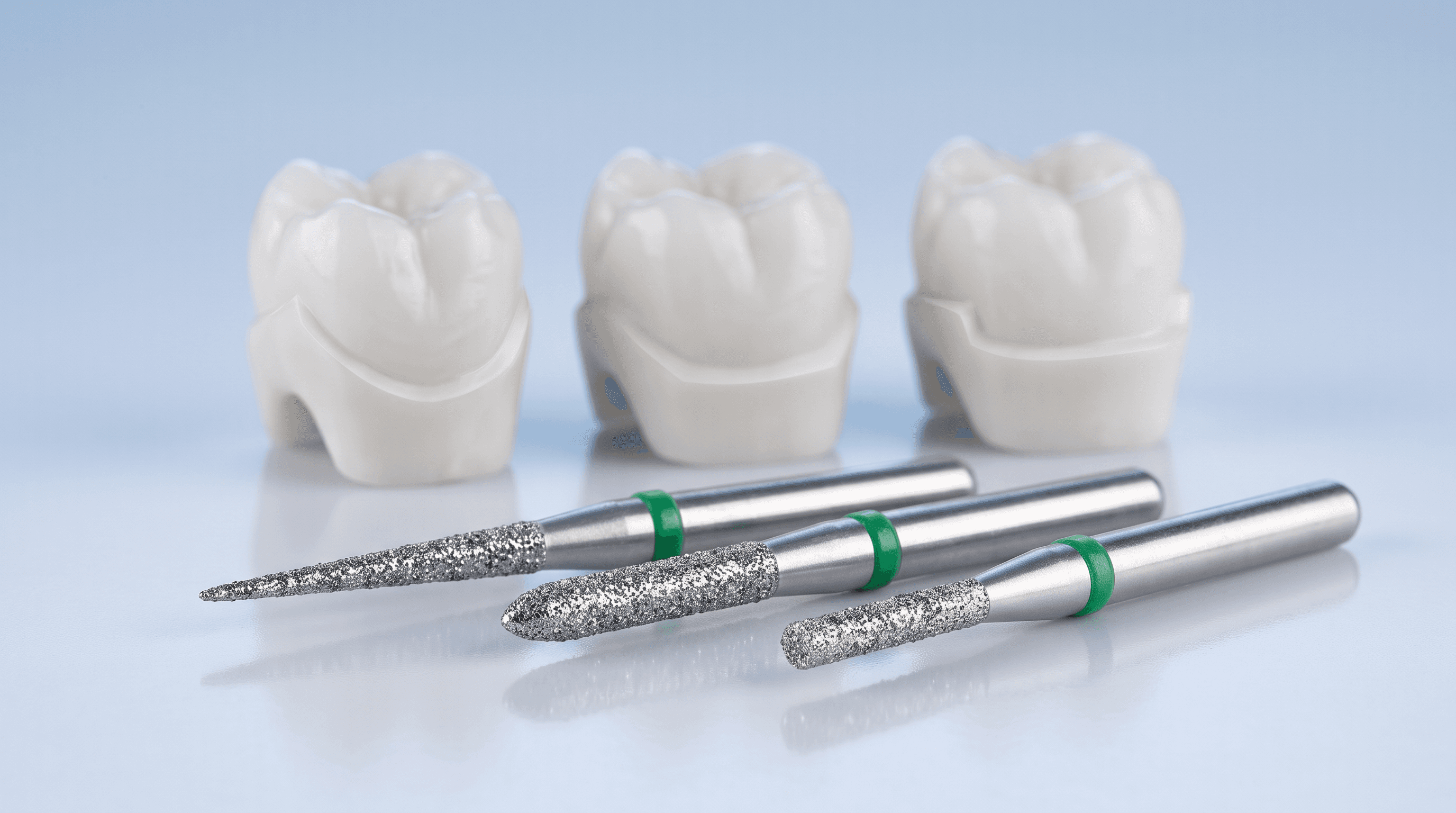
Tangential preparation, chamfer or shoulder: which preparation margin suits each material, and which of 187 diamond burs in 8 shapes produce it.
Anwendung
Crown preparation: procedure and instrument sequence
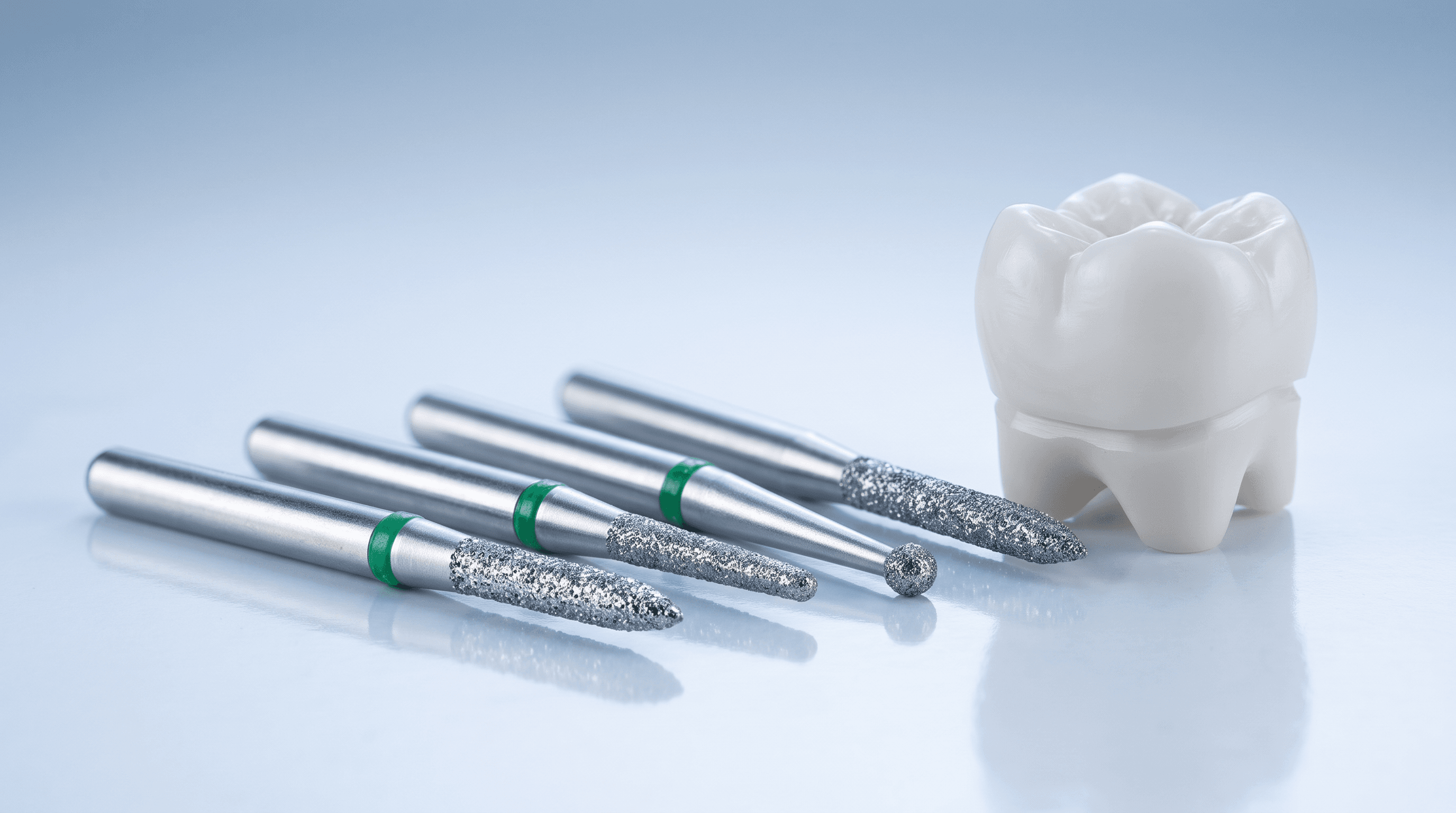
Crown preparation in 5 steps: which diamond shape and grit for each step, depth marking from 0.5 to 0.9 mm and maximum permissible speed of up to 450,000 min⁻¹.
Anwendung
Polishers and prophylaxis: why polishing works in stages
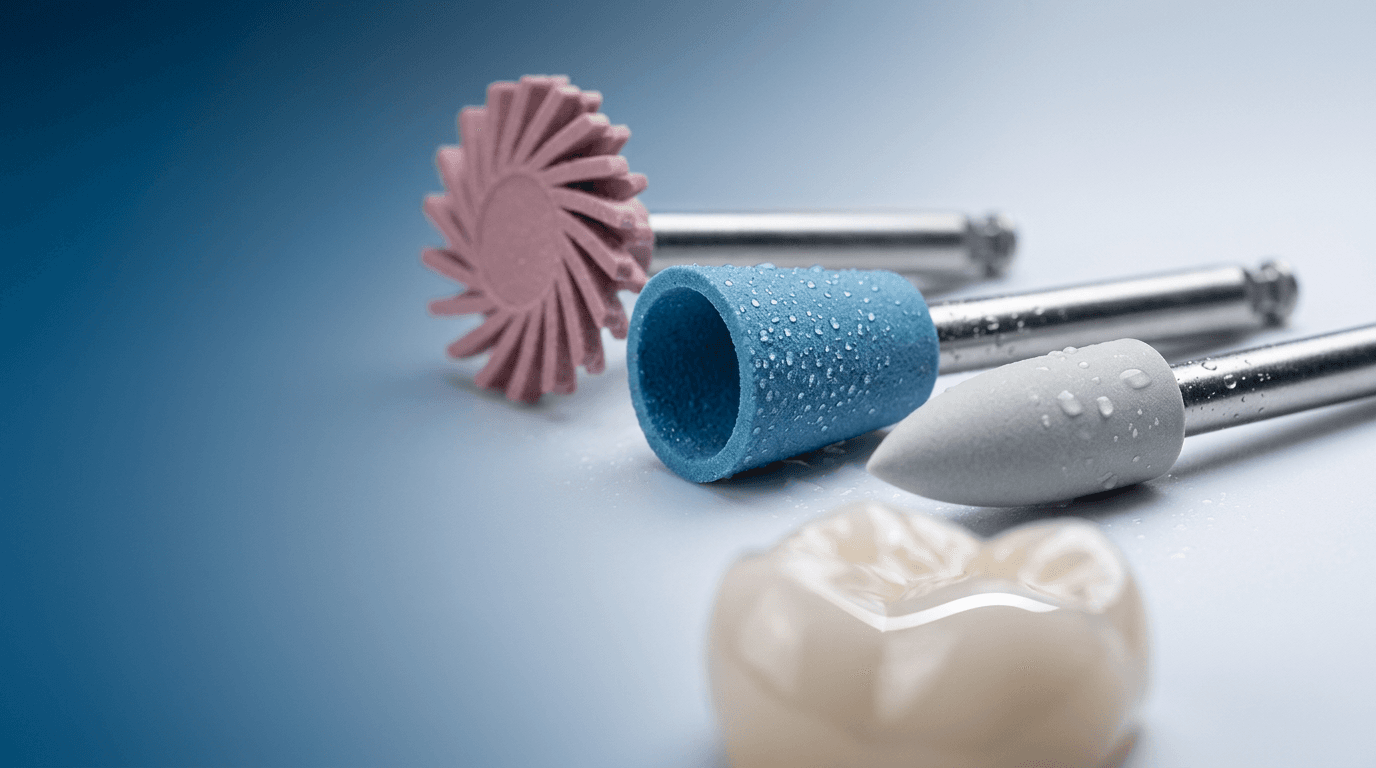
179 instruments for polishing and prophylaxis. Why a fine polisher achieves nothing on a coarse surface, and which polisher suits composite or ceramic.