Anwendung19 November 20269 min readby rotatec
Tangential preparation, chamfer or shoulder?
Tangential preparation, chamfer or shoulder: which preparation margin suits each material, and which of 187 diamond burs in 8 shapes produce it.

Wird geladen …
2'413 items in stock, ready to ship in 48 hours.
Tangential preparation, chamfer or shoulder: which preparation margin suits each material, and which of 187 diamond burs in 8 shapes produce it.
Tangential preparation is a finish line without a step: the abutment tapers out flat into the unprepared tooth surface. It is regarded as particularly conservative of tooth structure but does not produce as clearly identifiable a margin as a step. Chamfers and shoulders, by contrast, create a defined margin thickness; which finish line is appropriate depends above all on the crown material.
At the crown margin, four basic forms of finish line are distinguished: tangential, chamfer, shoulder with a rounded internal angle, and shoulder with a right-angled internal angle, the square shoulder. They differ in cross-section, in the amount of tooth structure removed and in the space they leave for the material at the margin. The article Crown preparation: procedure and instrument sequence describes the entire crown preparation from depth marking to finishing.
The table compares the four basic forms.
| Finish line | Cross-section | Tooth structure removal | Margin identification |
|---|---|---|---|
| Tangential (feather edge) | no step, flat run-out | low | difficult |
| Chamfer | concave groove | moderate | good |
| Shoulder, rounded internal angle | step with radius | high | very good |
| Square shoulder | right-angled step | highest | very good |
A literature review found no finish line design that is demonstrably superior in marginal accuracy; what matters more for a well-fitting restoration is that the dental technician and the intraoral scanner can identify the margin clearly. A distinct step, however, requires more removal at the cervical area.
In a tangential preparation, also known as a feather-edge preparation, the abutment ends without a step and without a groove, and the restoration tapers to a knife edge at the margin. Clinical data are available mainly for monolithic restorations: in a retrospective study of 1472 units, monolithic zirconia restorations with a tangential finish line achieved a survival rate of 98.5 per cent after a mean of 44 months, and in another study monolithic lithium disilicate crowns in the posterior region achieved 98.8 per cent after a mean of 24 months.
Its advantage is the lower amount of removal. The disadvantage is that without a step there is no distinct edge between the prepared and unprepared surface, even though it is precisely the identifiability of the margin that is considered decisive for the dental technician and the scanner. It is created with pointed instruments such as the tapered diamond 859 with a diameter of 1.2 mm.
The chamfer preparation creates a concave, quarter-circle groove at the margin that blends seamlessly into the tooth surface. It is used for many crown materials, for metal-ceramic on the oral side, for example. For greater margin thickness it is prepared as a deep chamfer with a larger radius.
The shape of the groove is determined by the instrument: the torpedo and the round-end taper reproduce their rounded tip. The groove can be no deeper than the radius of this tip rounding. Sinking the instrument deeper no longer produces a chamfer but a steeper wall, at whose outer edge unsupported enamel may remain, the so-called lip. Such enamel can fracture during or after cementation and open the margin. For greater depth, therefore, choose a larger diameter, not more pressure. One example is the torpedo 878 with 1.4 mm.
The shoulder preparation creates a horizontal step at the margin, giving the material its full layer thickness there. It comes in two variants. The square shoulder with a right-angled internal angle is the classic finish line for metal-ceramic on the vestibular side, for example for a ceramic shoulder. For all-ceramic restorations the internal angle is rounded; sharp edges impair the marginal and internal fit of CAD/CAM-fabricated restorations.
The shoulder width can be controlled via the instrument diameter. If a cylinder is guided sunk to half its diameter, the shoulder width corresponds mathematically to its radius: 0.6 mm with a 1.2 mm diameter, 0.8 mm with 1.6 mm. The required minimum width is stated in the material manufacturer's processing instructions.
The finish line depends on the crown material; the minimum layer thickness at the margin is stated in the material manufacturer's processing instructions.
The table summarises what the cited sources show for each material.
| Material | Finish line according to sources | Tangential |
|---|---|---|
| Metal-ceramic (PFM) | vestibular square shoulder, oral chamfer | not provided for in the source |
| All-ceramic in general | chamfer or shoulder with rounded internal angle | no information |
| Zirconia, monolithic | chamfer or tangential | clinically investigated: 98.5 % survival rate after a mean of 44 months |
| Lithium disilicate, monolithic | chamfer, rounded shoulder or tangential in the posterior region | clinically investigated: 98.8 % after a mean of 24 months |
For all-ceramic crowns, a meta-analysis found a slightly better marginal fit with a rounded shoulder and a better internal fit with a chamfer; the difference at the margin was clinically small.
Which diamonds are suitable for preparation for zirconia is shown in Diamond burs for zirconia. Processing the finished restoration is described in Processing all-ceramics: lithium disilicate and zirconia.
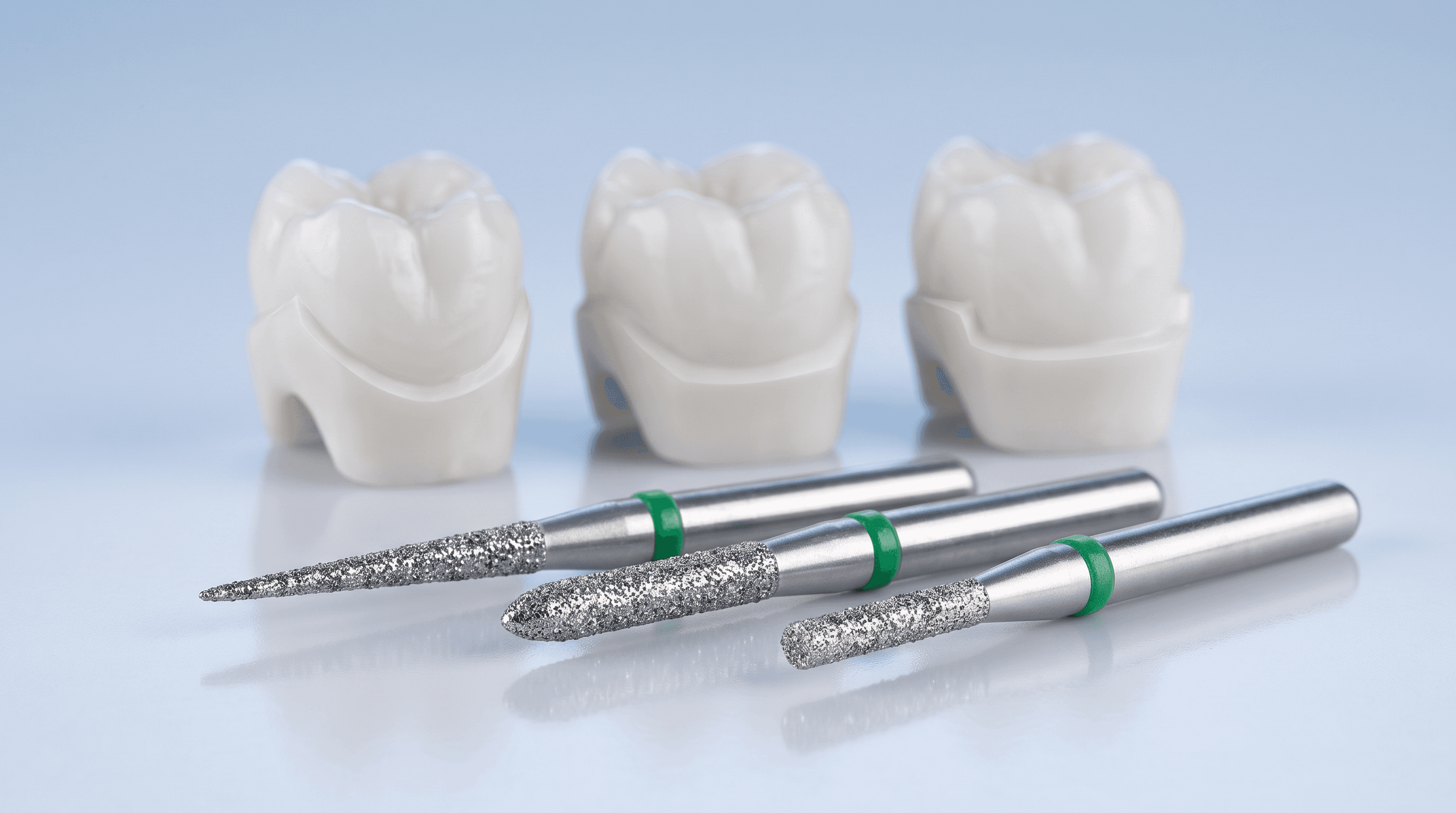
The shape of the working part is transferred directly to the margin: a pointed tapered shape produces the tangential preparation, a rounded tip the chamfer, a flat end the shoulder. In the Clinical diamond burs group, 187 articles in eight shapes with FG shank 314 are available for this purpose.
The table shows shape, ISO shape number, diameter and number of articles.
| Finish line | Shape, ISO (article) | Ø FG | Articles |
|---|---|---|---|
| Tangential | Pointed taper, 166 (859) | 1.0 to 1.8 mm | 20 |
| Chamfer | Torpedo, 289 (878) | 1.0 to 1.6 mm | 18 |
| Chamfer, long | Torpedo, 290 (879) | 1.0 to 1.8 mm | 20 |
| Deep chamfer | Round-end taper, 198 (856) | 1.2 to 2.3 mm | 35 |
| Deep chamfer, long | Round-end taper, 199 (850) | 1.2 to 2.3 mm | 30 |
| Shoulder, rounded internal angle | Cylinder, rounded edge, 156 (835R) | 0.8 to 1.6 mm | 20 |
| Rounded shoulder, long | Cylinder, rounded edge, 157 (836R) | 1.0 to 2.7 mm | 23 |
| Square shoulder | Cylinder, flat end, 107 (835) |
The long variants have a working part of 10 mm instead of 8 mm (torpedo, round-end taper) or 6 mm instead of 4 mm (cylinder) and are suitable for long clinical crowns. Up to a diameter of 1.8 mm, a maximum speed of 450,000 min⁻¹ applies.
The finish line is created and smoothed with the same shape in progressively finer grits so that no second edge is formed.
| Step | ISO code | Grit | Torpedo, 1.4 mm |
|---|---|---|---|
| Axial reduction | 534 | coarse | 6878 |
| Creating the finish line | 524 | medium | 878 |
| Finishing the finish line | 514 | fine | 8878 |
| Smoothing the finish line | 504 | extra fine | 878EF |
How shape, grit and size appear in the article code is explained in ISO 6360: grit and shank.
Many margin problems already arise at the finish line: in an evaluation of 392 preparations for zirconia crowns, more than half showed undercuts, unsupported enamel or an inadequate finish line.
The table summarises typical errors, their cause and the consequence.
| Error | Cause | Consequence |
|---|---|---|
| Lip, unsupported enamel | Chamfer deeper than the tip radius | Enamel fractures during or after cementation, margin opens |
| Sharp internal angle | Square shoulder without rounding under all-ceramic | poorer marginal and internal fit |
| Irregular, jagged margin | coarse grit not refined by finishing | longer, poorly legible margin line |
| Double finish line | change of shape during finishing | stepped margin, unclear margin position |
A crown preparation without a shoulder and without a chamfer, in which the abutment tapers flat into the tooth surface. It is also known as a feather edge and is considered particularly conservative of tooth structure. Clinical data are available mainly for monolithic zirconia and for monolithic lithium disilicate in the posterior region.
A distinction is made between tangential preparation, chamfer, deep chamfer and shoulder with a rounded or right-angled internal angle. The right-angled variant is known as a 90° shoulder.
A preparation margin shaped as a rounded, concave groove. It combines moderate tooth reduction with a clearly visible margin. It is created with torpedoes or round-end tapers.
A preparation with a horizontal step at the crown margin, which creates a defined margin thickness for ceramic or veneering. For all-ceramic restorations, the internal angle is rounded. The instrument used is a flat-end cylinder or a cylinder with a rounded edge.
Both are possible. A meta-analysis found slightly better marginal fit with a rounded shoulder and better internal fit with a chamfer; the difference at the margin was clinically small. What matters is a rounded internal angle and the minimum material thickness specified in the processing instructions.
A torpedo (ISO shape 289 or 290) for a standard chamfer or a round-end taper (198 or 199) for the deep variant. Choose the diameter according to the desired depth of the groove. For finishing, follow with the same shape in fine and extra fine grit.
Without a step, there is no visible edge between the prepared and the natural tooth surface. Yet the recognisability of the margin for the dental technician and for intraoral scanners is considered crucial for a well-fitting restoration.
Anwendung
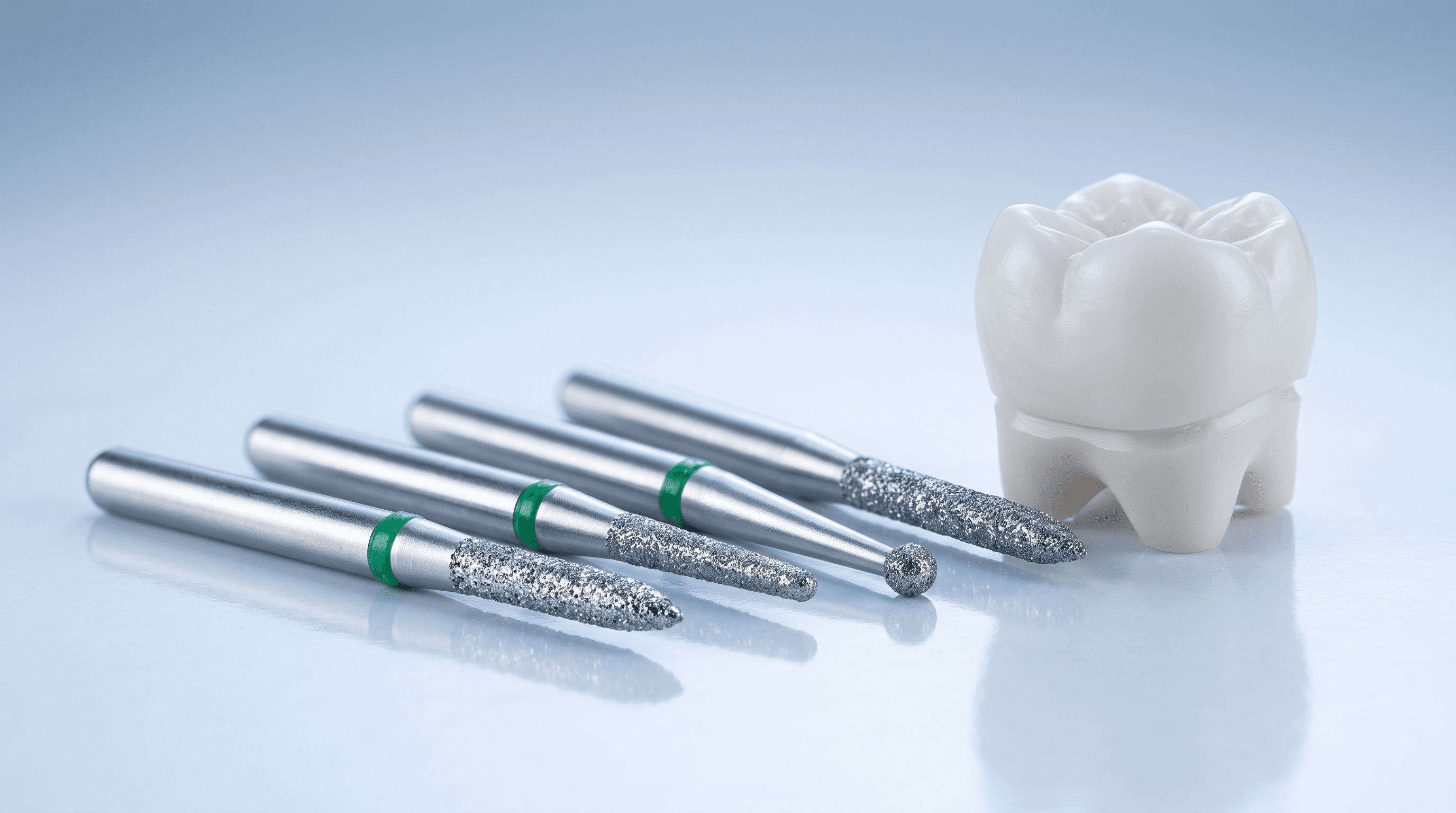
Crown preparation: procedure and instrument sequence
Crown preparation in 5 steps: which diamond shape and grit for each step, depth marking from 0.5 to 0.9 mm and maximum permissible speed of up to 450,000 min⁻¹.
Anwendung
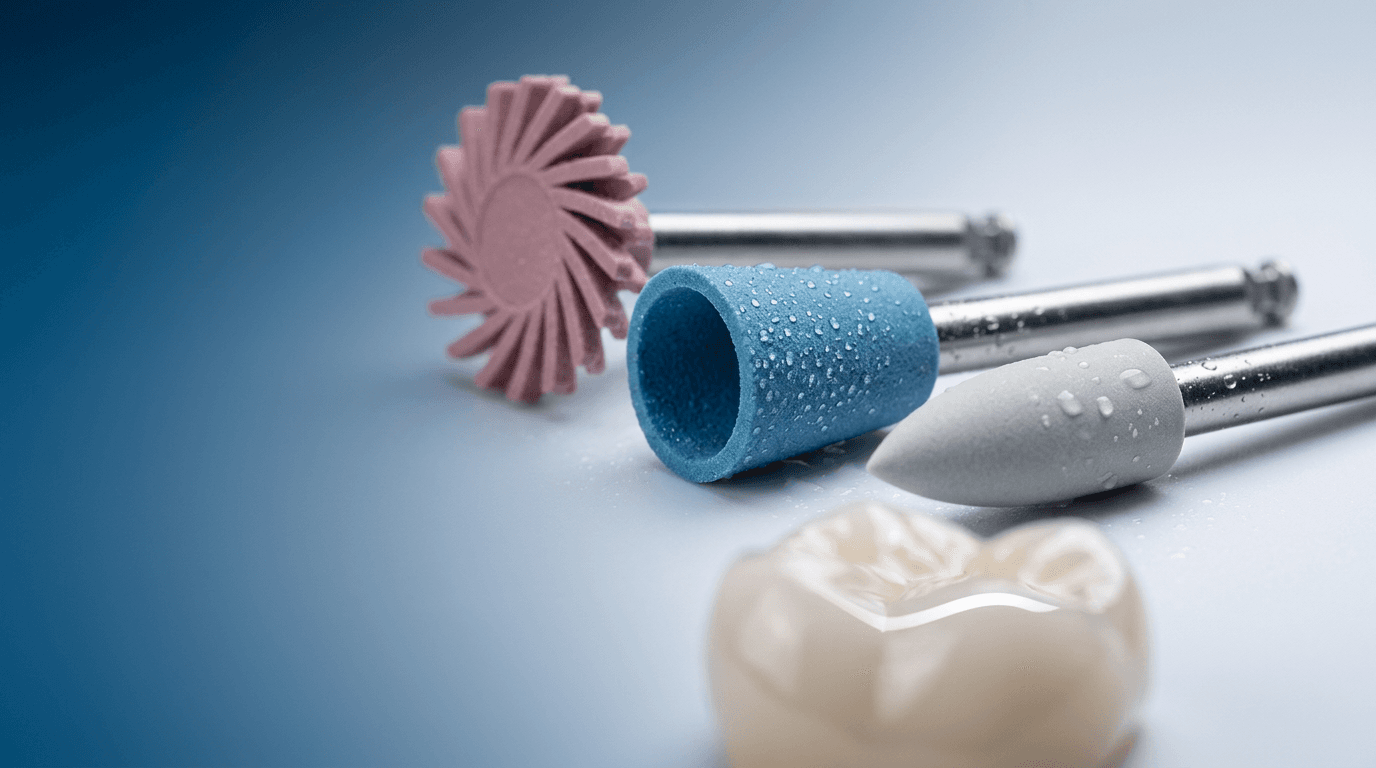
Polishers and prophylaxis: why polishing works in stages
179 instruments for polishing and prophylaxis. Why a fine polisher achieves nothing on a coarse surface, and which polisher suits composite or ceramic.
Anwendung
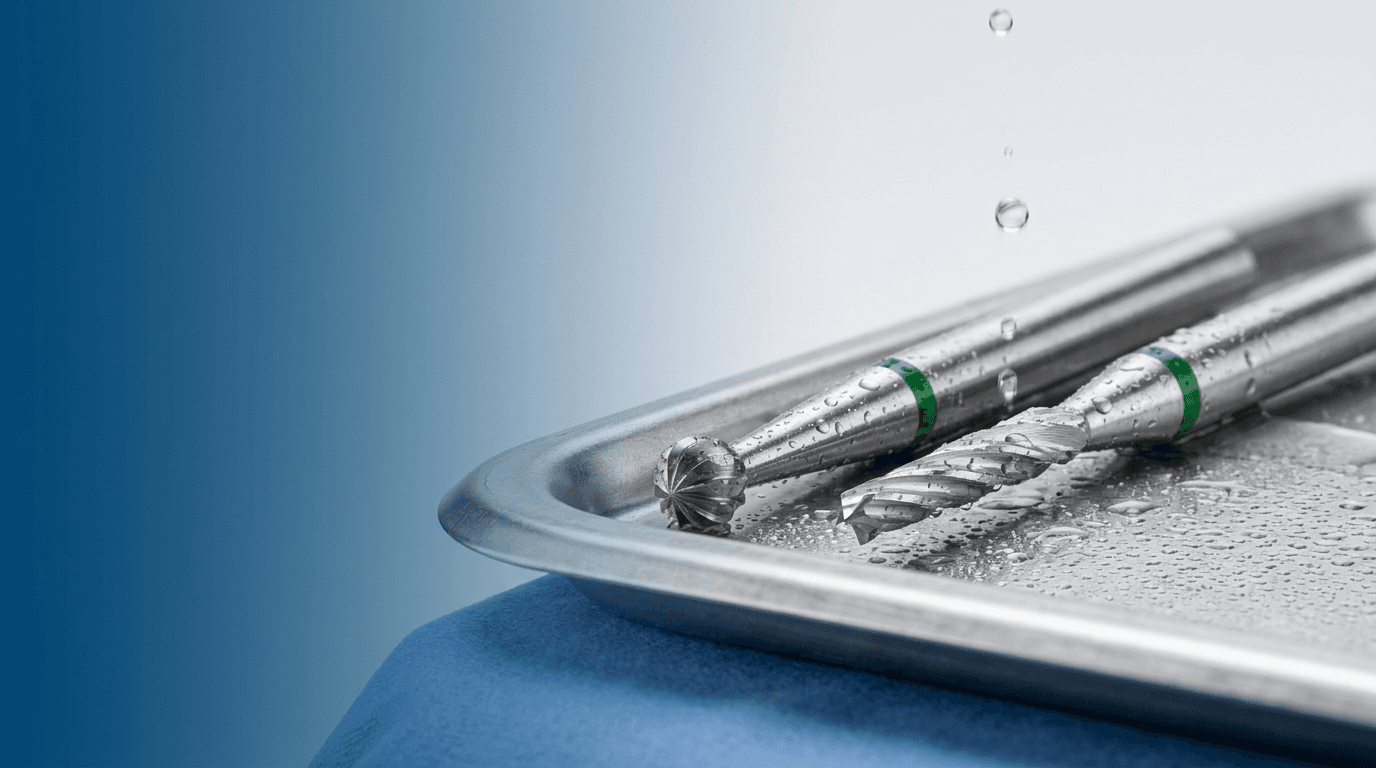
Bone cutters in oral surgery: shapes, shanks and heat
66 surgical round burs from 1.0 to 5.0 mm and 32 cutters for sectioning. Why a bone cutter cuts laterally and how to avoid heat damage.
| 0.8 to 1.6 mm |
| 21 |