Produkt07 October 20268 min readby rotatec
Diamond burs for zirconia: grit and cooling
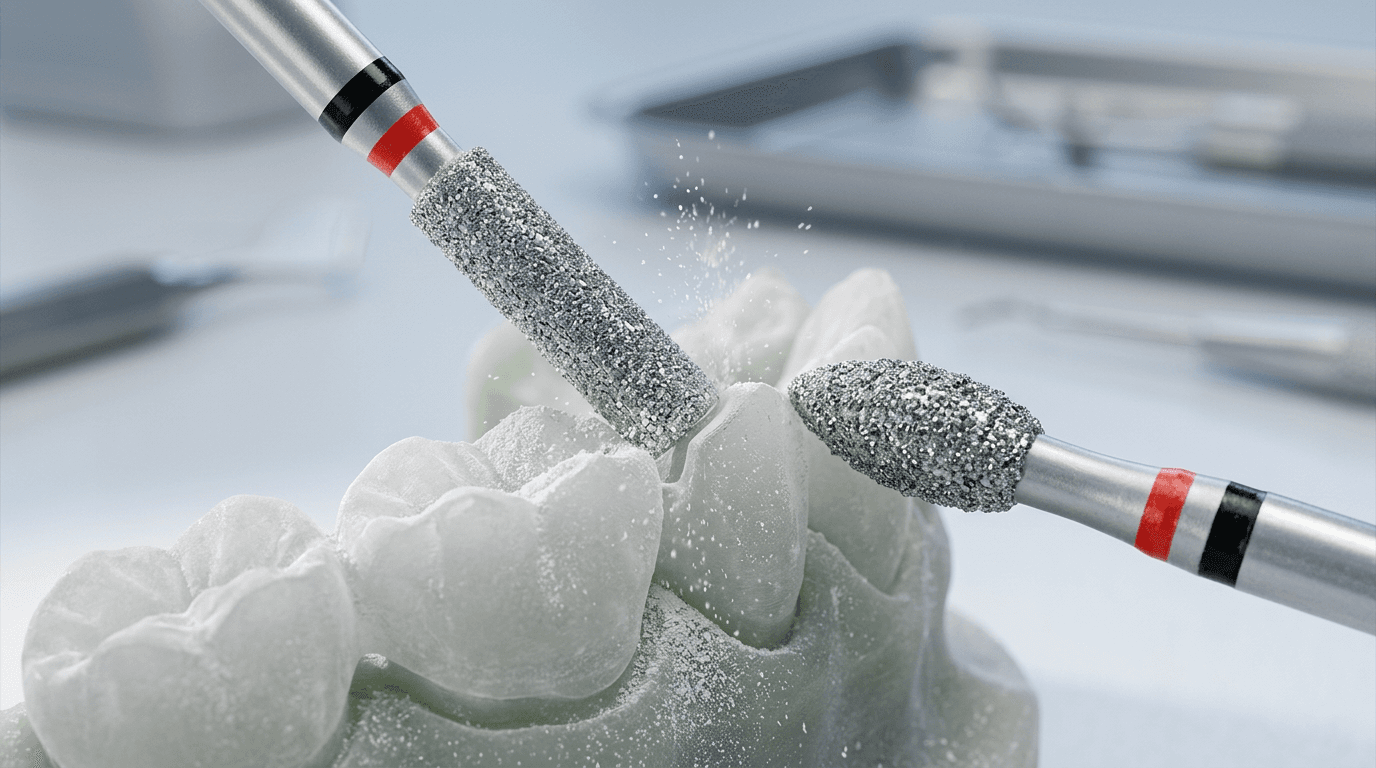
Diamond burs for zirconia on the tooth: rhodia with increased diamond concentration, 19 shapes, 3 grits, maximum speed per Ø and rules against microcracks.

Wird geladen …
2'413 items in stock, ready to ship in 48 hours.
Diamond burs for zirconia on the tooth: rhodia with increased diamond concentration, 19 shapes, 3 grits, maximum speed per Ø and rules against microcracks.
Diamond burs for zirconia carry an increased diamond concentration so that they remove material on zirconia and high-performance ceramics instead of merely generating heat. At the chair, you choose a grit for each working step and a diameter whose maximum speed suits the drive, and you work under water spray throughout. The rotatec rhodia line comprises 130 items in 19 shapes and three grits for this purpose, grouped under diamond burs for zirconia.
Zirconia is considerably harder than enamel and veneering ceramic, so a standard instrument wears particularly quickly on it. A standard diamond bur rapidly loses its coating on zirconia and then only works under pressure. This creates a cycle: more pressure, more heat, faster wear and, in the worst case, microcracks. A sure sign of wear: you have to press harder to achieve any removal at all.
The table shows for which material rhodia is worthwhile and where the standard diamond is sufficient.
| Material | Instrument | Reason |
|---|---|---|
| Zirconia, monolithic | rhodia, extra coarse 544R | high removal, longer service life |
| Lithium disilicate | rhodia or standard diamond | controlled removal |
| Veneering ceramic | standard diamond, fine | conserves tooth structure, smooth surface |
| Enamel, dentine, composite | standard diamond | no benefit from higher density |
rhodia diamond instruments carry an increased diamond concentration on the working part; more grit in contact means more removal and a longer service life, even on zirconia. The matrix bond holds the grit securely and prevents breakout, and the individual grains cut with little vibration. On the tooth, rhodia is intended for three tasks: preparation on high-performance ceramics, adjusting seated zirconia and all-ceramic crowns, and opening and removing zirconia crowns.
If zirconia is regularly on the treatment plan, the cost per preparation counts, not the cost per instrument. An instrument that completes a zirconia crown without changing is cheaper than several worn-out standard instruments.
rhodia is available in three dedicated grits, identified by an R appended to the ISO code: extra coarse for removal, fine for the preparation margin and extra fine for smooth transitions.
The table shows the three grits with number of items and application.
| Grit | ISO code | Items | Application on the tooth |
|---|---|---|---|
| Extra coarse | 544R | 66 | removal, opening a crown |
| Fine | 514R | 58 | finishing the preparation margin, correcting occlusion |
| Extra fine | 504R | 6 | smooth transitions before polishing |
The table shows the three shank lengths by ISO code.
| Shank | ISO code | Items | Pack size |
|---|---|---|---|
| FG, standard length 19 mm | 314 | 98 | 6 |
| FGL, long 21 mm | 315 | 10 | 6 |
| FGXL, extra long 25 mm | 316 | 22 | 6, discs 1 |
How grit and shank are designated by standard is explained in Understanding the instrument code: ISO 6360, grit and shank.
The maximum speed of a rhodia instrument decreases as the head diameter increases; the value on the label is always decisive.
The table shows the maximum speed per head diameter according to the catalogue.
| Ø working part | Maximum speed | Items |
|---|---|---|
| 0.9 to 1.6 mm | 450,000 min⁻¹ | 93 |
| 1.8 and 2.1 mm | 300,000 min⁻¹ | 19 |
| 2.3 mm | 160,000 min⁻¹ | 16 |
| 8.0 and 10.0 mm (disc) | 45,000 min⁻¹ | 2 |
On zirconia: it is better to use a smaller diameter below the maximum speed than a large head at the upper limit.
The shape depends on the preparation margin and the surface you are working on.
The table assigns the matching rhodia shape with number of items and diameter to the most common tasks.
| Task | Shape (ISO) | Items | Ø |
|---|---|---|---|
| Chamfer | round-end taper (198, 199) | 21 | 1.2 to 2.3 mm |
| Chamfer | torpedo (289, 290) | 12 | 1.0 to 1.6 mm |
| Shoulder | cylinder, flat end (107) | 7 | 0.9 to 1.4 mm |
| Occlusal, palatal | egg (277, 277L) | 17 | 1.4 to 2.3 mm |
| Trepanning | pear (274), FGL | 2 | 1.4 mm |
| Opening a crown | round-end cylinder (141) | 12 | 1.0 to 1.8 mm |
Carbide crown cutters are unsuitable for zirconia because their blade blunts immediately. Which material requires which tool in the laboratory is shown in Rotary tools by material in the dental laboratory.
On zirconia, cooling, low contact pressure and constant movement determine the service life and the outcome for the restoration.
The table summarises the rules and the reasons for them.
| Rule | Implementation | Reason |
|---|---|---|
| Cooling | water spray throughout | protects restoration, tooth, instrument |
| Contact pressure | keep it low | pressure generates heat and damage |
| Movement | guide over the surface, not with the tip | no local heating |
| No levering | do not pull out at an acute angle | prevents fracture |
| Speed | observe the label, see reprocessing recommendation for burs | limit per head diameter |
| Sequence | 544R, then 514R or 504R | coarse grit leaves scratches |
| Inspection | check before every use | discard blunt instruments |
Yes, a seated zirconia crown can be adjusted in the patient's mouth if you work with rhodia fine 514R under water spray and polish the surface afterwards. Adjustment is followed by multi-stage polishing, because a smooth zirconia surface protects the antagonist. Polishers for ceramics work without polishing paste, and the colour coding shows the stage. Larger corrections and work on the restoration outside the mouth are described in Working on all-ceramics: lithium disilicate, zirconia.
In the laboratory, sintered diamond grinders take over the finishing of zirconia frameworks. rhodia is also available with an HP shank for the milling unit in milling technology, in the shapes round-end taper and pointed cylinder. According to the data sheet, this milling version is designed for feldspathic ceramics and composite, not for zirconia.
rhodia instruments can be reused when reprocessing is validated. Clean them immediately after the procedure, because zirconia dust quickly clogs the coating. The procedure is set out in the instructions for use and reprocessing of burs, and the key points are summarised in Reprocessing instruments: hygiene and service life.
The rhodia series is complemented by sintered diamond grinders for the laboratory and by polishers for polishing. All instruments are Swiss Made to ISO 13485, in stock and ready to ship within 48 hours. Register as a professional customer and discover the rhodia series in the shop.
The permitted speed depends on the head diameter and is stated on the label. For rhodia it is 450,000 min⁻¹ up to 1.6 mm, 300,000 min⁻¹ for 1.8 and 2.1 mm and 160,000 min⁻¹ for 2.3 mm. These values are upper limits and apply only with water spray.
Yes, minor corrections to occlusion and contour are possible at the chair with a fine zirconia diamond. Water spray, low pressure and subsequent polishing in several stages are important. Extensive changes belong in the laboratory.
Diamond burs grind hard, brittle materials such as enamel, ceramics and zirconia. They are used for preparation, trepanning and finishing margins. Zirconia requires a higher diamond concentration than natural hard tooth tissue.
Extra coarse (544R) for removal, fine (514R) for the preparation margin and occlusal correction. Extra fine (504R) smooths transitions before polishing. If you stop at a coarse grit, polishing afterwards takes considerably longer.
For regular work on zirconia, yes, because standard diamonds quickly lose their coating on this material. An instrument with an increased diamond concentration lasts through an entire preparation. On enamel and dentine it offers no benefit.
Enough to keep the working part and the contact surface wet throughout grinding. Dry grinding heats the ceramic locally and promotes microcracks. The minimum value for the spray is given in the instructions for use.
There is no fixed number of uses; the service life depends on material, pressure and cooling. As soon as you have to press harder to remove material, the instrument is worn out. Cleaning immediately after the procedure extends its useful life.
Produkt
Ceramic polishers for zirconia and lithium disilicate
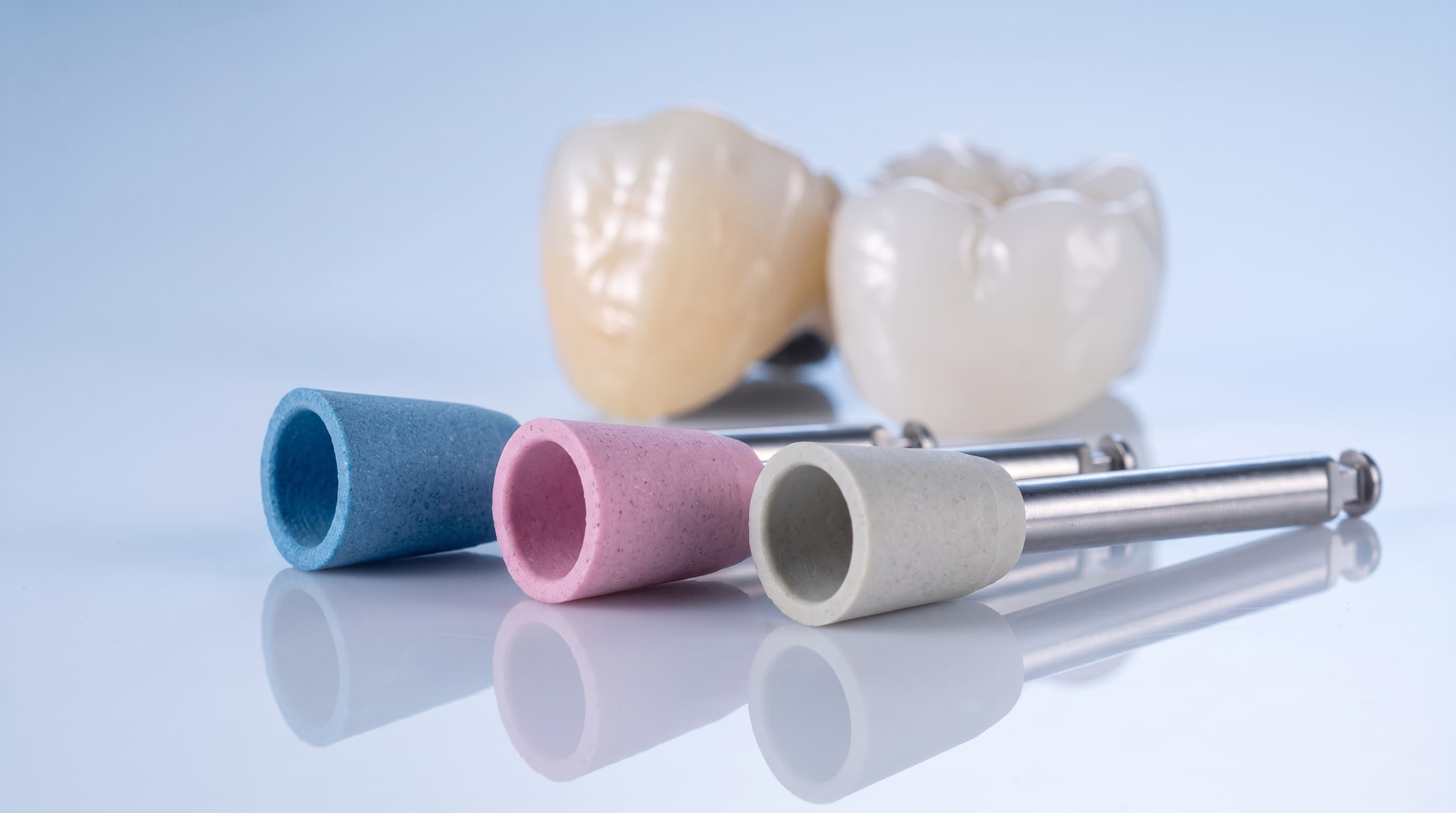
Ceramic polishers for practice and laboratory: cerdia polishes zirconia, lithium disilicate and feldspathic ceramic in 3 stages without paste, up to 12,000 min⁻¹. Shapes, speed.
Produkt
Cross-cut: choosing the right carbide cutter
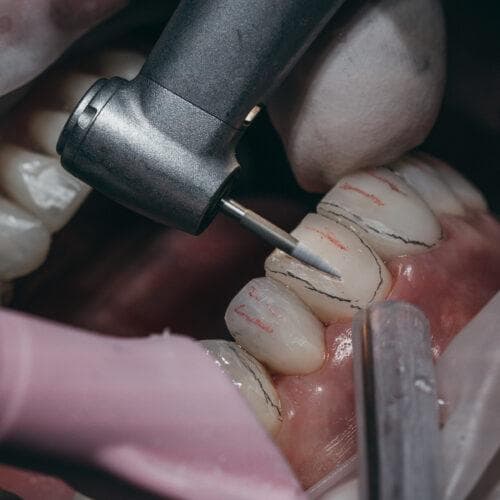
Cross-cut carbide cutters: 13 laboratory blade patterns from E to XMV with colour, material and speed, plus the A blade pattern used in surgery.
Produkt
Round burs: sizes, shank and excavation
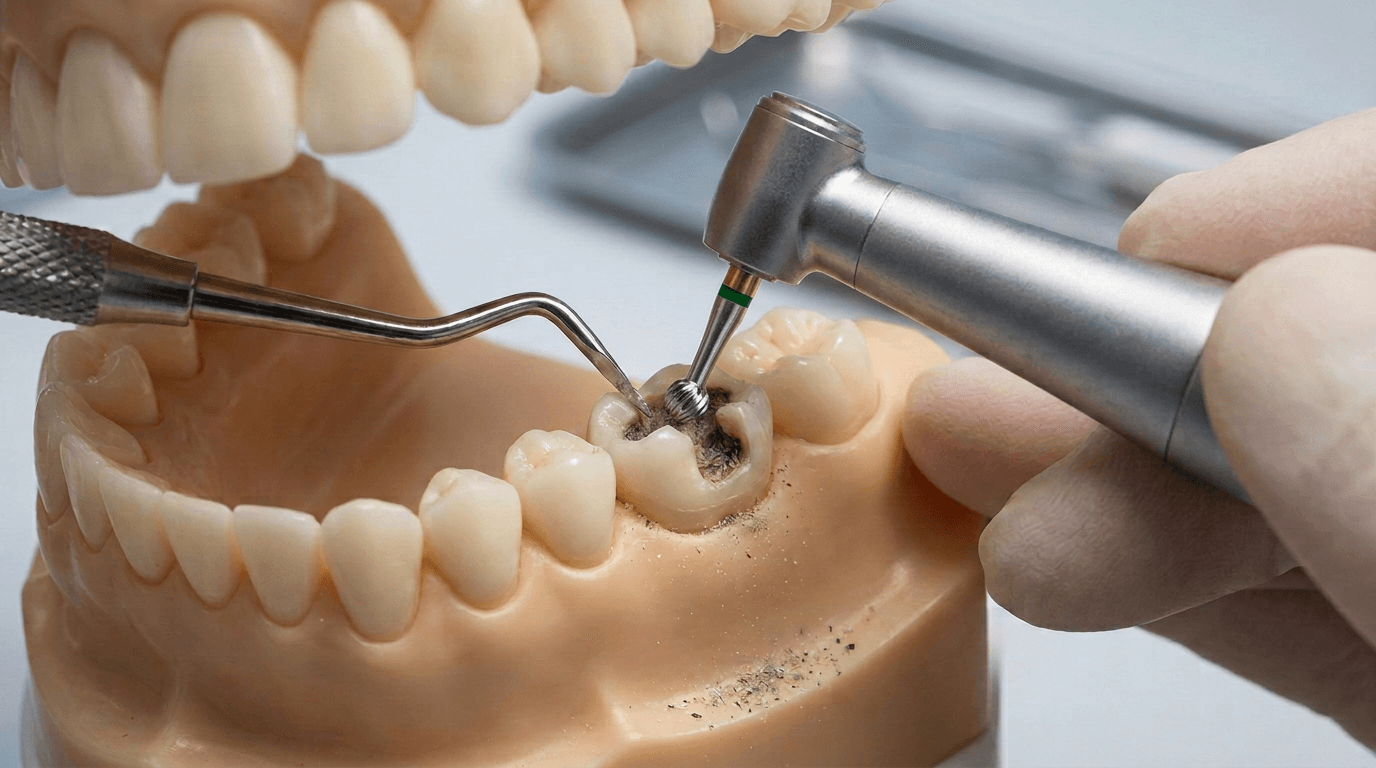
Carbide round burs from 0.5 to 5.0 mm with RA, FG and HP shanks. An overview of sizes, maximum speeds and blade patterns for caries excavation.
