Dental Laboratory Cutters: Choosing by Material
Dental laboratory cutters by material: blade pattern, ISO code and speed for plaster, resin, NPM, titanium and zirconia. With 5 tables from the lab catalogue.

Wird geladen …
2'413 items in stock, ready to ship in 48 hours.
Dental laboratory cutters by material: blade pattern, ISO code and speed for plaster, resin, NPM, titanium and zirconia. With 5 tables from the lab catalogue.


From the range
Hartmetallfräser
142 items in stock, ready to ship in 48 hours. Swiss made.
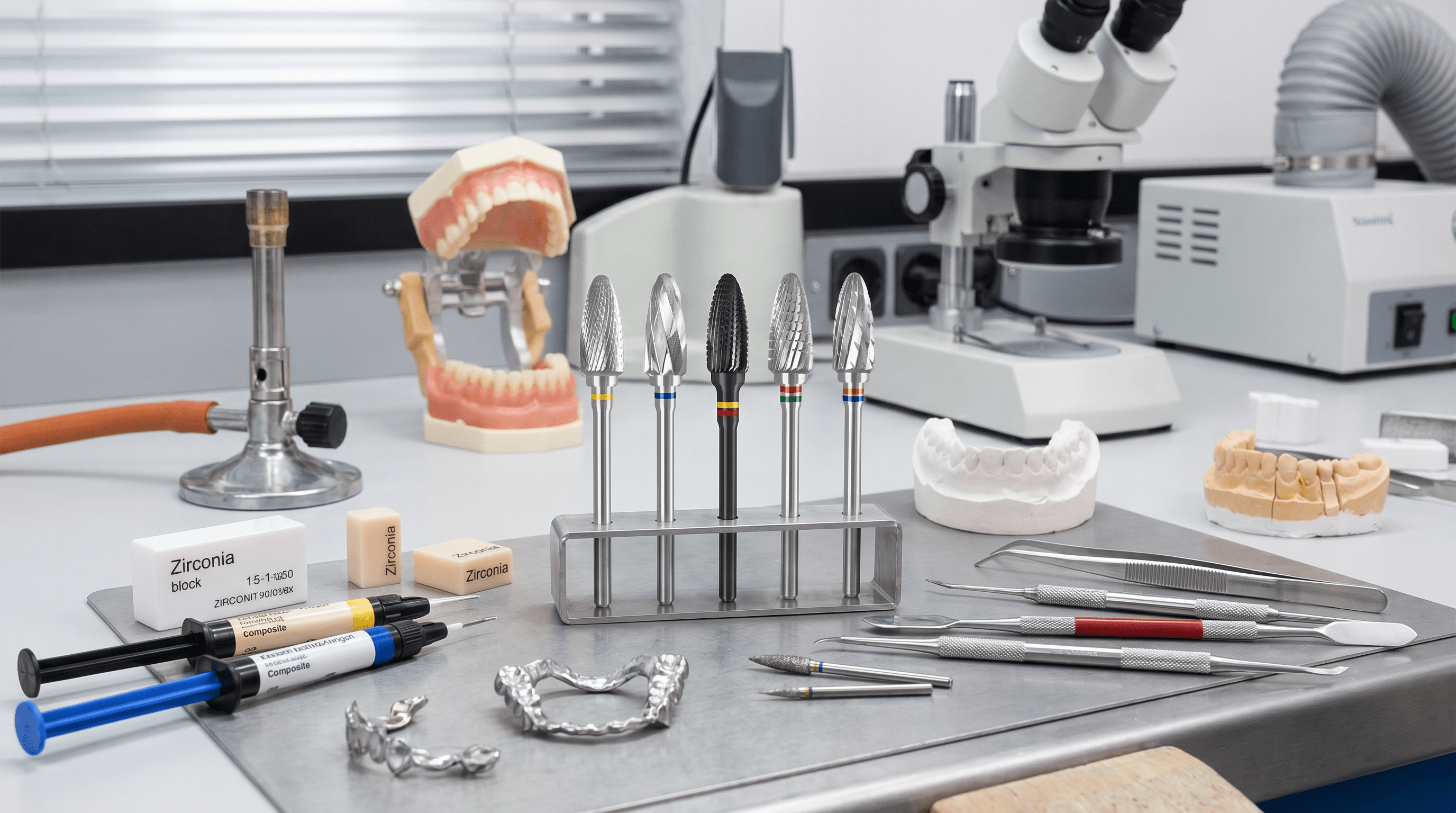
Which cutter is right in dental technology depends on the material: you work plaster and resin with coarse-cut carbide cutters, precious metal, non-precious metal (NPM) and titanium with fine or spiral blade patterns. No carbide blade cuts zirconia or all-ceramics; sintered diamond grinders are used there. All tools in this overview have the HP shank (ISO 104, 2.35 mm) for the laboratory handpiece.
Dental technology has three classes of tool for material removal: carbide cutters with blades, bonded abrasives and diamond grinders with grit. In addition there are cutting discs and polishers. Each class has its own material and its own maximum speed.
The table assigns tool, ISO code and maximum speed from the rotatec laboratory range to each material:
| Material | Tool | ISO code | max. speed |
|---|---|---|---|
| Plaster, model dies | carbide cutter, coarse cross-cut | 220 | 15,000 to 20,000 min⁻¹ |
| Denture resin, PEEK/PMMA | carbide cutter, coarse or medium | 220, 190 | 15,000 to 20,000 min⁻¹ |
| Precious metal, NPM, veneering resin | carbide cutter, fine cross-cut | 140 | 15,000 to 30,000 min⁻¹ |
| Titanium, NPM, precious metal | carbide cutter, QRF spiral blade pattern | 274 | 15,000 to 30,000 min⁻¹ |
| Grinding alloys | ceramic grinder | 524, 534 | 15,000 min⁻¹ |
| Zirconia, glass and all-ceramics | sintered diamond grinder | 524, 544, 554 | 25,000 min⁻¹ |
| Polishing ceramics | diamond polisher, 3 stages | 534, 524, 514 | 12,000 min⁻¹ |
| Polishing denture resin | arcyline polisher, 4 stages | 513 to 543 | 7,000 min⁻¹ |
The ISO codes are in positions ten to twelve of the item number and denote blade pattern or grit.
Plaster and resin require large chip space so that the cutter removes material quickly and does not clog. Plaster can be worked dry, with effective extraction being mandatory. Resin smears at excessive speed because it melts at the blade and clogs the chip space. Work with an even feed rather than with pressure.
The table shows the carbide cutters by blade pattern with number of items, diameter and pack size according to the catalogue:
| Blade pattern (ISO) | Items | Ø | Pack size |
|---|---|---|---|
| 222, extra coarse | 4 | 4.0 to 7.0 mm | 1 |
| 220, coarse, cross | 9 | 2.7 to 7.0 mm | 1 |
| 175, medium | 9 | 2.7 to 6.0 mm | 1 |
| 190, medium, cross | 28 | 1.2 to 6.0 mm | 3 or 1 |
| 140, fine, cross | 24 | 1.0 to 6.0 mm | 3 or 1 |
| 274, QRF spiral | 9 | 1.4 to 6.0 mm | 3 or 1 |
| 137XMV, fine, carbon coating | 11 | 1.4 to 6.0 mm | 3 |
For coarse trimming and removing flash on denture resin, 220 is suitable; for fine trimming, 190. For plaster and model dies the catalogue lists 222, 220, 190 and 175. The XMV fine blade pattern is listed as universal for all laboratory materials.
Metals require a stable blade, so choose finer or spiral blade patterns here. NPM alloys are tough and put heavy stress on the blade. Precious metal is softer and tends to smear. The fine cross-cut 140 covers precious metal, NPM, cast partial frameworks and veneering resin; the QRF spiral blade pattern (274) covers precious metal, NPM and titanium. For titanium, the catalogue also lists blade patterns 137, 176 and 194. How blade pattern and chip space are related is explained in Choosing the right carbide blade pattern.
For grinding sprue channels, crown margins and occlusal surfaces on alloys, ceramic grinders are suitable. Bonded grit keeps its shape there, while diamond clogs on tough metals.
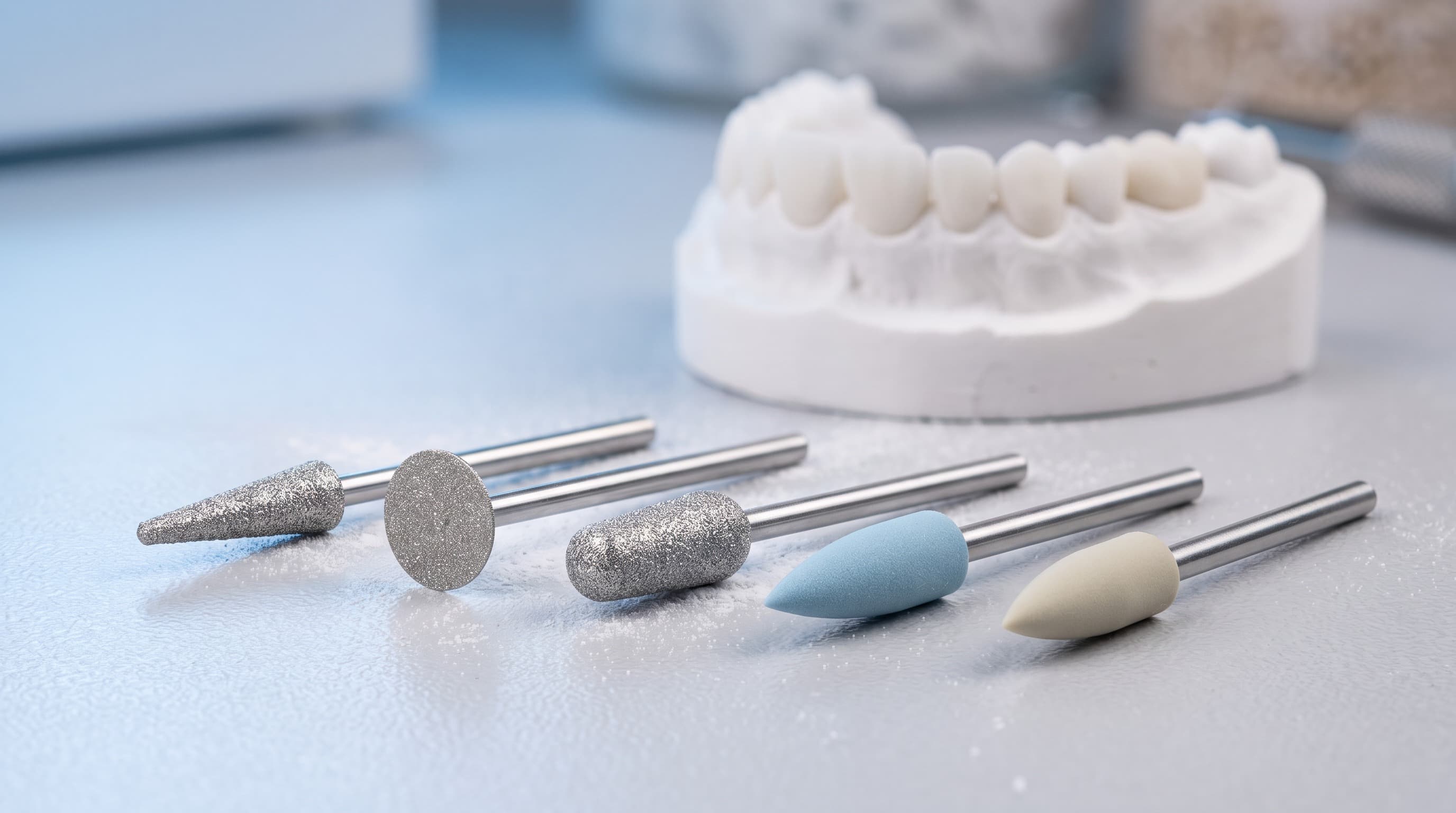
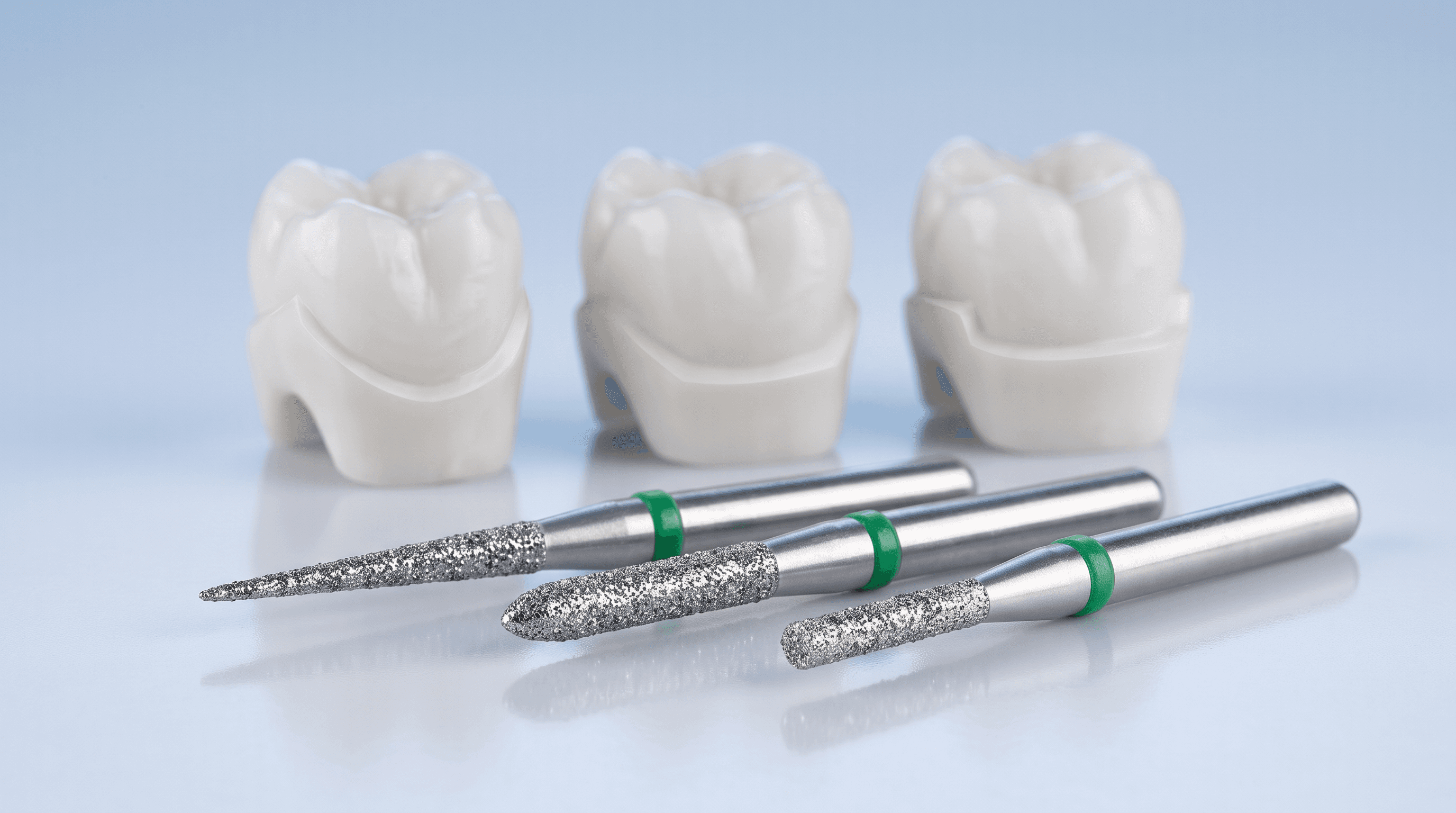
As soon as the material is harder than the blade, you work with diamond: ceramics are ground, not cut. Carbide blunts immediately on zirconia, and zirconia is too hard for bonded grit. For zirconia frameworks and glass ceramics, sintered diamond grinders are the first choice. As they wear, new grit is exposed and grinding performance remains constant for a long time.
The table compares the two abrasives for metal and for zirconia:
| Feature | Ceramic grinder | Sintered diamond grinder |
|---|---|---|
| Grit | corundum or silicon carbide | diamond |
| Bond | vitrified bond | bronze matrix, throughout |
| Materials | metal, alloys, ceramics | zirconia, glass ceramics, NPM, cast partial frameworks |
| Items | 28 | 96 in 16 shapes |
| Ø | 3.3 to 22.0 mm | 1.6 to 8.0 mm |
| max. speed | 15,000 min⁻¹ | 25,000 min⁻¹ |
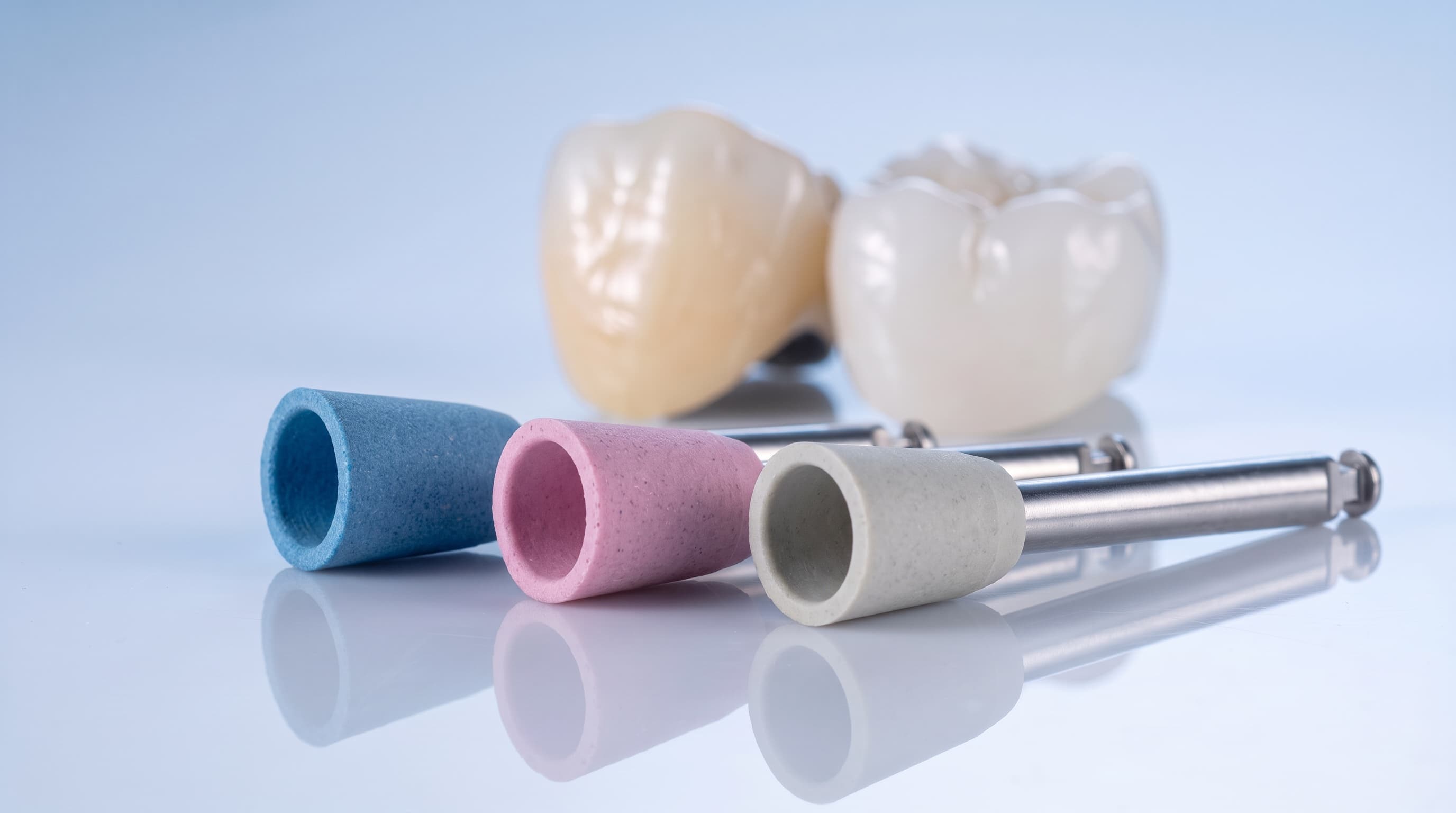
Polishing follows: diamond polishers for ceramics work in three stages without polishing paste. The sequence from cutting to high gloss is described in Working all-ceramics: lithium disilicate, zirconia.
The task determines the coating and diameter of the cutting disc: discs coated on both sides cut through, discs coated on one side separate, because the smooth side protects the adjacent part. The cutting discs for the laboratory in the catalogue are diamond-coated, 84 of 93 electroplated, the plasincut series sintered.
The table shows the classification by ISO shape according to the catalogue:
| Task | Disc (ISO shape) | Ø | max. speed |
|---|---|---|---|
| Cutting plaster models | plastercut, perforated, toothed (333) | 30 to 45 mm | 18,000 min⁻¹ |
| Model fabrication | plasincut, peripheral cutting (321) | 9 to 45 mm | 18,000 min⁻¹ |
| Cutting through | coated on both sides (358) | 19 to 40 mm | 20,000 to 35,000 min⁻¹ |
| Separating | coated on one side, top or bottom | 6.5 to 22 mm | 20,000 to 25,000 min⁻¹ |
The larger the head diameter, the lower the permitted maximum speed, because peripheral speed increases with diameter. Keep contact pressure low with all materials: pressure generates heat, deforms resin and smears precious metal into the chip spaces.
The table shows this using the example of the fine cross-cut 140:
| Ø | max. speed | Example |
|---|---|---|
| 2.3 mm | 30,000 min⁻¹ | H138EF.104.023x003 |
| 4.0 mm | 20,000 min⁻¹ | H79EF.104.040x001 |
| 6.0 mm | 15,000 min⁻¹ | H251EF.104.060x001 |
The value on the label always applies. More on this in Understanding blade pattern and speed.
The laboratory range is organised by tool class: 143 carbide cutters in 14 blade patterns, 96 sintered diamond grinders, 28 ceramic grinders, 93 cutting discs and polishers for ceramics, metal and resin. Everything is Swiss Made to ISO 13485, in stock and ready to ship within 48 hours.
The shop can be filtered and grouped by material and application as well as by shank, size, grit, blade pattern and pack size. Register as a professional customer and find the right tool in the shop.
A cutter removes material with geometrically defined blades, each lifting a chip with every revolution. The space between the blades takes up the chip and carries it away. Abrasives, by contrast, work with many irregular grains.
A carbide cutter with a coarse to medium blade pattern, for example ISO 220 for trimming and 190 for finishing. Keep the speed moderate, at most 15,000 min⁻¹ with a 6.0 mm head. If the resin smears, the speed is too high.
A fine cross-cut (ISO 140) or the QRF spiral blade pattern (ISO 274). Both are listed in the catalogue for NPM and precious metal, QRF also for titanium. For grinding sprue channels, a bonded abrasive is the better choice.
The blades are crossed by a second cut running in the opposite direction. This breaks the chip short, so the cutter runs more smoothly and catches less. Coarse, medium and fine differ in the number of blades.
The maximum speed depends on the head diameter. In the range it goes from 30,000 min⁻¹ for small heads down to 15,000 min⁻¹ and below for 6.0 and 7.0 mm. The value on the label applies.
For materials that are harder than the carbide blade, i.e. zirconia, glass and all-ceramics. There, no blade cuts any more, only grit. For metal, plaster and resin, carbide remains the more economical choice.
Coarse and extra coarse blade patterns with large chip space, for example ISO 222 or 220. Fine blade patterns clog immediately with plaster dust. Work dry and with extraction.

Zahntechnik
Zirconia in the Laboratory: Pre-Sintered, Sintered and Polishing
Zirconia in the laboratory: shape the white body dry, correct the sintered framework with 96 sintered diamond grinders, veneering with ceramic grinders, polishing in three stages.

Anwendung
Tangential preparation, chamfer or shoulder?
Tangential preparation, chamfer or shoulder: which preparation margin suits each material, and which of 187 diamond burs in 8 shapes produce it.

Produkt
Ceramic polishers for zirconia and lithium disilicate
Ceramic polishers for practice and laboratory: cerdia polishes zirconia, lithium disilicate and feldspathic ceramic in 3 stages without paste, up to 12,000 min⁻¹. Shapes, speed.