Zirconia in the Laboratory: Pre-Sintered, Sintered and Polishing
Zirconia in the laboratory: shape the white body dry, correct the sintered framework with 96 sintered diamond grinders, veneering with ceramic grinders, polishing in three stages.

Wird geladen …
2'413 items in stock, ready to ship in 48 hours.
Zirconia in the laboratory: shape the white body dry, correct the sintered framework with 96 sintered diamond grinders, veneering with ceramic grinders, polishing in three stages.

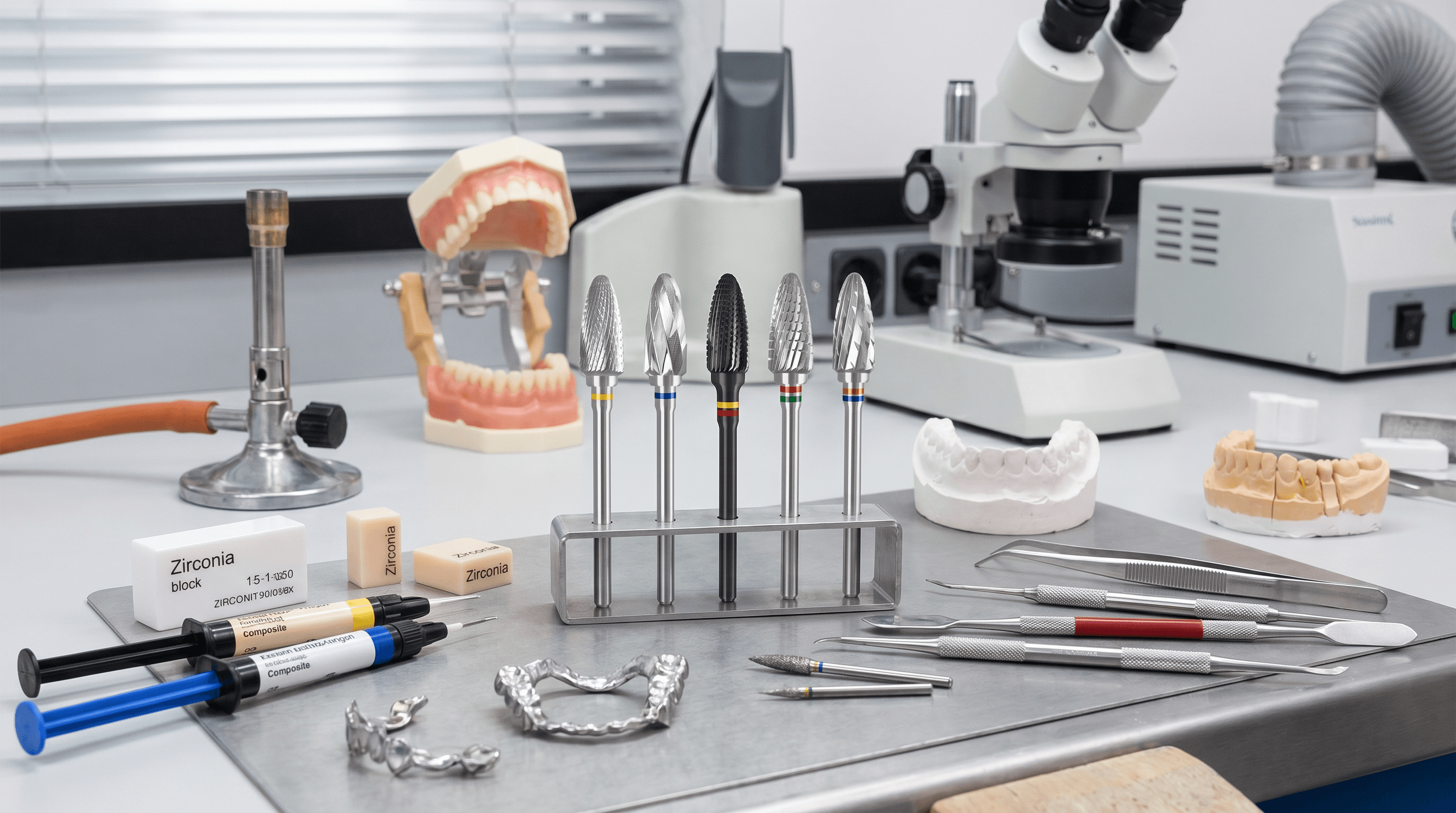
Zirconia is worked in the laboratory in two states, each with different rules: shape the white body before sintering without water or coolant and with light pressure; work the densely sintered framework only with diamond under water cooling and as little as possible. This is followed by a multi-stage diamond polish or glaze firing. For sintered zirconia, rotatec offers 96 sindia sintered diamond grinders with HP shank and 15 cerdia diamond polishers for the handpiece.
The white body is pre-sintered, porous and easy to work, but prone to fracture; only the sintering firing turns it into a dense restoration with high strength. For this reason, according to material manufacturers, all finishing belongs in the unsintered state, and any correction afterwards should be kept to the minimum necessary.
The table shows what changes in processing between the two states.
| Feature | White body, before sintering | Densely sintered |
|---|---|---|
| State | porous, easy to work, prone to fracture | dense, final strength |
| Task | sprues, connectors, fissures, margins | fit, contacts, occlusion |
| Instrument | fine carbide or diamond instruments, light pressure | diamond: sindia in the laboratory, rhodia chairside |
| Fluid | no water, no coolant, with extraction | water cooling with diamond grinders |
| Main risk | fracture, edge chipping | local overheating, scoring, cracks |
Sintering shrinkage is factored into the design: the white body is milled around 25 per cent larger. Any material removed from the white body therefore shrinks with it, and so does any notch.
Work the white body without water or coolant and with light pressure, because according to material manufacturers unsintered restorations are susceptible to damage and fracture. The rotatec article data do not list a separate material specification for the pre-sintered state; the processing instructions of the blank manufacturer are authoritative, including for colouring liquids.
One material manufacturer sets out three rules for this. First: separate the sprues with fine carbide or diamond instruments, notching them on one side before detaching them completely; coarse instruments cause vibration and edge chipping. Second: never re-separate bridge connectors with a separating disc, as this creates predetermined breaking points. Third: do not go below the connector cross-section and minimum wall thickness specified by the manufacturer, because whatever is missing on the white body will be missing in the same proportion after sintering. Zirconia dust belongs in the extraction system; when finishing, the manufacturer additionally recommends an FFP2 class dust mask.
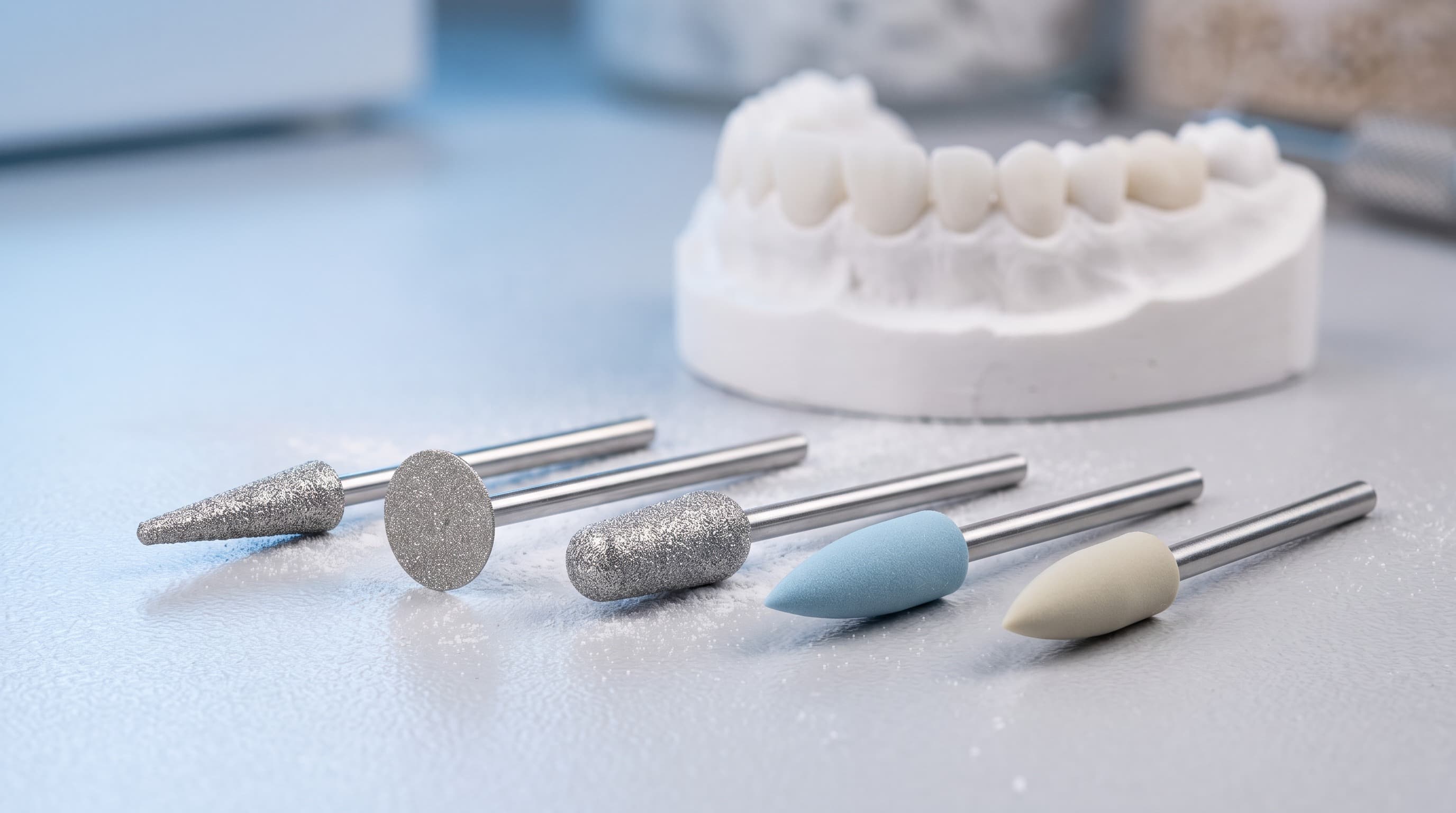
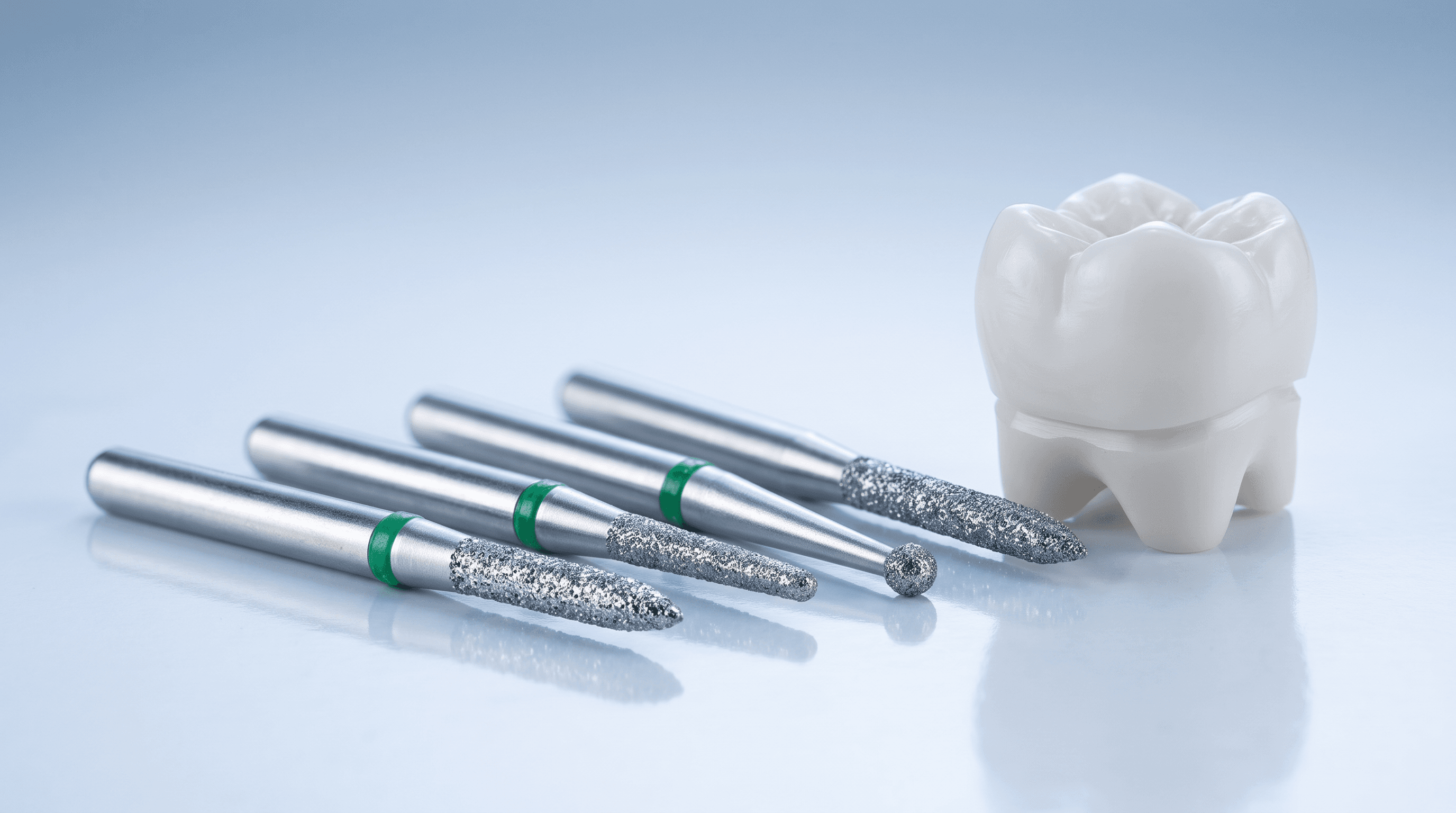
For sintered zirconia in the laboratory, the sindia sintered diamond grinders are intended, according to the article data for zirconia, glass and all-ceramics, non-precious alloys and model casting alloys. According to the catalogue, they are made from a single piece in a hard, compact metal sintered bond, and according to the product text they are sintered with diamond grit throughout.
sindia is available in 11 ISO shapes from 1.6 to 8.0 mm and three grits: 554 ultra coarse (24 items), 544 extra coarse (36) and 524 medium (36). According to the article data, the speed range is 20,000 to 25,000 min⁻¹.
The table assigns the shapes to typical tasks on the framework.
| Shape (ISO) | Ø | Items | Task on the framework |
|---|---|---|---|
| Round-end taper (198, 200) | 1.6 to 5.0 mm | 15 | Axial surfaces, crown walls |
| Round-end cylinder (141) | 1.6 to 5.0 mm | 14 | Walls, transitions |
| Bud (257, 263) | 1.6 to 6.0 mm | 14 | Occlusal surfaces, fissures |
| Flame (243) | 3.1 and 5.0 mm | 6 | Interdental spaces, connectors from the outside |
| Wheel, concave wheel (041, 493) | 1.6 to 8.0 mm | 18 | Basal surfaces, edges |
| Inverted cone (014) | 1.6 to 8.0 mm | 14 | Edges, shoulders |
| Long cylinder, round (111, 001) | 2.1 to 5.0 mm | 15 | Surfaces, recesses |
An example for broad surfaces is the round-end taper 7745 with 5.0 mm. Begin corrections with 524 and use 544 or 554 only for larger adjustments: grinding can reduce the strength of zirconia, and every score mark must then be polished away again.
sindia works on the zirconia framework itself, the ceramic grinder on the veneer and rhodia at the dental chair. The catalogue lists the ceramic-bonded, diamond-impregnated diagrinder grinders for feldspathic ceramics, glass ceramics and aluminium oxide, not for zirconia.
The table compares the four instrument groups.
| Instrument | Materials according to catalogue | Shank | Maximum speed | Use |
|---|---|---|---|---|
| sindia | zirconia, glass and all-ceramics, non-precious alloys, model casting alloys | HP | 25,000 min⁻¹ | Framework in the laboratory |
| diagrinder | feldspathic ceramics, glass ceramics, aluminium oxide | HP | 15,000 min⁻¹ | Veneering ceramics |
| rhodia | hard all-ceramics (product text) | FG, FGL, FGXL | 45,000 to 450,000 min⁻¹ | Chairside adjustment |
| cerdia | feldspathic ceramics, lithium disilicate, zirconia | HP, RA, FG | 12,000 min⁻¹ | Polishing |
The 23 diagrinder grinders are available in hard (534) and soft (524) grades, for example as a ZF5 disc with 22 mm for veneers. The 130 diamond burs for zirconia in the rhodia line have FG shanks exclusively; their use on the tooth is described in Diamond burs for zirconia: grit and cooling.
You avoid damage to sintered zirconia with minimal removal, light pressure and cooling: one material manufacturer requires that sintered restorations be worked only when absolutely necessary, with light pressure and low speed, and that diamond grinders be used with water cooling to avoid local overheating. The recommendations for use and reprocessing likewise require that no excessive pressure be applied and that the instrument be kept constantly moving.
According to the material manufacturer, three further limits apply to the framework: bridge connectors are not re-separated with a separating disc, the minimum wall thickness and connector cross-section are not undercut, and sharp edges are avoided. Check the fit on the model and make only slight corrections; inspect the restoration for defects and cracks before and after grinding. Grinding can reduce the flexural strength of zirconia and transform part of its microstructure; more on this in Working zirconia, grinding lithium disilicate. Whether a regeneration firing is required after larger corrections is determined by the material manufacturer.
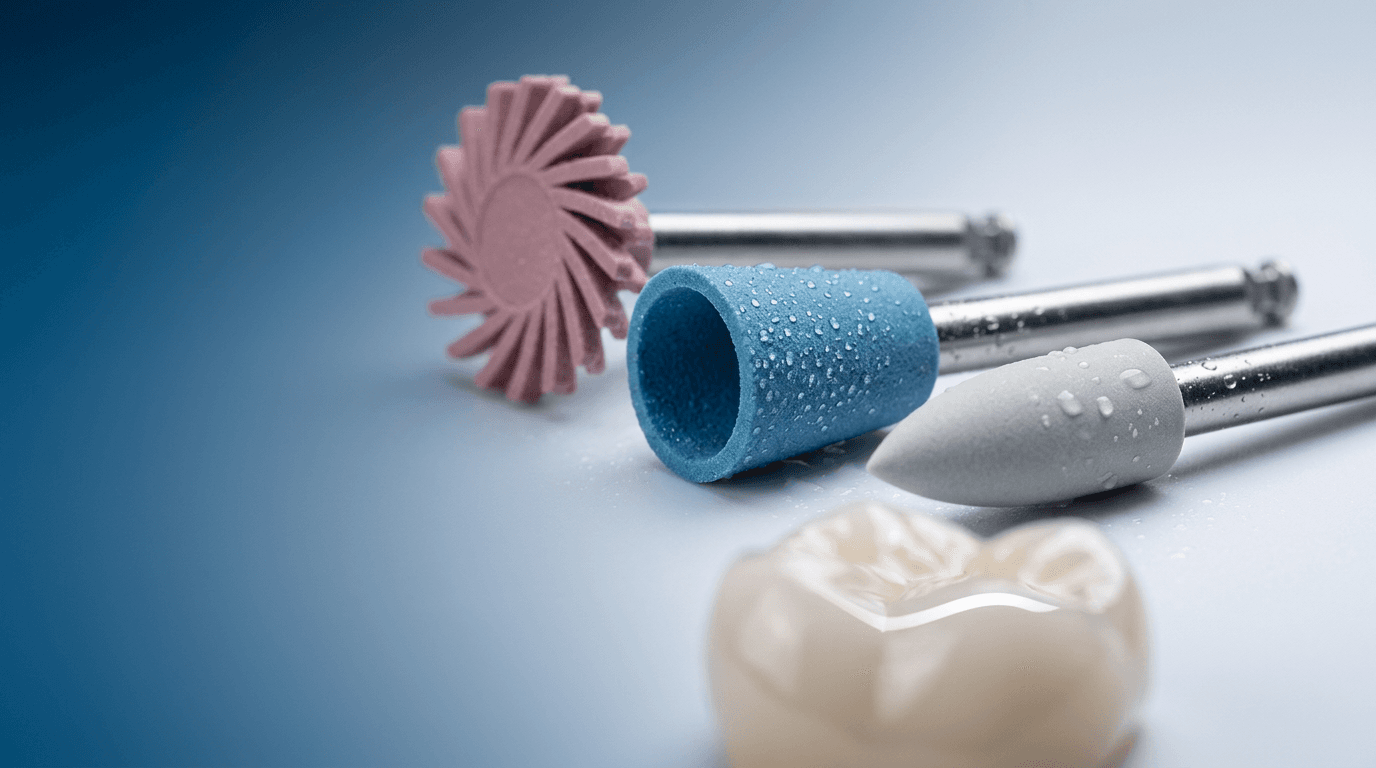
After every correction, the zirconia surface must be made smooth again, either with a multi-stage diamond polish or with glaze firing. According to the catalogue, the cerdia system allows quick surface corrections without additional glaze firing. The 15 cerdia polishers with HP shank are available in five designs, each in three stages.
The table shows the three stages using the 5.0 mm torpedo as an example.
| Stage | Grit (ISO) | Example | Maximum speed |
|---|---|---|---|
| Pre-polishing | 534 | BD6 | 12,000 min⁻¹ |
| Polishing | 524 | RD6 | 12,000 min⁻¹ |
| High gloss | 514 | GD6 | 12,000 min⁻¹ |
For the handpiece, the catalogue specifies 7,000 to 12,000 min⁻¹. Always polish occlusal contact surfaces to a high gloss: one material manufacturer describes polishing the occlusal surfaces as very important to protect the antagonist, and in a laboratory study the glaze on zirconia wore away significantly and caused more enamel wear than a polished surface. You will find the polishers under Polishers.
Register as a professional customer and find the sintered diamond grinders for zirconia under Sintered diamond grinders, laboratory.
Without water or cooling lubricant and with light pressure, because the white body is porous and prone to fracture. Shape corrections to connectors, fissures and margins belong in this state. The processing instructions of the blank manufacturer are authoritative.
Diamond: in the laboratory, these are the sindia sintered diamond grinders with HP shank, specified for zirconia according to the product data. One material manufacturer requires water cooling, light pressure and low speed for diamond grinders on sintered zirconia.
For corrections, start with the medium grit 524, and use 544 or 554 only for larger adjustments. Grinding can reduce strength, so work as finely and as little as possible; scratches are then polished away. This is followed by polishing in three stages.
According to the product data, the speed range of the sindia grinders is 20,000 to 25,000 min⁻¹. The maximum speed is a limit, not a recommendation. If you notice heat, reduce the pressure first.
The catalogue lists the ceramic-bonded diagrinder for feldspathic ceramic, glass ceramic and aluminium oxide, not for zirconia. They are suitable for the veneer on the zirconia framework. The framework itself is processed with sindia.
Both are possible; what matters is a smooth surface. The cerdia system polishes zirconia in three stages up to 12,000 min⁻¹ and, according to the catalogue, allows corrections without an additional glaze firing. Polish contact surfaces with the antagonist to a high gloss, because a glaze wears away there.
sindia are sintered diamond grinders with HP shank for the laboratory, manufactured with diamond grit throughout. rhodia are diamond burs with increased diamond concentration and FG shank for chairside work. Both work on hard all-ceramic materials.

Zahntechnik
Dental Laboratory Cutters: Choosing by Material
Dental laboratory cutters by material: blade pattern, ISO code and speed for plaster, resin, NPM, titanium and zirconia. With 5 tables from the lab catalogue.

Anwendung
Crown preparation: procedure and instrument sequence
Crown preparation in 5 steps: which diamond shape and grit for each step, depth marking from 0.5 to 0.9 mm and maximum permissible speed of up to 450,000 min⁻¹.

Anwendung
Polishers and prophylaxis: why polishing works in stages
179 instruments for polishing and prophylaxis. Why a fine polisher achieves nothing on a coarse surface, and which polisher suits composite or ceramic.