
Working with all-ceramics: cutting, adjusting and polishing lithium disilicate and zirconia
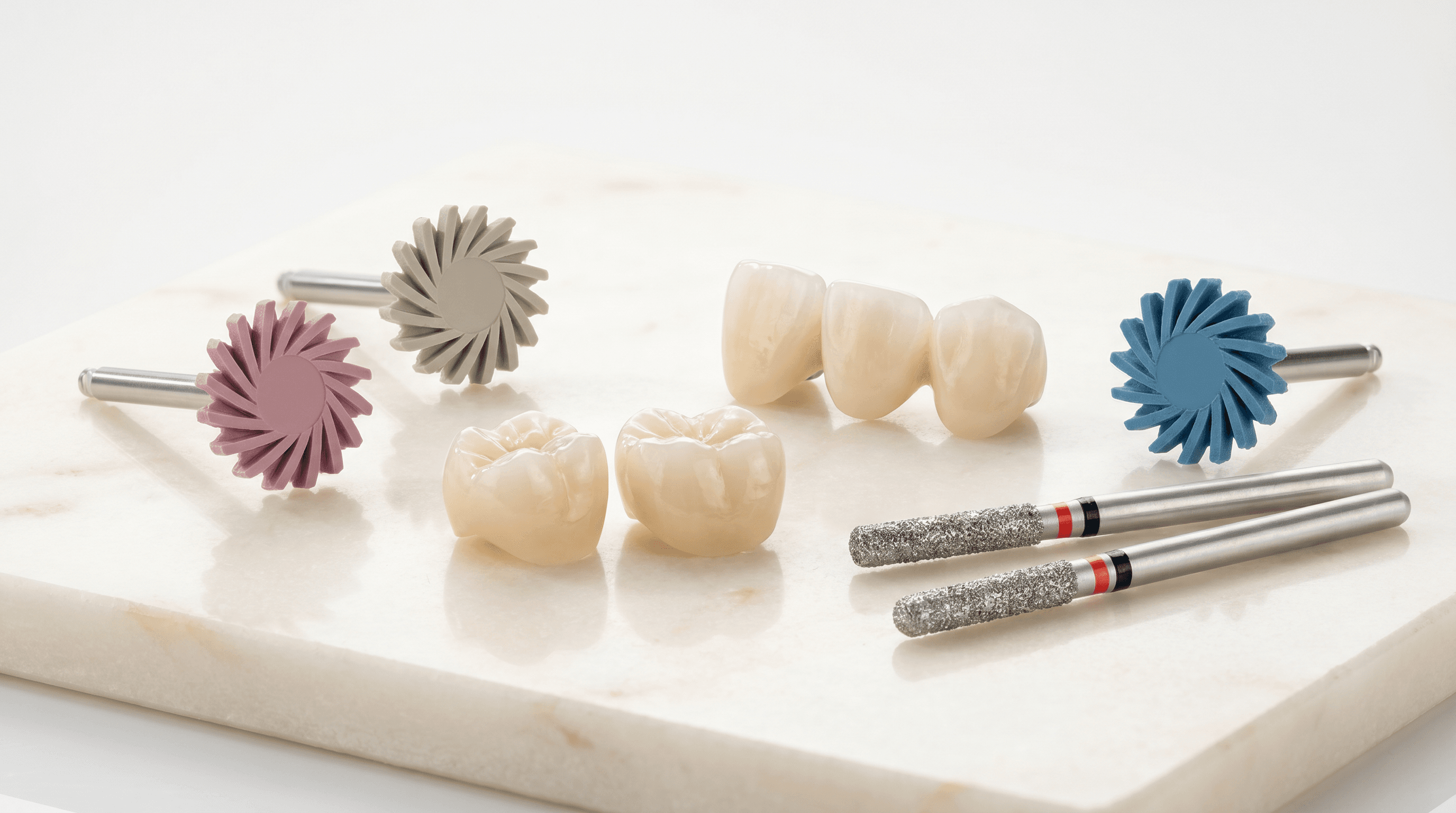
All-ceramics have become established for aesthetic restorations. The common materials, however, differ in strength and processing: lithium disilicate, zirconium oxide, hybrid and leucite ceramics each require a tailored approach.
Think ceramic right from the preparation stage
A durable ceramic restoration begins with the preparation. Maintain minimum layer thicknesses, avoid shallow cavities and create rounded internal edges: these are the basic rules. Preparations that are too shallow and layer thicknesses that fall below the minimum are common sources of error.
Intraoral adjustment
When grinding and adjusting in the mouth, the following applies to all ceramics:
- use a fine diamond grit
- work cool and with low pressure
- use sweeping movements rather than point loading
This keeps surface roughness and heat low, which reduces the risk of microcracks, particularly with brittle zirconia.
Polish rather than glaze
After every intraoral correction, the surface must be polished again, otherwise it will feel rough and act abrasively against the antagonist. A two-step diamond polish reliably brings lithium disilicate and zirconia to a high gloss. A smooth surface protects the opposing tooth and remains aesthetically stable.
The material determines the instrument
Zirconia is particularly hard and requires matched diamond instruments. Lithium disilicate is somewhat easier to work with, but reacts sensitively to coarse grits. The correct choice of instrument for each material determines the outcome and service life.
Register as a professional customer and discover the ceramics range in the shop.
From our range
All-ceramics need the right sequence: for zirconia we offer dedicated diamond instruments (rhodia) and ceramic grinders, separating discs for trimming and adjusting, and polishers for high gloss. All Swiss Made to ISO 13485, in stock and ready to ship within 48 hours.
Register as a professional and find the right instruments in the shop.
That makes finding the right instrument fast: our shop can be filtered and grouped by material and application as well as many further specifications (shank, size, grit, toothing, pack size).
Sources
- ISO 7711-1:2021 – Dentistry – Diamond rotary instruments – Part 1: general requirements
- ISO 7711-3:2004 – Dentistry – Diamond rotary instruments – Part 3: grit sizes, designation and colour code
- rotatec Produktkatalog und Gebrauchsanweisung (IFU), rotatec GmbH