Ceramic polishers for zirconia and lithium disilicate
Ceramic polishers for practice and laboratory: cerdia polishes zirconia, lithium disilicate and feldspathic ceramic in 3 stages without paste, up to 12,000 min⁻¹. Shapes, speed.

Wird geladen …
2'413 items in stock, ready to ship in 48 hours.
Ceramic polishers for practice and laboratory: cerdia polishes zirconia, lithium disilicate and feldspathic ceramic in 3 stages without paste, up to 12,000 min⁻¹. Shapes, speed.

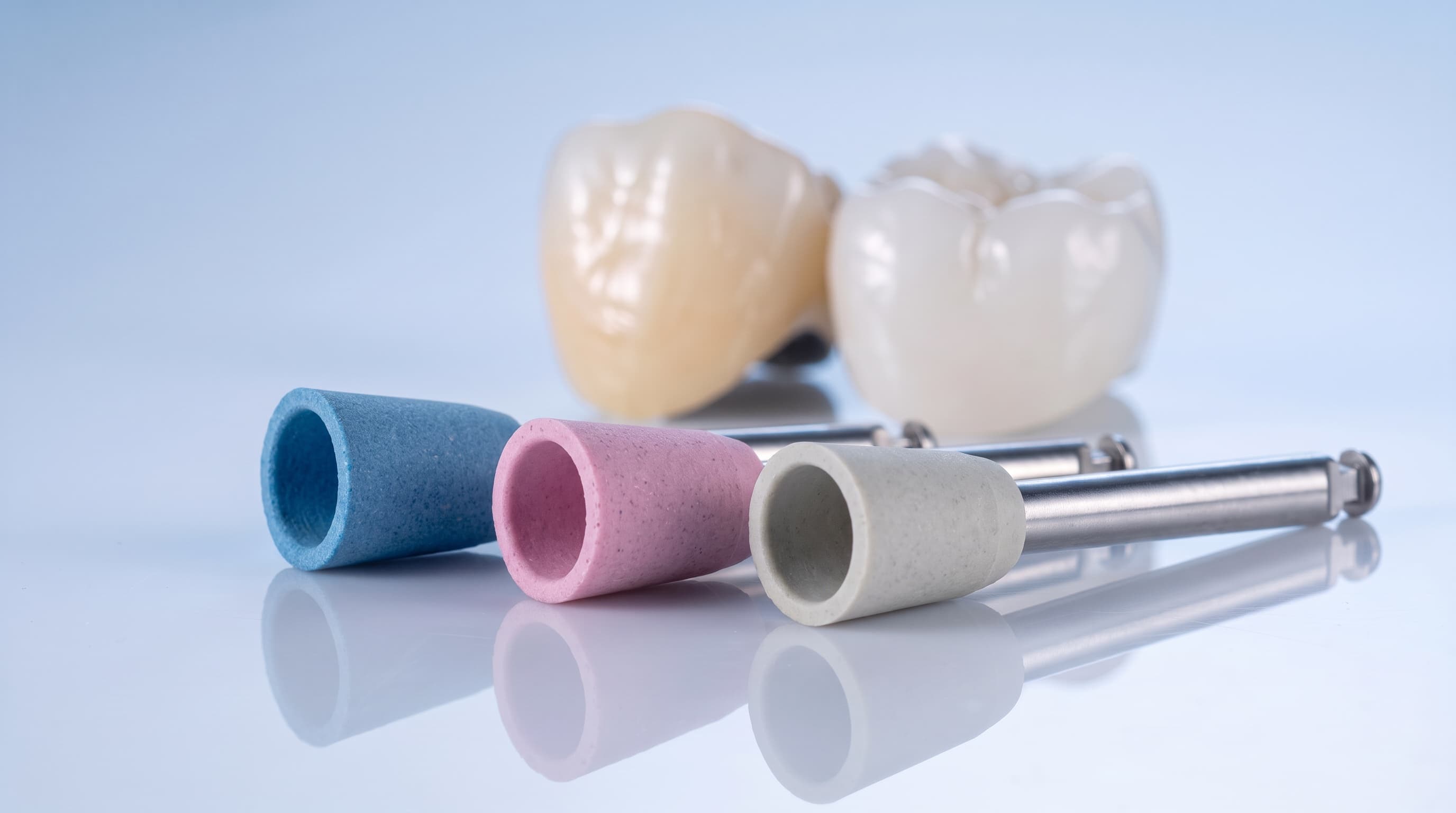
A ceramic polisher for the dental practice carries diamond grit in its matrix and smooths feldspathic ceramic, lithium disilicate and zirconia after adjustment. In the rotatec range, this is the cerdia line with 33 items and 3 stages, and for hybrid ceramics the hybridia line with 2 stages. quickdia, by contrast, is a single-stage diamond polisher for composite.
The material determines the polishing line: each line is specified for particular materials in the item data. The rotatec instructions for use emphasise that all polishers are designed for their specific application and that improper use can lead to premature wear.
The table assigns the polishing lines to the materials, according to the item data:
| Material | Line | Stages | Maximum speed |
|---|---|---|---|
| Feldspathic ceramic | cerdia | 3 | 12,000 min⁻¹ |
| Lithium disilicate | cerdia | 3 | 12,000 min⁻¹ |
| Zirconia | cerdia | 3 | 12,000 min⁻¹ |
| Hybrid ceramic | hybridia | 2 | 8,000 min⁻¹ |
| Composite | quickdia | 1 | 10,000 min⁻¹ |
You will find all lines in the Polishers group with 147 items. For grinding ceramics with the handpiece before polishing, there are the Ceramic grinders with 28 items up to 15,000 min⁻¹.
Diamond-impregnated polishers contain the diamond grit within the matrix itself. According to the product text, cerdia achieves pre-polishing, polishing and high gloss without polishing paste. The catalogue describes cerdia as a three-stage polishing system with diamond grit for quick surface corrections without an additional glaze firing. How long a polisher remains in use is limited by the instructions for use and reprocessing: a maximum of 10 reprocessing cycles, and damaged or worn polishers are discarded.
Each cerdia stage can be identified by its grit code according to ISO 6360-6 and by its article number. The item data assign an application step to each grit, and the sequence runs from coarse to fine.
The table shows the three stages using the long cup with 6.0 mm as an example:
| Stage | ISO grit | Item (RA) | Application step according to item data |
|---|---|---|---|
| 1 | 534 coarse | CG5.204.060x012 | Smoothing |
| 2 | 524 medium | CM5.204.060x012 | Pre-polishing |
| 3 | 514 fine | CF5.204.060x012 | High-gloss polishing |
With hybridia, only two stages follow one another: pre-polishing with grit 524 and high gloss with grit 514, both on the contra-angle handpiece up to 8,000 min⁻¹. Why polishing after adjustment matters: a rougher ceramic surface can promote discolouration and plaque accumulation and increase wear on the opposing tooth.
Polish ceramics below the maximum speed, with water cooling and with light pressure. The maximum speed is 12,000 min⁻¹ for cerdia and 8,000 min⁻¹ for hybridia. According to the instructions for use and reprocessing for polishers, high contact pressure leads to greater heat generation and increased wear and can destroy the polisher; intraorally, overheating can damage the pulp. The instructions require water cooling of at least 50 ml/min. Bring the polisher up to speed before applying it and polish with slight circular movements to avoid dents.
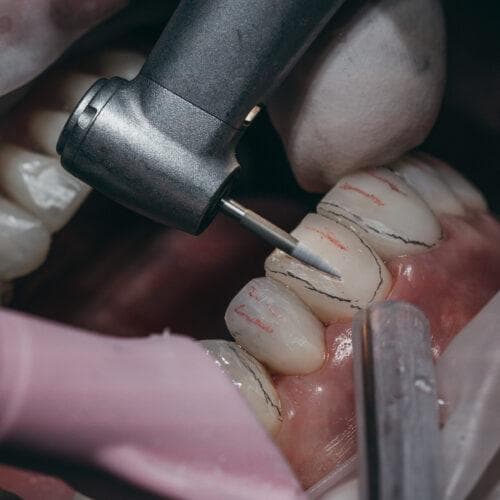
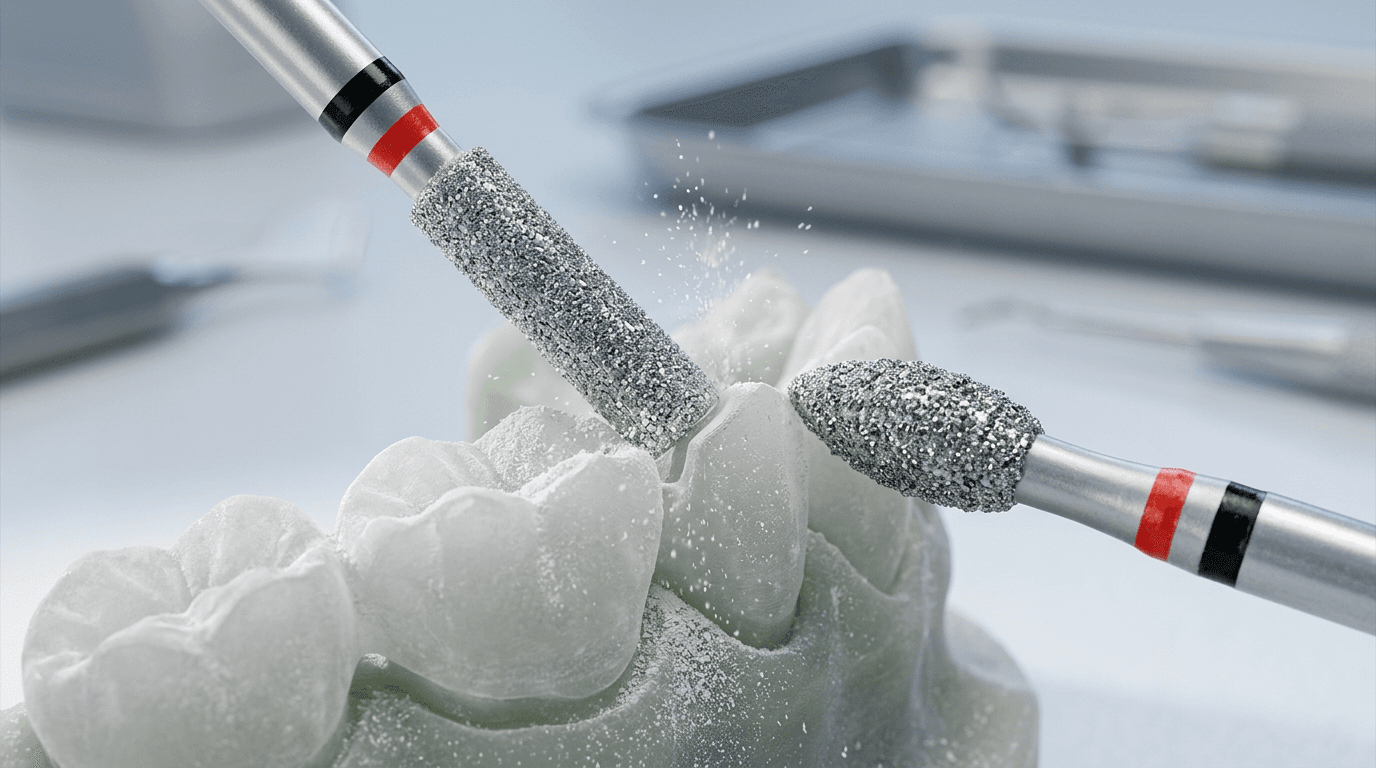
After chairside adjustment, you can polish zirconia directly in the mouth without reglazing: according to the product text, cerdia is intended for corrections on the model or chairside without reglazing, and in an in vitro study, adjusted, chairside-polished monolithic zirconia was similarly smooth to glazed zirconia. Adjustment is carried out with diamond instruments for zirconia such as rhodia, which according to the catalogue have a higher diamond concentration. Which instruments these are is explained in the article Diamond instruments for zirconia. In the chewing simulator, adjusted but unpolished zirconia caused more enamel wear on the opposing tooth than adjusted and polished zirconia; the authors recommend polishing zirconia and lithium disilicate after adjustment. This is followed by the three cerdia stages from coarse to fine. For the laboratory, cerdia is available with an HP shank; laboratory processing is described in Processing all-ceramics.
cerdia is available in six shapes for the contra-angle handpiece (RA), the straight handpiece (HP) and the turbine (FG).
The table shows the cerdia shapes with size and shank:
| Shape | ISO shape | Size | Shank |
|---|---|---|---|
| Flame | 243 | 4.0 mm (RA), 5.0 mm (HP) | RA, HP |
| Flame, short | 244 | 3.0 mm | RA, FG |
| Cup, long | 030L | 6.0 mm | RA |
| Lens | 303 | 10.0 mm (RA), 20.0 and 26.0 mm (HP) | RA, HP |
| Wheel | 543 | 14.0 mm (RA), 16.0 mm (HP) | RA, HP |
| Wheel with hub | 044 | 11.0 mm | HP |
quickdia is a single-stage diamond polisher for composite: pre-polishing and high-gloss polishing with one instrument, grit 524, up to 10,000 min⁻¹. The line comprises 11 items with RA and HP shanks. The catalogue recommends increased pressure for surface preparation and reduced pressure for high-gloss polishing. The item data list composite as the only material, not ceramics or zirconia. Anyone who also polishes a composite margin on a ceramic restoration therefore works with two lines: cerdia for the ceramic, quickdia for the composite.
Like all rotatec polishers, ceramic polishers are reprocessed a maximum of 10 times. Cleaning agents and disinfectants must be expressly specified as suitable for rubber polishers or plastics/silicones. The ultrasonic bath must not exceed 42 °C, and sterilisation is carried out at 134 °C. The details can be found in the Instructions for use and reprocessing for polishers, and the complete procedure in the article Instrument reprocessing in the dental practice.
All polishers are Swiss Made in accordance with ISO 13485, available from stock and ready for dispatch within 48 hours. Register as a professional customer and put together your polishing system in the Shop.
A diamond-impregnated polisher whose material specification explicitly lists zirconia. At rotatec, this is cerdia, available for contra-angle handpiece, straight handpiece and turbine. The three stages work without additional polishing paste.
For intraoral adjustments, the cerdia polishers with RA shank for the contra-angle handpiece are the main choice, 15 items in five shapes, plus the short flame with FG shank. The HP versions with large lenses and wheels are intended for the straight handpiece, for example for adjustments on the model.
The lines are separated by material: according to the item data, cerdia is specified for feldspathic ceramic, lithium disilicate and zirconia, while quickdia, comdia and compol are for composite. The maximum speeds also differ: cerdia 12.000 min⁻¹, quickdia and compol 10.000 min⁻¹, comdia 8.000 min⁻¹.
The material specification for cerdia lists only feldspathic ceramic, lithium disilicate and zirconia. Separate lines are intended for composite, such as quickdia, comdia or compol. Use polishers only for the specified material; according to the instructions for use, improper use can lead to premature wear and poor results.
With cerdia, three: smoothing (grit 534), pre-polishing (524) and high-gloss polishing (514). According to the item data, the high gloss is produced by the third stage. A wear study shows that polishing after adjustment is worthwhile: adjusted, unpolished lithium disilicate caused more enamel wear on the antagonist tooth than polished lithium disilicate.
Yes, rotatec polishers are sterilised in an autoclave at 134 °C with fractionated pre-vacuum. In Germany, the holding time according to KRINKO and BfArM is at least 5 minutes. Temperatures above 150 °C must be avoided.
Polishers in which diamond grit is bonded into the carrier material. According to the product text, cerdia polishes ceramic without polishing paste. The rotatec instructions for use permit a maximum of 10 reprocessing cycles; damaged or worn polishers are discarded.

Produkt
Cross-cut: choosing the right carbide cutter
Cross-cut carbide cutters: 13 laboratory blade patterns from E to XMV with colour, material and speed, plus the A blade pattern used in surgery.

Produkt
Diamond burs for zirconia: grit and cooling
Diamond burs for zirconia on the tooth: rhodia with increased diamond concentration, 19 shapes, 3 grits, maximum speed per Ø and rules against microcracks.

Produkt
Round burs: sizes, shank and excavation
Carbide round burs from 0.5 to 5.0 mm with RA, FG and HP shanks. An overview of sizes, maximum speeds and blade patterns for caries excavation.