
Reprocessing instruments correctly: hygiene, sterilisation and service life
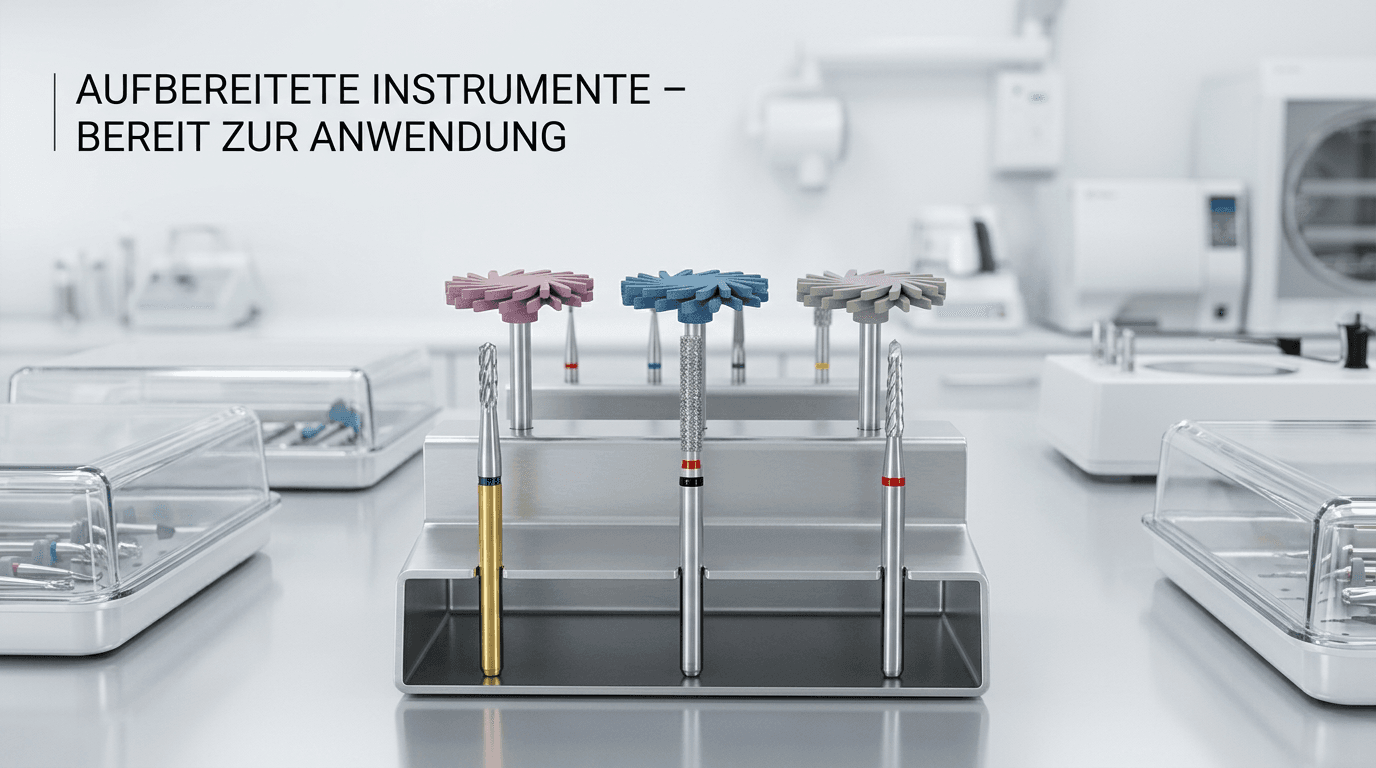
Rotary instruments are medical devices. Reprocessing them correctly is not only a hygiene obligation, it also protects patients, the team and the investment in high-quality instruments. The recommendations of KRINKO and BfArM and the manufacturer's reprocessing instructions in accordance with EN ISO 17664 are authoritative.
Before first use
rotatec instruments are supplied clean but non-sterile. They therefore go through the complete reprocessing cycle before first use and after every use. Single-use products marked with the symbol ⊘ are sterilised only once, before first use.
The reprocessing procedure
- Pre-cleaning immediately after use with a soft plastic or nylon brush under running water, so that residues do not dry on. Reprocessing begins as soon as possible, and for polishers no later than 2 hours after use.
- Cleaning and disinfection, manually or mechanically in a washer-disinfector (thermal disinfector).
- Inspection with an illuminated magnifier for cleanliness, integrity and wear. Damaged instruments are discarded.
- Packaging in a sterile barrier system intended for steam sterilisation.
- Steam sterilisation in an autoclave at 134 °C, with the holding times given in the relevant reprocessing recommendation.
- Storage packaged, dry, clean and at room temperature.
Manual or mechanical
Mechanical reprocessing is standardised and reproducible and is therefore preferable. The manufacturer's reprocessing recommendation specifies which procedures, agents and parameters are permitted for which instrument. For rotatec, these are set out in the Instructions for Use and Reprocessing: Burs and the Instructions for Use and Reprocessing: Polishers. You can also find both under Downloads.
Diamond and carbide burs
The following applies to diamond burs, diamond burs for zirconia, carbide burs and finishers:
- Cleaning agents and disinfectants must be suitable for rotary dental instruments, otherwise there is a risk of corrosion.
- Do not leave soiled instruments in the cleaning or disinfectant solution for more than 12 hours. Longer immersion promotes corrosion.
- Do not immerse uncleaned burs in fixing disinfectants, for example aldehyde-based ones.
- Sterilisation at 134 °C with a 4-minute holding time and 15 minutes of drying.
- Bur stands are only suitable for sterilisation if the instruments are used immediately afterwards.
Polishers
Separate rules apply to polishers, as rubber and silicone are more sensitive than steel and tungsten carbide:
- No alcohol: do not clean or disinfect polishers with agents containing alcohol. Use only cleaning and disinfectant solutions that are expressly labelled as suitable for rubber polishers or for plastics and silicones.
- The ultrasonic bath must not exceed 42 °C, otherwise proteins coagulate.
- Avoid temperatures above 150 °C. Strong acids and alkalis attack the stainless steel shank.
- Sterilisation with fractionated pre-vacuum at 134 °C and a holding time of at least 3 minutes, in Germany at least 5 minutes in accordance with KRINKO and BfArM.
- A maximum of 10 reprocessing cycles. After a final sterilisation cycle, polishers are then disposed of with general practice waste.
Labelling and traceability
Clear identification by figure and code number helps with sorting and assignment. For traceability, the lot number on the label is what counts: it belongs in every enquiry and every report concerning the product.
Service life as an economic factor
For diamond and carbide burs, service life is determined not by reprocessing but by wear and damage during use. Checking for chips, cracks, chatter marks and bent shanks at every pre-cleaning and discarding worn instruments in good time protects tooth structure, results and patients. For polishers, the limit of 10 reprocessing cycles sets the framework. High-quality instruments with consistent cutting and polishing performance reduce the cost per treatment.
From our range
Well-maintained instruments last longer, and this applies to our entire range: diamond burs, carbide burs, finishers, surgery and polishers. All are Swiss Made in accordance with ISO 13485. You can replace worn instruments from stock, ready for dispatch within 48 hours.
Register as a trade customer and discover the range in our shop.
Sources
- ISO 13485:2016, Medical devices: Quality management systems (https://www.iso.org/standard/59752.html)
- EN ISO 17664: Aufbereitung von Produkten für die Gesundheitsfürsorge, vom Hersteller bereitzustellende Informationen
- Empfehlung der KRINKO und des BfArM: Anforderungen an die Hygiene bei der Aufbereitung von Medizinprodukten (rki.de, bfarm.de)
- rotatec Anwendungs- und Aufbereitungsempfehlung Bohrer und Polierer