
How is a diamond instrument made? Manufacturing in Appenzell
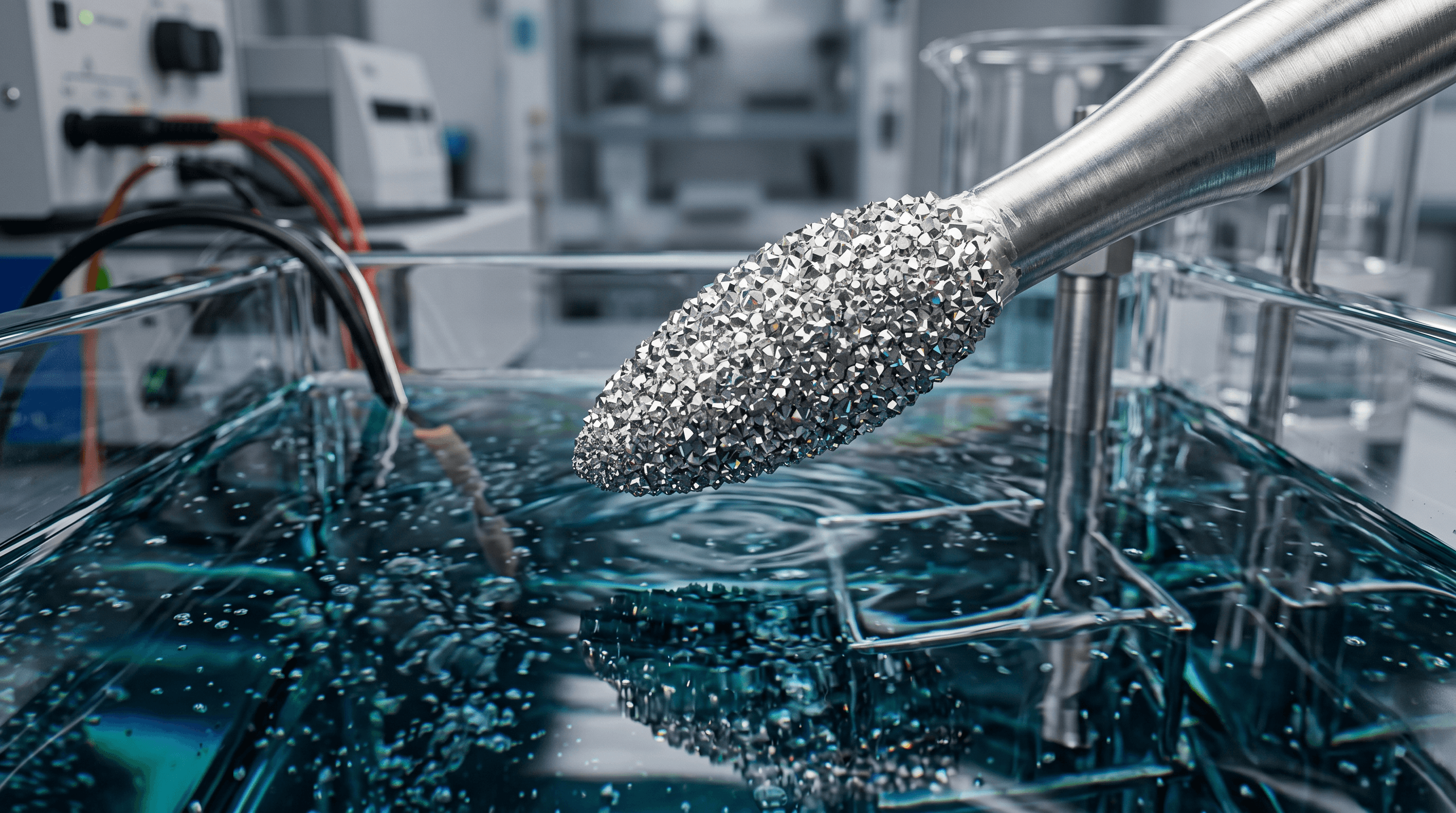
A diamond instrument looks small and simple. Behind the even diamond coating, however, lies a precise, multi-stage manufacturing process. rotatec develops and produces in Appenzell, Swiss Made to ISO 13485 and EU MDR 2017/745. A look behind the scenes shows why manufacturing depth determines quality, and how many controlled steps are needed before a single instrument passes final inspection.
From blank to carrier body
It starts with a stainless steel blank. It is turned and ground to size so that shank and working part match the intended shape and standard dimensions exactly. This geometric precision is the basis for smooth running and an accurate fit.
The diamond coating
The decisive step is bonding the diamond grains onto the carrier body. Two factors determine later performance:
- Grain distribution: the diamond grains must sit evenly and at a defined density on the working surface
- Bond: a stable bond holds the grains securely in engagement and determines service life
Only when distribution and bond are right does the instrument work evenly and without one-sided wear.
Step by step: six phases, more than 36 operations
What looks like a single tool from the outside passes through six consecutive phases with more than 36 documented operations in our production, plus the associated inspection and correction steps. Every step is recorded per batch on a routing sheet, so the path of each instrument stays fully traceable, as ISO 13485 requires.
Phase 1: Blanks and preparation. The stainless steel blank is sourced and put through incoming inspection using defined test equipment. The surfaces that are not to be diamond-coated are then protected with a masking lacquer. The prepared batch is recorded and put into storage.
Phase 2: Batch preparation. The batch is demagnetised and mounted onto a coating fixture. Fine working parts below 1.2 mm in diameter are additionally inspected under magnification for cracks, deformation or lacquer defects and sorted out if necessary. A protective lacquer secures the parts and dries fully for one to two days, after which the batch is demagnetised again. Finally, the coating parameters are defined for each product.
Phase 3: Galvanic diamond coating. This is where the actual diamond layer is formed. The working parts are etched and thoroughly rinsed to prepare the coating surface. A first thin nickel layer creates the adhesion base, followed by pre-nickel plating. The diamond grains are then applied galvanically in the diamond fixture; degassing under the microscope removes gas bubbles so that no defects form in the coating. A final nickel layer bonds the diamond grains permanently onto the working part.
Phase 4: Finishing and inspection. The batch is dried and the coating is checked under the microscope as well as with calliper and micrometer for completeness, evenness and dimensions. Defective batches are corrected where possible or re-coated entirely. The parts are then separated from the fixture, the masking lacquer is dissolved, rinsed, polished and cleaned in an ultrasonic bath.
Phase 5: Demagnetisation and colour coding. After renewed demagnetisation comes the concentricity check: parts that do not run smoothly are sorted out. The colour ring that identifies the grit is then applied, checked and permanently baked in an oven.
Phase 6: Final inspection and release. In final inspection every batch is checked against a defined control instruction with a complete inspection record. Individual defective parts are sorted out; for recurring faults the cause is localised and the process is adjusted. Only after documented release is the batch stored, protected from moisture, dust and mechanical impact.
Quality control across the entire chain
Every production stage is checked: dimensional accuracy, coating and concentricity. This control is part of the quality management system to ISO 13485. It ensures that one instrument in a batch matches the next, something users experience in daily practice as a consistent working feel.
Why manufacturing depth in Switzerland matters
Anyone who combines development, production and testing at a single site controls the entire quality chain. This shows in evenness, service life and reproducibility. That is exactly what Swiss Made stands for at rotatec: precision micromechanics from Appenzell.
Coatings and reproducibility
Besides grain distribution and bond, the surface of the carrier body also plays a role. Hard coatings can increase service life and improve resistance to the chemical baths of reprocessing. What matters in daily practice is reproducibility: a consistent quality management system to ISO 13485 ensures that every instrument in a series works the same. Users experience this evenness as a consistent working feel, regardless of which batch an instrument comes from.
Would you like to test Swiss Made quality? Register as a professional customer and discover the diamond range in the shop.
From our range
This manufacturing produces our diamond range: diamond burs for the clinic, special instruments for zirconia (rhodia), plus separating discs and grinders for the lab, each in graded grits. All Swiss Made to ISO 13485, in stock and ready to ship within 48 hours.
Register as a professional customer and discover the diamond range in the shop.
Sources
- ISO 13485:2016 – Medical devices – Quality management systems
- ISO 7711-1:2021 – Dentistry – Diamond rotary instruments – Part 1: general requirements
- rotatec Produktkatalog und Gebrauchsanweisung (IFU), rotatec GmbH