Qualität & Normen06 July 20268 min readby rotatec
ISO 6360: Reading Grit, Shank and Size
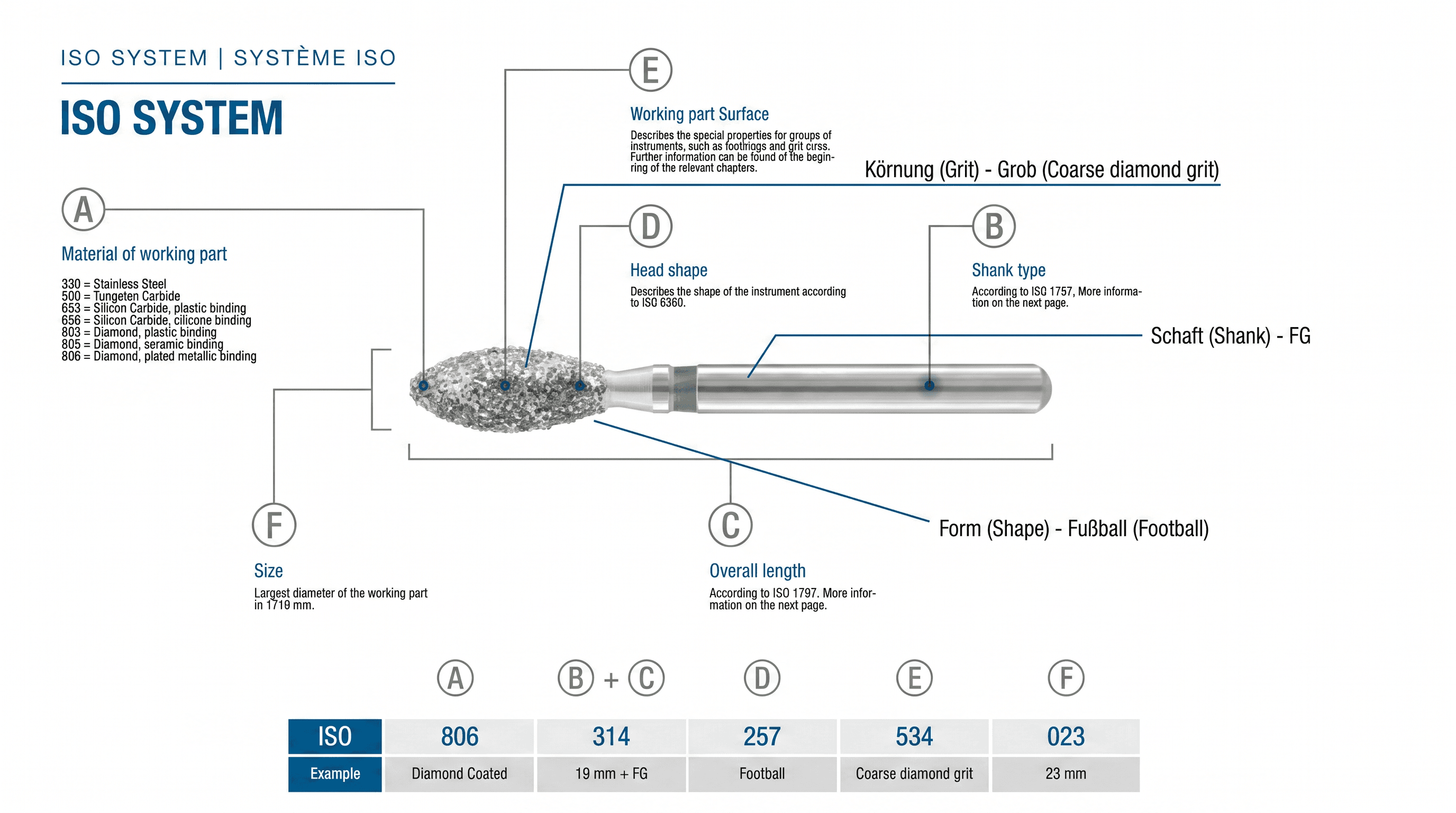
ISO 6360 explained simply: 15 digits for material, shank, shape, grit and size. With colour code, shank dimensions in mm and example 806 314 001 524 014.

Wird geladen …
2'413 items in stock, ready to ship in 48 hours.
ISO 6360 explained simply: 15 digits for material, shank, shape, grit and size. With colour code, shank dimensions in mm and example 806 314 001 524 014.
ISO 6360 describes every rotary dental instrument with a 15-digit code in five groups of three: material, shank, shape, grit or blade pattern, and size. A diamond ball grinder with FG shank, medium grit and 1.4 mm diameter carries the code 806 314 001 524 014. Anyone who can read the five groups identifies every instrument unambiguously, regardless of the manufacturer.
ISO 6360 is the international numbering system for rotary dental instruments and consists of several parts. Part 1 sets out the general characteristics and the structure of the code, part 2 the shapes, part 3 the carbide burs and cutters, part 4 the diamond instruments. Shank dimensions are governed by a separate standard, ISO 1797; grit levels and the colour code for diamonds by ISO 7711-3. This makes an instrument with the same ISO number comparable across manufacturers.
Each of the five groups of three in the ISO 6360 code stands for exactly one characteristic, and the order is always the same. This is why the code can be read without a catalogue.
The table shows the structure using the example 806 314 001 524 014.
| Digits | Characteristic | Example | Meaning in the example |
|---|---|---|---|
| 1 to 3 | Material of the working part | 806 | diamond |
| 4 to 6 | Shank type and overall length | 314 | FG, standard length 19 mm |
| 7 to 9 | Shape of the working part | 001 | ball |
| 10 to 12 | Grit or blade pattern | 524 | medium grit |
| 13 to 15 | Size in 1/10 mm | 014 | 1.4 mm |
Carbide instruments begin with 500. The round bur H1 with FG shank and 1.4 mm diameter carries the code 500 314 001 001 014. Here the group 10 to 12 describes not a grit but the blade pattern, in this example a straight blade pattern.
The rotatec item number contains figure, shank, size and pack size in compact form. Example 801.314.014x006: figure 801 is the ball, 314 the FG shank, 014 the diameter of 1.4 mm, x006 the pack size of 6 pieces. The shank digits are identical to the ISO code. The grit appears as a digit before the figure or as an abbreviation after it.
The table shows each grit identifier with ISO code and number of items in the clinical diamond burs group.
| Identifier | ISO code | Grit | Items |
|---|---|---|---|
| 4 prefixed | 554 | super coarse | 36 |
| 5 prefixed | 544 | extra coarse | 121 |
| 6 prefixed | 534 | coarse | 287 |
| no addition | 524 | medium | 366 |
| 8 prefixed | 514 | fine | 260 |
| EF appended | 504 | extra fine | 116 |
| UF appended | 494 | ultra fine | 7 |
The same 1.4 mm ball is therefore called 6801.314.014x006 in coarse, 8801.314.014x006 in fine and 801EF.314.014x006 in extra fine grit. A reading example from the laboratory: H79E.104.050x001 corresponds to 500 104 194 190 050, i.e. tungsten carbide, HP shank, round-end cone, standard cross-cut E, 5.0 mm diameter, pack size 1 piece.
On diamond instruments, a colour ring on the shank identifies the grit; codes and colours are specified in ISO 7711-3. This lets you see before use how coarse or fine an instrument removes material. The group clinical diamond burs comprises 1,195 items in all grits.
The table assigns grit and typical use to each colour ring.
| ISO code | Grit | Colour ring | Use |
|---|---|---|---|
| 554 | super coarse | see label | maximum removal |
| 544 | extra coarse | black | rapid reduction |
| 534 | coarse | green | reduction, preparation |
| 524 | medium | no ring, sometimes blue | universal preparation |
| 514 | fine | red | finishing |
| 504 | extra fine | yellow | pre-polishing, margin area |
| 494 | ultra fine | white | ultra-fine finishing |
A graduated sequence from coarse to fine reduces roughness and makes polishing easier. On carbide finishing burs and laboratory cutters, by contrast, the colour ring identifies the blade pattern.
The shank determines which handpiece or contra-angle an instrument fits; its dimensions are standardised in ISO 1797. FG stands for Friction Grip, RA for Right Angle (contra-angle, in German also WST), HP for Hand Piece. The last digit of the shank group codes the length.
The table shows the shank codes in the range with diameter, overall length and drive.
| ISO code | Shank, drive | Diameter | Overall length |
|---|---|---|---|
| 313 / 314 / 315 / 316 | FG short, standard, long, extra long | 1.6 mm | 16 / 19 / 21 / 25 mm |
| 204 / 205 / 206 | RA, RA long, RA extra long | 2.35 mm | 22 / 26 / 34 mm |
| 104 / 105 | HP, HP long | 2.35 mm | 44 / 65 mm |
FG instruments run in the turbine and the red contra-angle, RA instruments in the blue and green contra-angle, HP instruments in the straight handpiece for laboratory and surgery. In the clinical diamond burs group, 816 items have the FG shank 314, 59 the RA shank 204 and 170 the HP shank 104. The carbide burs follow the same shank system. Which speed belongs to which contra-angle is explained in the article Speed: diamond burs, carbide burs, contra-angles.
The last group of three gives the largest diameter of the working part in tenths of a millimetre, so 014 means 1.4 mm and 016 means 1.6 mm. The diameter also determines the permitted maximum speed, because a larger head has a higher peripheral speed at the same speed of rotation.
The table shows the maximum speed of the diamond ball 801 with FG shank by size, according to the item data.
| ISO size | Diameter | Maximum speed | Pack size |
|---|---|---|---|
| 008 to 018 | 0.8 to 1.8 mm | 450,000 min⁻¹ | 6 pieces |
| 023 | 2.3 mm | 300,000 min⁻¹ | 6 pieces |
| 029 | 2.9 mm | 140,000 min⁻¹ | 6 pieces |
| 035 | 3.5 mm | 120,000 min⁻¹ | 1 piece |
The maximum speed on the label always applies to the individual instrument and must not be exceeded.
Rotary instruments are medical devices, and anyone using them on patients is liable for their suitability. The table compares the two central requirements.
| Feature | ISO 13485 | CE under MDR |
|---|---|---|
| Type | international standard | EU Regulation 2017/745 |
| Subject | manufacturer's quality management | conformity of the product |
| Demonstrates | monitored development, production, inspection | fulfilment of MDR requirements |
rotatec instruments are Swiss Made to ISO 13485 and CE-compliant.
Unambiguous labelling via figure and code number makes instruments identifiable and traceable in reprocessing. Rotary instruments are cleaned, disinfected and sterilised according to the recommendations of RKI and KRINKO; details are in the article Reprocessing instruments: hygiene and service life.
Knowing the code and standards lets you order more precisely and avoid wrong deliveries of shank or grit. The shop can be filtered by shank, size, grit, blade pattern and pack size. An overview of all instruments for the practice is on the page dental burs. Register as a professional customer and find the right instrument in the shop.
The shank is the smooth part of the instrument that is clamped in the handpiece or contra-angle. Its diameter and length are standardised in ISO 1797. In the ISO code it occupies digits 4 to 6.
FG stands for Friction Grip: the instrument is held in the chuck by friction. The shank measures 1.6 mm in diameter and 19 mm in standard length (code 314). FG instruments run at high speed.
Both have a diameter of 2.35 mm but differ in length and retention. RA is 22 mm long and has a flat with a groove at the end for the contra-angle latch. HP is 44 mm long, cylindrical and is clamped in the straight handpiece.
It governs the numbering system used to identify rotary dental instruments by material, shank, shape, grit or blade pattern, and size. The code is independent of the manufacturer. It is therefore suitable for comparison and reordering.
According to the first code group, the main distinction is between diamond instruments (806) and carbide instruments (500). Within these groups, shank, shape and grit or blade pattern subdivide further. Well-known shapes are ball, cylinder, cone, flame and torpedo.
A red ring stands for fine grit, ISO code 514. It is used for finishing after preparation with medium or coarse grit. At rotatec it carries a prefixed 8 in the item number, for example 8801.314.014x006.
Yes, the red contra-angle takes FG instruments with a 1.6 mm shank. Blue and green contra-angles, by contrast, are built for RA shanks of 2.35 mm. The manufacturer's specification for the respective contra-angle applies.
Anwendung
Tangential preparation, chamfer or shoulder?
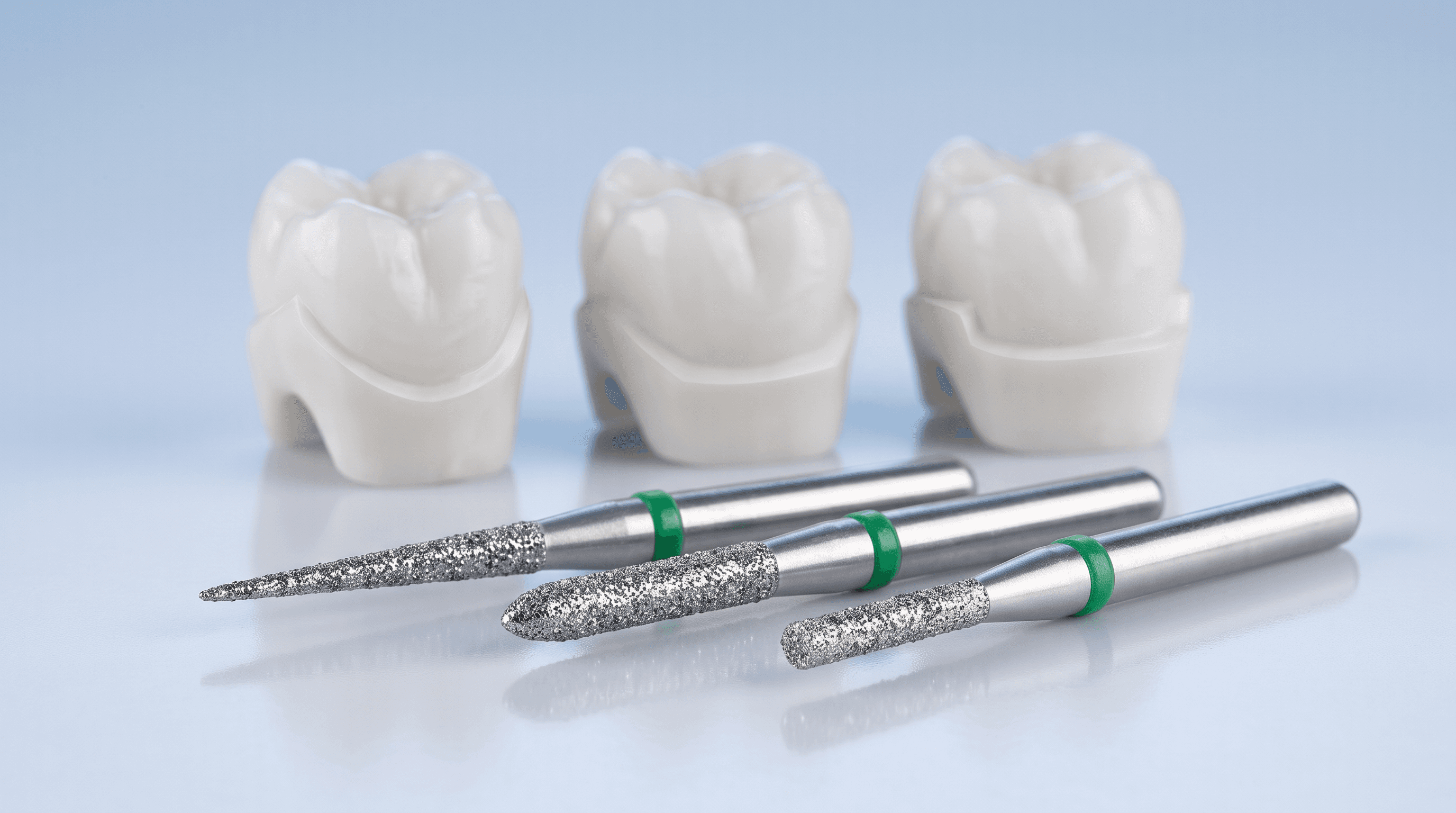
Tangential preparation, chamfer or shoulder: which preparation margin suits each material, and which of 187 diamond burs in 8 shapes produce it.
Produkt
Ceramic polishers for zirconia and lithium disilicate
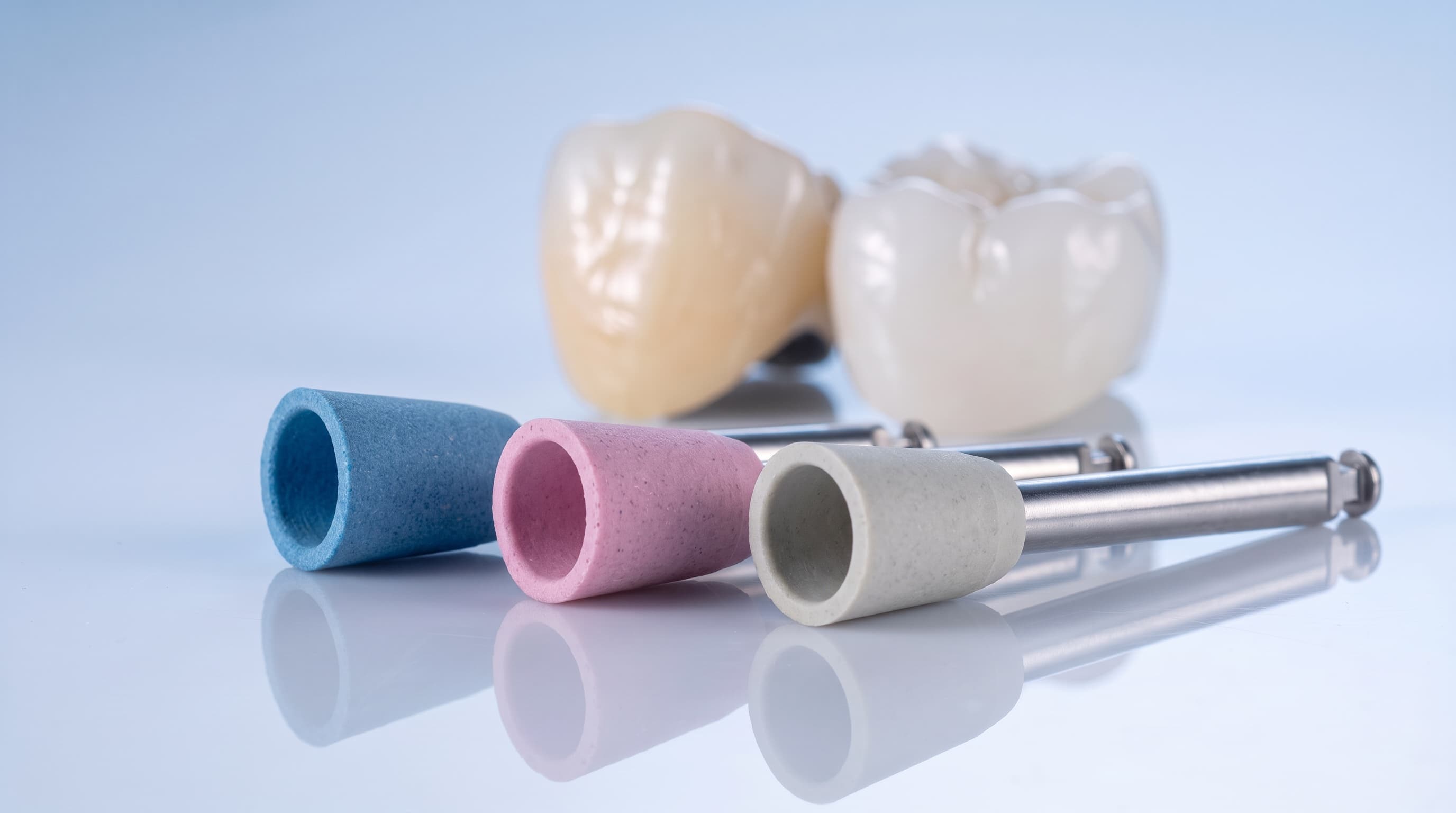
Ceramic polishers for practice and laboratory: cerdia polishes zirconia, lithium disilicate and feldspathic ceramic in 3 stages without paste, up to 12,000 min⁻¹. Shapes, speed.
Zahntechnik
Zirconia in the Laboratory: Pre-Sintered, Sintered and Polishing
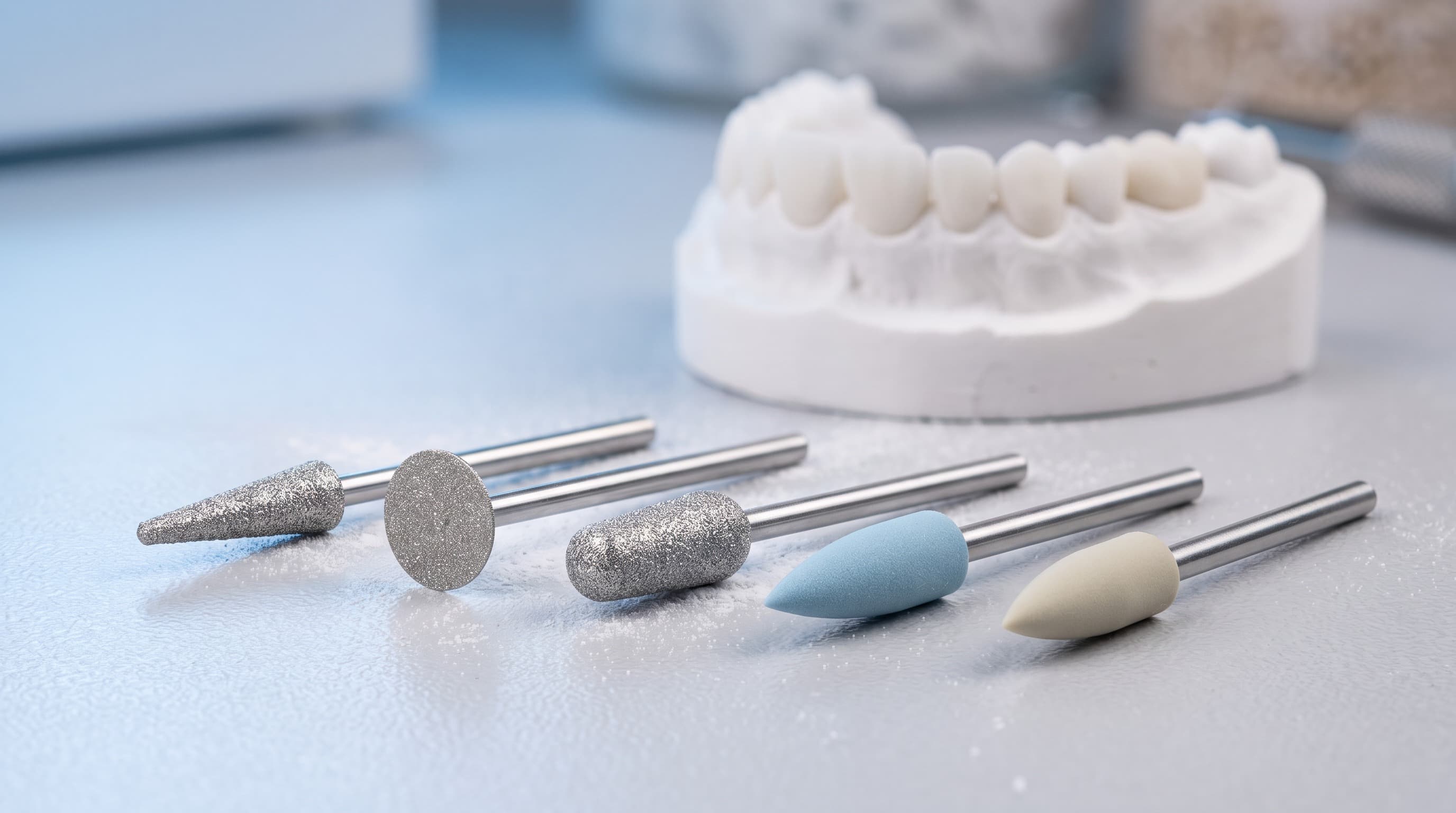
Zirconia in the laboratory: shape the white body dry, correct the sintered framework with 96 sintered diamond grinders, veneering with ceramic grinders, polishing in three stages.