Produkt17 September 20268 min readby rotatec
Round burs: sizes, shank and excavation
Carbide round burs from 0.5 to 5.0 mm with RA, FG and HP shanks. An overview of sizes, maximum speeds and blade patterns for caries excavation.

Wird geladen …
2'413 items in stock, ready to ship in 48 hours.
Carbide round burs from 0.5 to 5.0 mm with RA, FG and HP shanks. An overview of sizes, maximum speeds and blade patterns for caries excavation.
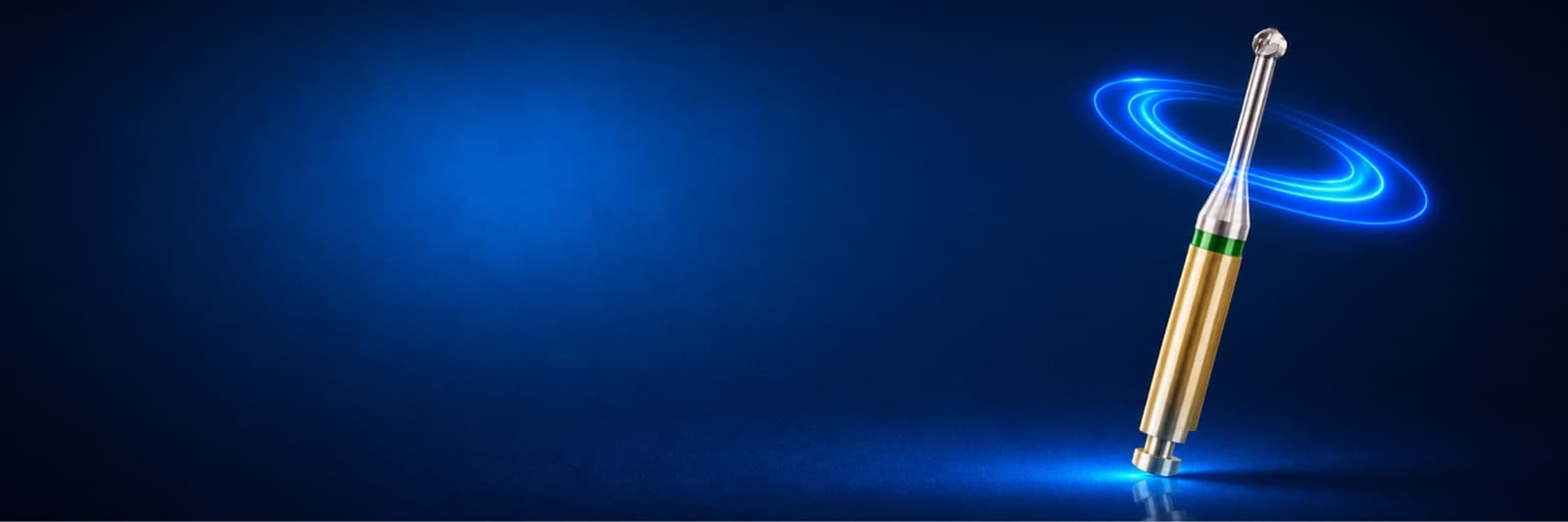
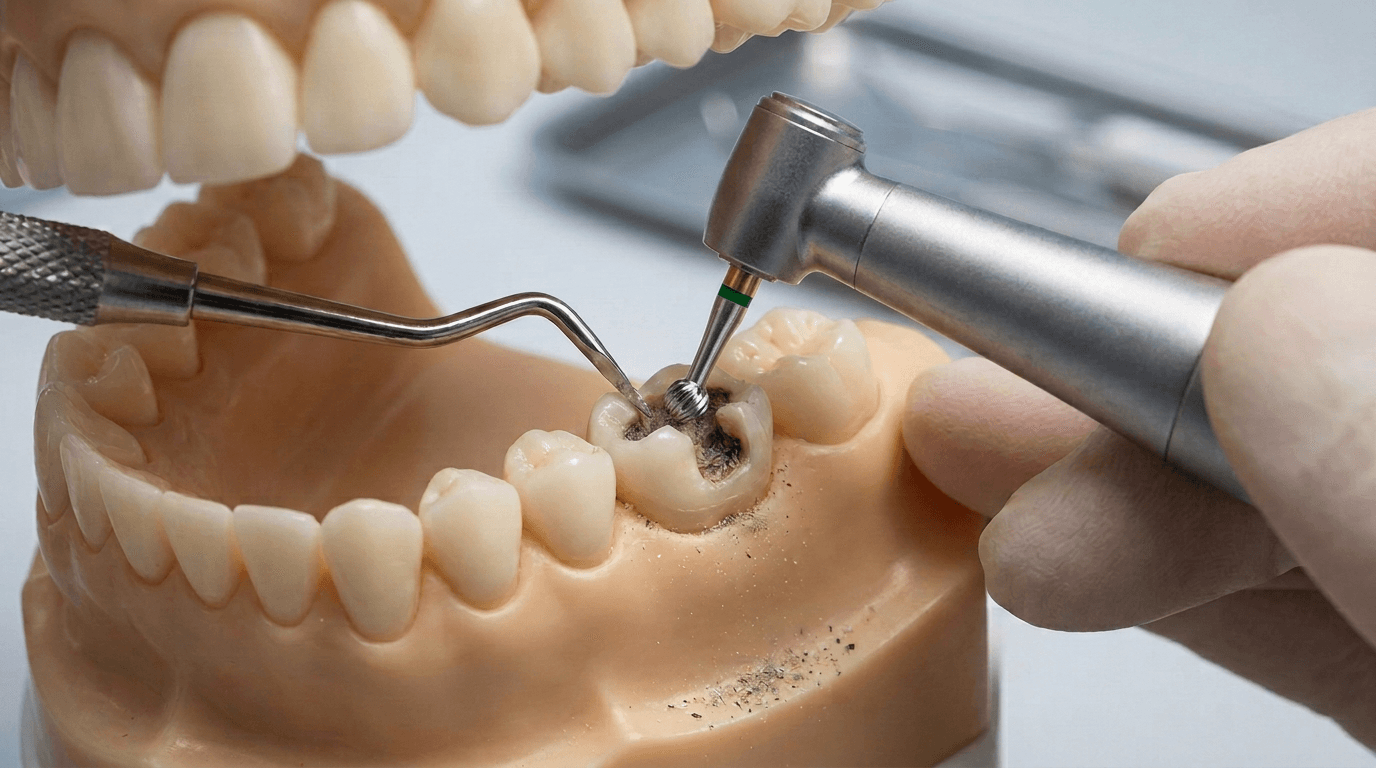
A round bur is a rotary instrument with a ball-shaped working part (ISO shape 001) used for the controlled removal of carious dentine. The ball size depends on the extent of the lesion, the shank on the drive: RA for the contra-angle, FG for the turbine and red contra-angle, HP for the straight handpiece. rotatec stocks round burs exclusively in tungsten carbide, from 0.5 to 5.0 mm in diameter, Swiss Made to ISO 13485 in Appenzell.
The round bur is used primarily for excavation, that is, clearing out softened, carious dentine. With several blades, the ball removes material evenly in every direction without enlarging the cavity unnecessarily. The name rose-head bur comes from its shape: the head with its blades resembles a rose blossom. It is also known as a round bur or excavator.
In addition to caries excavation, the round bur opens cavities, exposes canal orifices and removes bone in surgery. There is a dedicated version with a suitable shank and diameter for each of these tasks. You will find the excavators for restorative therapy grouped under excavators.
The size of a round bur appears as a three-digit number in the article number and gives the head diameter in tenths of a millimetre: 010 means 1.0 mm, 023 means 2.3 mm. The choice depends on the lesion, not on the type of tooth. Changing from larger to smaller balls helps you work towards sound dentine in a controlled manner.
The table assigns the ISO sizes to their typical use.
| ISO size | Diameter | Use | Example |
|---|---|---|---|
| 005 to 008 | 0.5 to 0.8 mm | canal orifices, finest areas | H1.204.006x006 |
| 009 to 012 | 0.9 to 1.2 mm | close to the pulp, difficult access | SH1L.204.010x006 |
| 014 to 018 | 1.4 to 1.8 mm | standard excavation of medium-sized lesions | SH1.204.014x006 |
| 021 to 029 | 2.1 to 2.9 mm | extensive removal in widespread caries | SH1.204.023x006 |
| 031 to 050 | 3.1 to 5.0 mm | bone removal in surgery | H141.104.031x003 |
How size, shape and shank are encoded is explained in the article ISO 6360: reading grit, shank and size.
The shank determines which drive the round bur runs in, and for excavation the RA shank in the contra-angle is the standard choice. RA and HP have a diameter of 2.35 mm, FG has 1.6 mm. The length determines the reach in the posterior region.
The table shows the shanks in which rotatec stocks round burs.
| Shank (ISO) | Overall length | Drive | Round burs at rotatec |
|---|---|---|---|
| RA (204) | 22 mm | contra-angle | SH1, SH1E, SH1L, H1 |
| RAL (205) | 26 mm | contra-angle, deep cavities | SH1, SH1L, H141 |
| FG (314) | 19 mm | turbine, red contra-angle | H1, 0.5 to 2.3 mm |
| HP (104) | 44 mm | straight handpiece, surgery | H141, H141A, 1.0 to 5.0 mm |
For surgery, the lengths HPL (65 mm), RAXL (34 mm) and FGXL (25 mm) are also available. You will find the FG round burs H1 under the round shape in carbide burs.
The 44 rotatec excavators are divided into three versions and two shank lengths, all made of tungsten carbide and in packs of 6. SH1 has straight blades and is the standard choice. SH1E is cross-cut: the interrupted blades produce smaller chips. SH1L is the extended version 001L for proximal areas and areas that are difficult to access.
The table shows version, shank, diameter range and number of items.
| Version | Shank | Diameter | Items |
|---|---|---|---|
| SH1, straight blades | RA / RAL | 0.9 to 2.9 mm | 11 / 5 |
| SH1E, cross-cut | RA | 1.0 to 2.9 mm | 10 |
| SH1L, 001L extended | RA / RAL | 0.6 to 2.9 mm | 11 / 7 |
All variants can be grouped by diameter, shank and shape in the excavators group.
Excavation is carried out at low speed: the rotatec instructions for use specify up to 2,000 min⁻¹ for excavation in dentine. The maximum speed on the label, by contrast, is a limit, not a recommendation. It decreases with diameter, because a larger head has a higher peripheral speed at the same speed.
The table shows the permitted maximum speeds according to the product data.
| Instrument | Shank | Diameter | Maximum speed |
|---|---|---|---|
| H1, SH1, SH1E, SH1L | RA / RAL | 0.5 to 2.9 mm | 100,000 min⁻¹ |
| H1 | FG | 0.5 to 1.8 mm | 450,000 min⁻¹ |
| H1 | FG | 2.1 to 2.3 mm | 300,000 min⁻¹ |
| H141 | HP | 1.0 to 3.5 mm | 100,000 min⁻¹ |
| H141 | HP | 4.0 / 5.0 mm | 80,000 / 60,000 min⁻¹ |
Low speed preserves tactile feedback, and that is exactly how you recognise the transition from soft, carious to hard, sound dentine. Work with light pressure. Why diameter and speed are linked is explained in the article Speed: diamond burs, carbide, contra-angle.
Tungsten carbide is the material of choice for excavation because the blade stays sharp over many reprocessing cycles. Round burs are also available on the market in steel, usually cheaper to buy. We deliberately do not stock them: what cuts at first only scrapes after a few cavities, and a blunt instrument does not conserve tooth structure.
The table compares the two materials on the features that count at the chair.
| Feature | Tungsten carbide | Steel |
|---|---|---|
| Blade | lasts over many cycles | blunts quickly |
| Pressure and heat | light pressure, little heat | blunt: more pressure, more heat |
| Tissue removal | controlled | more sound tissue |
| Cost per cavity | predictable | price advantage quickly used up |
Diamond-coated balls are not suitable for excavation. They grind instead of cutting and give hardly any feedback on dentine hardness.
Rotary instruments let you work faster and more evenly; by hand you retain the finest control. The round bur handles most of the excavation, especially with firm, leathery caries and on the cavity walls. The spoon-shaped hand excavator comes into play where soft dentine lies close to the pulp and any vibration is too much.
For deep lesions, selective caries removal is the standard: close to the pulp, firmer, leathery dentine may remain to avoid exposing the pulp. A small ball of 1.0 to 1.2 mm and a very low speed pay off here. In endodontics, long, small round burs expose calcified canal orifices; more on this in the article Endodontics: access cavity and canal preparation.
Round burs are reusable instruments that are cleaned, disinfected and sterilised after every use. If cutting performance is still lacking after reprocessing, the blades are rounded and the instrument is replaced. The procedure is described in the article Reprocessing instruments: hygiene and service life.
All excavators are in stock and ready to ship within 48 hours, directly from our own production in Appenzell. Register as a professional customer and find the right size directly among the excavators in the shop.
A round bur is a bur with a ball-shaped head, shape 001 according to ISO. It usually runs in the contra-angle and clears out carious dentine. Other names are rose-head bur and excavator.
Basically two groups: carbide burs with defined blades and diamond instruments with bonded diamond grit. Tungsten carbide is used for caries, dentine and old fillings, diamond for enamel and ceramics. In addition, there are finishing burs for smoothing and polishers for shine.
Excavation means removing softened, carious dentine from a cavity. This is done with a rotary round bur or by hand with the spoon-shaped excavator. The aim is to remove infected tissue and preserve sound hard tooth tissue.
FG stands for friction grip, a smooth shank with a diameter of 1.6 mm that is clamped in the turbine and the red contra-angle. The standard length (ISO 314) measures 19 mm. Round burs with FG shank are suitable for opening and for fine work at high speed.
By the working part with visible blades instead of diamond grit, and by the ISO number, which starts with 500 for tungsten carbide. At rotatec, carbide burs and finishing burs start with H, excavators with SH. This information is also on the label of every pack.
First a larger ball for extensive removal, then 1.0 to 1.2 mm close to the pulp. The extended version 001L reaches deep and proximal areas more easily. The speed remains low throughout.
001 is the ISO shape number of the ball; the L identifies the extended version. rotatec stocks it as SH1L in 18 variants, 11 with RA and 7 with RAL shank. All are supplied in packs of 6.
Produkt
Cross-cut: choosing the right carbide cutter
Cross-cut carbide cutters: 13 laboratory blade patterns from E to XMV with colour, material and speed, plus the A blade pattern used in surgery.
Produkt
Diamond burs for zirconia: grit and cooling
Diamond burs for zirconia on the tooth: rhodia with increased diamond concentration, 19 shapes, 3 grits, maximum speed per Ø and rules against microcracks.
Produkt
Lindemann bur: use, shanks, blade pattern
Carbide Lindemann bur: use in oral surgery, H161, H162 and H162A with 1.6 mm, HP, RA and FG shanks with overall length and maximum speed for each.