Produkt17 August 20268 min readby rotatec
Lindemann bur: use, shanks, blade pattern
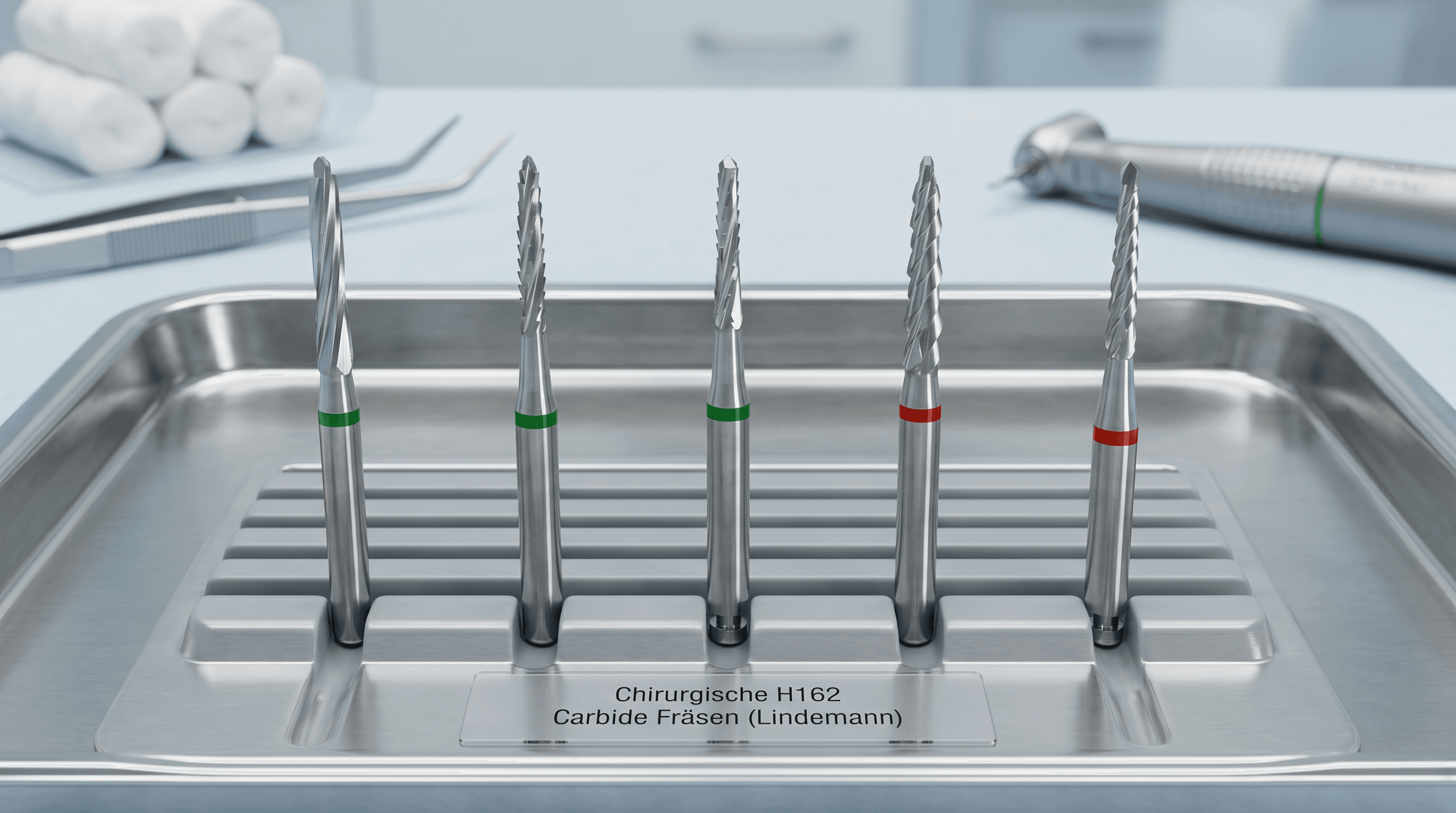
Carbide Lindemann bur: use in oral surgery, H161, H162 and H162A with 1.6 mm, HP, RA and FG shanks with overall length and maximum speed for each.

Wird geladen …
2'413 items in stock, ready to ship in 48 hours.
Carbide Lindemann bur: use in oral surgery, H161, H162 and H162A with 1.6 mm, HP, RA and FG shanks with overall length and maximum speed for each.
A Lindemann bur is a surgical bur made of tungsten carbide with a slender, elongated working part that cuts at the tip and on the side. It separates bone and tooth structure along a line, for example in osteotomy, root separation and apicoectomy. rotatec manufactures it as H162 and H162A with a diameter of 1.6 mm in 9 variants, Swiss Made to ISO 13485.
The Lindemann bur is a side-cutting instrument: its blade pattern runs over the entire working part, not just the tip. This lets you guide the cut through the bone like a saw. The large chip space carries the moist bone chips out of the kerf, so the bur does not clog and cuts with little pressure. In the rotatec range, 13 items have ISO shape 408: figures H161, H162, H162A and H163A.
The table shows the difference from the round bur, which works at a single point:
| Feature | Lindemann bur H162 | Surgical round bur H141 |
|---|---|---|
| ISO shape | 408, side-cutting | 001, round |
| Cutting surface | tip and side | ball |
| Guidance | as a line through the bone | at a single point |
| Typical task | cutting, separating, smoothing | opening, clearing out |
| Diameter | 1.6 mm | 1.0 to 5.0 mm |
The round bur opens, the Lindemann bur cuts the line. You can read more about the round head in the article Round burs and excavators.
The Lindemann bur is the standard instrument in oral surgery for anything that has to be separated along a line. In addition to osteotomy, specialist authors also cite the preparation of bone blocks and bone lids over impacted teeth.
The table assigns the task of the bur to each indication:
| Indication | Task of the bur |
|---|---|
| Osteotomy | remove and cut through bone in a controlled manner |
| Root separation | separate multi-rooted teeth before extraction |
| Impacted and displaced teeth | create access, prepare a bone lid |
| Apicoectomy | expose and resect the root apex |
| Osteoplasty, alveolar ridge smoothing | contour sharp bone edges |
| Implant surgery, ridge splitting | prepare the bone |
In root separation, guide the bur along the furcation until the roots are completely separated. The roots can then be removed individually while conserving tissue. Fine, long burs keep the bone defect small because they remove root rather than the bone bed.
There is a suitable shank version for every surgical drive: straight handpiece (HP), contra-angle (RA, RAL) or extra-long FG. The shank determines drive, overall length and maximum speed.
The table shows shank diameter, overall length of the H162A and maximum speed for each shank:
| Shank (ISO code) | Shank Ø | Overall length H162A | Maximum speed |
|---|---|---|---|
| HP (104) | 2.35 mm | 44.5 mm | 100,000 min⁻¹ |
| RA (204) | 2.35 mm | 27.5 mm | 100,000 min⁻¹ |
| RAL (205) | 2.35 mm | 32.0 mm | 100,000 min⁻¹ |
| FGL (315) | 1.6 mm | 26.1 mm | 160,000 min⁻¹ |
| FGXL (316) | 1.6 mm | 30.0 mm | 160,000 min⁻¹ |
How to read the shank code and size in the article number is shown in the article ISO 6360, grit and shank. One example is the H162A with HP shank.
In the contra-angle, the chuck determines the shank: RA and RAL sit in the latch-type chuck, FGL and FGXL in the friction grip chuck for FG instruments. The RAL shank makes the H162A 4.5 mm longer than RA, which provides access in the posterior region and for impacted wisdom teeth. The FG variants are intended for surgical high-speed handpieces with push-button chucks. Before use, check whether the maximum speed of the instrument matches the gear ratio of your contra-angle. Longer shanks make access in depth easier, shorter ones allow steadier guidance.
The three figures have the same shape 408 and the same diameter of 1.6 mm; they differ only in their blade pattern. The cross-cut of the H162A additionally breaks the chip crosswise, so the instrument runs more smoothly and catches less. The saw-tooth blade pattern of the H162 removes material more aggressively.
The table shows the differences according to the rotatec product master data:
| Feature | H161 | H162 | H162A |
|---|---|---|---|
| Blade pattern (ISO code) | surgical medium (295) | saw (297) | cross (298) |
| Shanks | HP, FGXL | HP, RA, RAL, FGXL | HP, RA, RAL, FGL, FGXL |
| Variants | 2 | 4 | 5 |
| Pack size | 3 pieces | 3 pieces | 3 pieces |
For a finer cut, there is the H163A with cross-cut and a diameter of 1.4 mm. The basics of blade count and chip space are explained in Choosing the right carbide blade pattern.
The working speed is well below the maximum speed and follows the instructions for use of the instrument and the drive. The values of 100,000 min⁻¹ and 160,000 min⁻¹ are upper limits for the instrument, not a recommendation for bone. Temperature is decisive: bone tissue is damaged from about 47 °C over one minute. This results in four rules:
High pressure displaces the irrigation solution from the kerf and also generates frictional heat.
There is no fixed number of procedures; the instrument itself shows when it has reached its end. The H162 is reusable and is cleaned, disinfected and sterilised after every procedure. If the cutting performance declines or chipping, corrosion or a bent shank appears, replace the bur. The procedure is described in the article Reprocessing instruments. The rotatec instructions for use are binding.
In addition to the Lindemann bur, surgical round burs and larger-diameter burs are part of the basic equipment. The surgery group comprises 98 items, 93 of them made of tungsten carbide.
The table shows the instruments that complement the H162:
| Instrument | ISO shape | Diameter | Blade pattern (ISO code) |
|---|---|---|---|
| H163A | 408 | 1.4 mm | cross (298) |
| H166 | 409 | 2.1 mm | saw (297) |
| H166A | 409 | 2.1 mm | cross (298) |
| H254E | 415, cylinder | 1.2 mm | cross (298) |
| H141 | 001, round | 1.0 to 5.0 mm | straight (291) |
All instruments are Swiss Made to ISO 13485, in stock and ready to ship within 48 hours. Register as a professional customer and view the surgery range with your terms.
Place the bur with the drive running and cooling applied, and guide it with light pressure along the planned cutting line. The side blades do the work; your hand only sets the direction. Lifting off and irrigating in between keeps the kerf clear.
The blades run spirally over the entire working part. Each revolution removes a chip laterally and conveys it outwards through the chip space. This creates a narrow cut instead of a hollow.
Yes. H162 and H162A are available with RA and RAL shanks for the latch-type chuck and with FGXL shank, and the H162A also with FGL. The RA shanks measure 2.35 mm, the FG shanks 1.6 mm.
The blade pattern. The H161 has the medium surgical blade pattern with ISO code 295, the H162 a saw-tooth blade pattern with code 297. Shape and diameter are the same; the H161 is available with HP and FGXL shanks.
The speed depends on the instructions for use of the instrument and the surgical drive. Catalogue values of 100,000 or 160,000 min⁻¹ only mark the load limit. Cooling and low contact pressure are more important than the number.
By the increasing force required and slower removal. Check the blades for chipping with a magnifier after each reprocessing cycle. More pressure does not compensate for blunt blades, it only generates heat.
Side-cutting burs such as the Lindemann bur, round burs and cylindrical burs for smoothing. They differ in shape, diameter and blade pattern. The choice depends on whether you want to cut, open or smooth.
Produkt
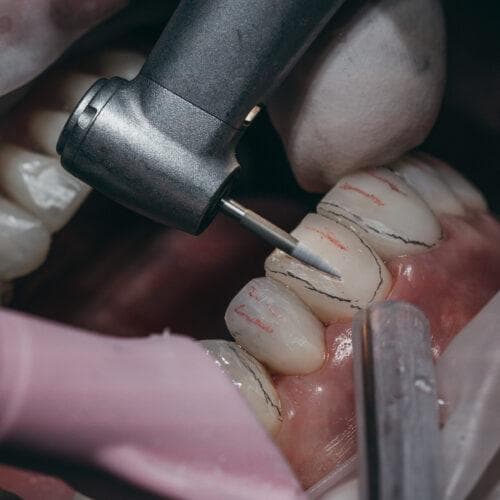
Cross-cut: choosing the right carbide cutter
Cross-cut carbide cutters: 13 laboratory blade patterns from E to XMV with colour, material and speed, plus the A blade pattern used in surgery.
Produkt
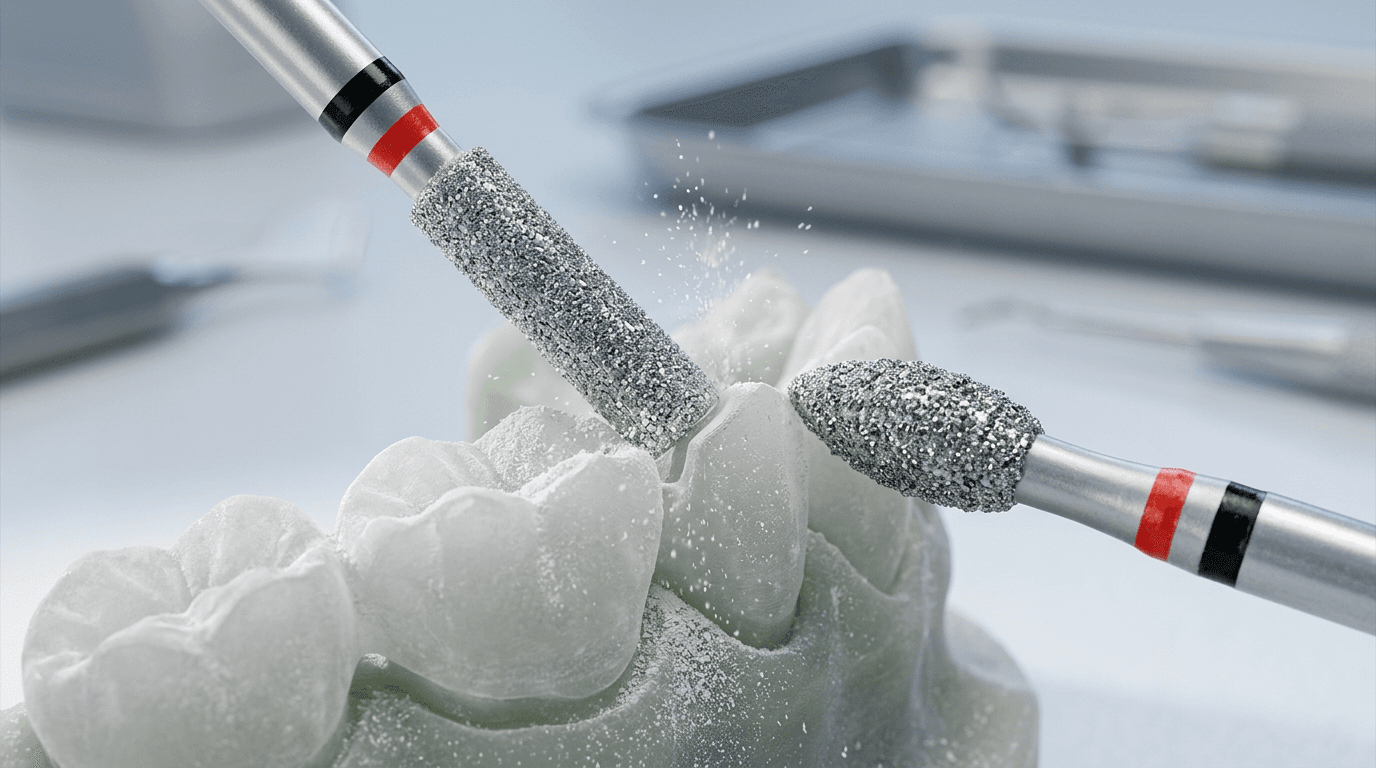
Diamond burs for zirconia: grit and cooling
Diamond burs for zirconia on the tooth: rhodia with increased diamond concentration, 19 shapes, 3 grits, maximum speed per Ø and rules against microcracks.
Produkt
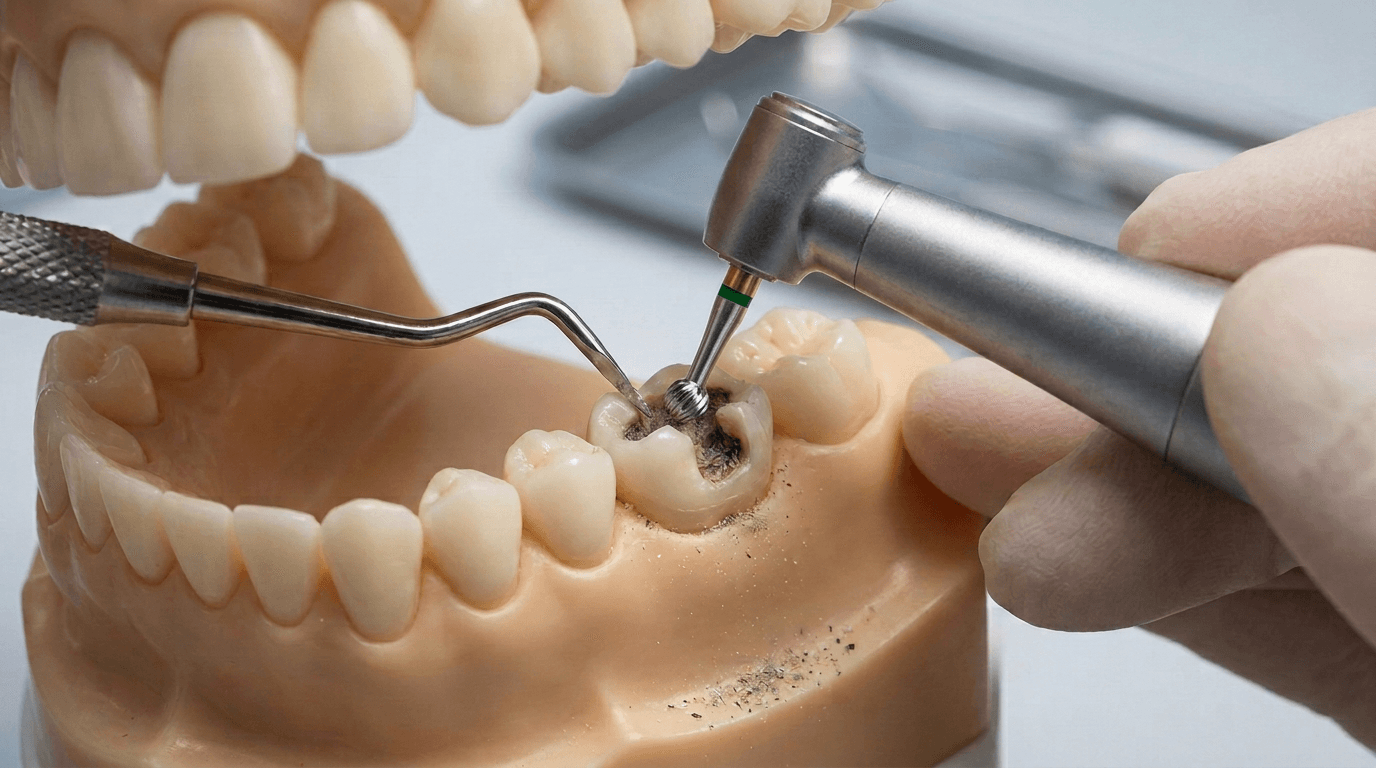
Round burs: sizes, shank and excavation
Carbide round burs from 0.5 to 5.0 mm with RA, FG and HP shanks. An overview of sizes, maximum speeds and blade patterns for caries excavation.