Choosing the shank length: short, standard, long and extra long
FG 313 to 316 and RA 204 to 206: overall lengths according to ISO 6360-1, clamping length according to ISO 1797 and when a short or long shank is the better choice.

Wird geladen …
2'413 items in stock, ready to ship in 48 hours.
FG 313 to 316 and RA 204 to 206: overall lengths according to ISO 6360-1, clamping length according to ISO 1797 and when a short or long shank is the better choice.

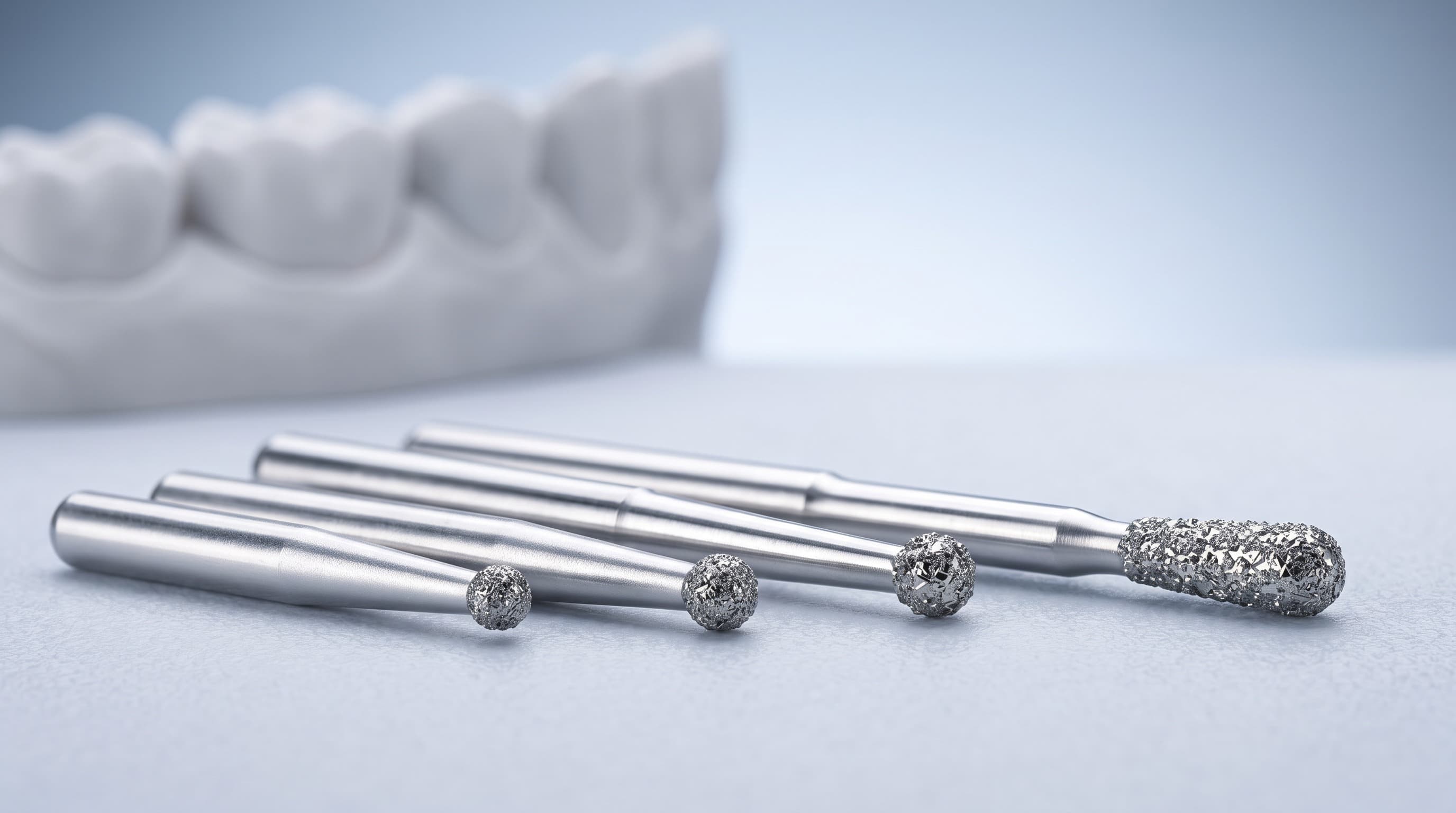
The shank length of a rotary instrument is given by the last digit of the shank code: for FG, 313 is short, 314 standard, 315 long and 316 extra long; for RA, 204 is standard, 205 long and 206 extra long. Short shanks combined with the contra-angle head give a lower overall height, while long shanks extend the working part further. In the Clinical Diamond Burs group, 816 articles have the standard FG shank, 72 the short, 56 the long and 14 the extra long.
The third digit of the shank code is the length class according to ISO 6360-1: 3 stands for short, 4 for normal, 5 for long and 6 for extra long. The first two digits indicate the shank type, 31 for FG and 20 for RA.
The table shows the length classes with the overall lengths from ISO 6360-1 and the number of articles in the visible shop groups.
| Code | Shank | Overall length ISO 6360-1 | Articles in range |
|---|---|---|---|
| 313 | FG short | 16.5 mm | 72 diamonds |
| 314 | FG standard | 19 mm | 816 diamonds, 98 zirconia diamonds, 62 carbide |
| 315 | FG long | 21 mm | 56 diamonds, 10 zirconia diamonds |
| 316 | FG extra long | 25 mm | 14 diamonds, 22 zirconia diamonds, 6 carbide |
| 204 | RA standard | 22 mm | 59 diamonds, 44 carbide, 32 excavators |
| 205 | RA long | 26 mm | 8 diamonds, 12 excavators, 22 surgery |
| 206 | RA extra long | 34 mm | 8 surgery |
The standard gives these lengths as guide values for classification; the exact length is governed by the product standard. The article data confirm these values; only the short FG shank is listed there at 16 mm. HP shanks for the straight handpiece follow the same logic: 104 at 44.5 mm, 105 at 65 mm.
The minimum clamping length is specified in ISO 1797, and it increases only slightly with shank length: for FG and RA it is 9 mm for miniature and short shanks, 11 mm for standard and long, and 12 mm for extra long shanks. A long shank therefore sits barely deeper in the head; it protrudes further.
The table shows the minimum clamping lengths according to ISO 1797.
| Shank | Diameter | Miniature, short | Standard, long | Extra long |
|---|---|---|---|---|
| FG (Type 3) | 1.6 mm | 9 mm | 11 mm | 12 mm |
| RA (Type 1) | 2.35 mm | 9 mm | 11 mm | 12 mm |
| HP (Type 2) | 2.35 mm | 15 mm | 30 mm | 30 mm |
This leads to the most important rule for long shanks: the lever arm between chuck and working part becomes greater. Lateral pressure and tilting have a stronger effect on the shank and bearings. One contra-angle manufacturer therefore requires that, when longer instruments are used, operating conditions be chosen so that no one is put at risk, and limits the permissible instrument length, for FG for example to 25 mm. The rotatec Bur Application and Reprocessing Recommendation requires the instrument to be clamped fully and leverage to be avoided, as it can lead to fractures.
A short FG shank is useful when space is limited. The instrument protrudes less from the head, and contra-angle and instrument together have a lower overall height. Manufacturers therefore state the head height with a 19 mm instrument inserted. The rotatec instructions for use recommend a mini handpiece for paediatric diamonds, designed for burs with a short shank and normal burs up to 20 mm in length. Some contra-angles with a miniature head are approved only for short shanks, such as a red 1:4.5 model that the manufacturer's catalogue describes as offering better visibility and access (see sources).
The range offers the short shank in two lines: 60 swissdia FGs articles and 12 microdia articles with heads from 0.7 mm. The shapes range from the round 801 through the pear 830 and the round-end taper 856 to the torpedo 878, mostly in coarse, medium and fine grit. The maximum speeds are the same as for the standard shank: 450,000 min⁻¹ up to 1.8 mm, 300,000 min⁻¹ at 2.1 and 2.3 mm. One example is the round 801 with 1.4 mm and short shank.
You need a long shank when the working part has to reach further than the standard shank allows. The article data list crown and cavity preparation, veneers, trepanation and surgery for this.
The table shows which shapes are available in the range with long and extra long FG shanks.
| Shank | Shape (rotatec) | Diameter | Application according to article data |
|---|---|---|---|
| 315 long | Pear 830L | 1.0 to 2.5 mm | Cavity and inlay preparation |
| 315 long | Torpedo 879L, pointed cylinder 882L, pointed taper 859L | 1.0 to 1.6 mm | Crown preparation, veneers |
| 315 long | 972 with safety tip | 1.4 and 2.1 mm | Cavity preparation |
| 316 extra long | Round 801L | 1.4 to 1.8 mm | Crown and cavity preparation, veneers |
| 316 extra long | 6389 and bone cutter 6161 | 1.4 to 2.0 mm | Trepanation, surgery |
| 316 extra long | Carbide H31 and H33L | 1.0 to 1.6 mm | Cavity preparation, filling removal |
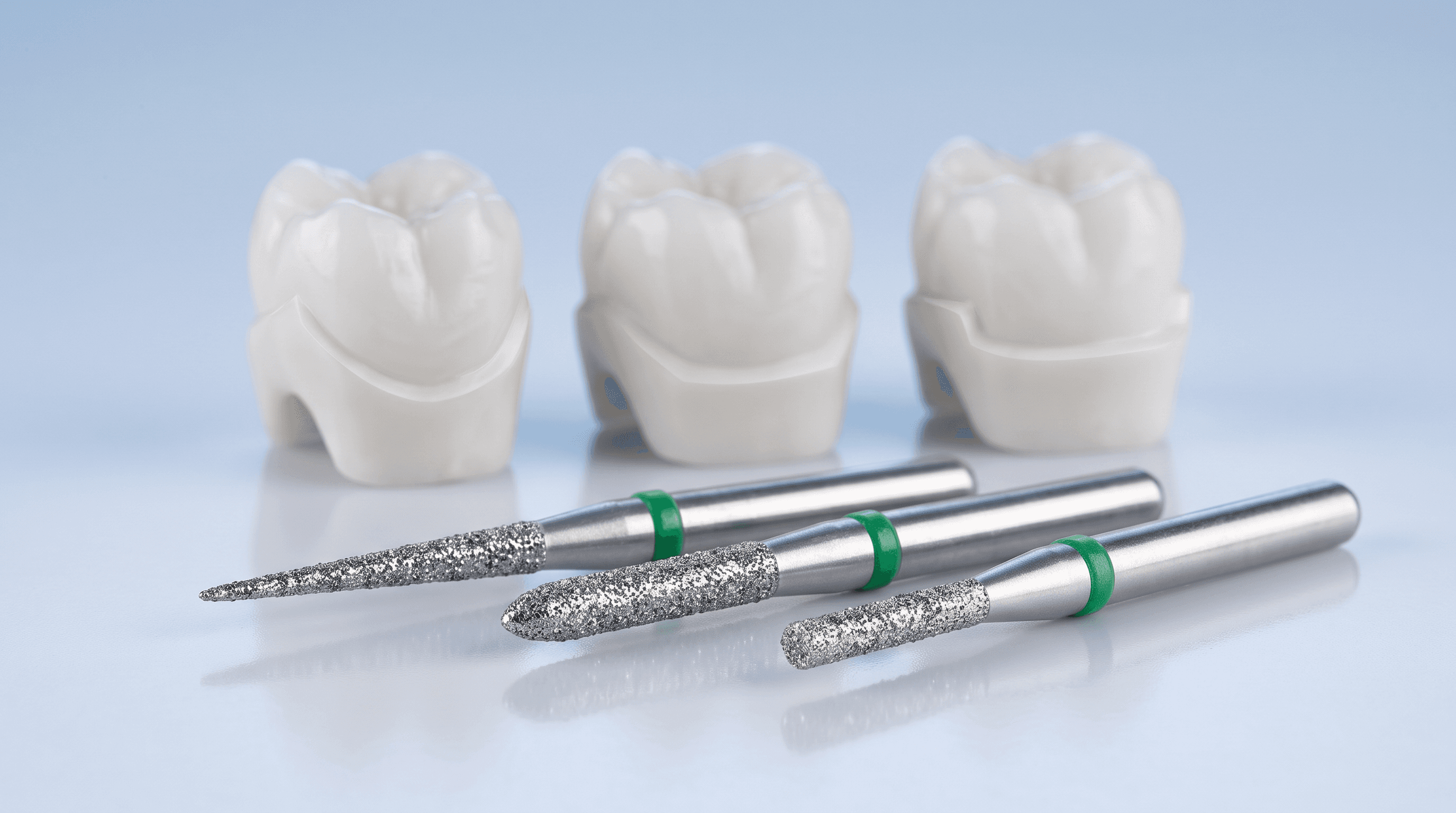
For zirconia, the Diamond Burs for Zirconia group lists 22 articles with extra long and 10 with long shanks. According to the article data, the maximum speed is the same for long and short shanks; the round 801L with extra long shank is approved up to 450,000 min⁻¹, like the standard round bur. Long shanks nevertheless require light pressure and guidance without tilting. Because the working part is further from the head, also check that the spray reaches it: according to Siegel and von Fraunhofer, the number and position of the spray outlets determine how much water reaches the cutting site.
For RA instruments, the long 205 shank mainly provides reach, according to the article data in excavation, periodontology and surgery. In the range, these are 12 rose head burs of the SH1 and SH1L series in the Excavators group, 8 diamonds of the perdia line for periodontology and 22 instruments in the Surgery group, including the Lindemann bur H162. The extra long 206 RA shank at 34 mm is available on 8 surgical round burs H141. For the straight handpiece, the long 105 HP shank at 65 mm is available on 7 surgical articles.
Which size is suitable for excavation is shown in Rose head burs: sizes, shank and excavation. Shapes, shanks and heat with surgical instruments are described in Bone cutters in oral surgery.
Choose the shortest length with which the working part reaches its target: it keeps the lever arm between chuck and working part as small as possible.
How the code is structured as a whole is explained in ISO 6360: reading grit, shank and size.
Register as a professional customer and filter the Clinical Diamond Burs by shank length.
The codes refer to the 1.6 mm FG shank in four lengths: 313 short, 314 standard, 315 long, 316 extra long. ISO 6360-1 specifies overall lengths of 16.5, 19, 21 and 25 mm for these. The last digit indicates the length class.
An FG instrument with a standard 314 shank is 19 mm long. Short shanks measure 16 to 16.5 mm, long shanks 21 mm and extra long shanks 25 mm. The figure applies to the entire instrument, including the working part.
When space is limited and for children: the rotatec instructions for use recommend a mini handpiece for short shanks for paediatric diamonds. Some contra-angles with a miniature head are approved for short shanks only. rotatec offers 72 FG diamonds with a short shank.
According to the product data, no: the round 801L with an extra long shank is approved up to 450,000 min⁻¹, like the standard round. The label of the individual instrument remains authoritative. Because of the greater leverage, however, the rule is: light pressure, no tilting.
ISO 1797 requires a minimum clamping length for FG and RA of 9 mm for short shanks, 11 mm for standard and long shanks and 12 mm for extra long shanks. Always insert the instrument fully up to the stop and check that it is firmly seated.
All three are 2.35 mm contra-angle shanks with a groove and flat. 204 is the standard at 22 mm, 205 the long at 26 mm and 206 the extra long at 34 mm. The range offers long RA shanks for rose head burs for excavation and in surgery.
The rotatec instructions for use recommend a mini handpiece designed for burs with a short shank for paediatric diamonds. In the range, these are the swissdia FGs and microdia lines with shank code 313. The smallest heads start at 0.7 mm.

Wissen
Speed: Diamond Burs, Carbide Burs, Contra-Angles
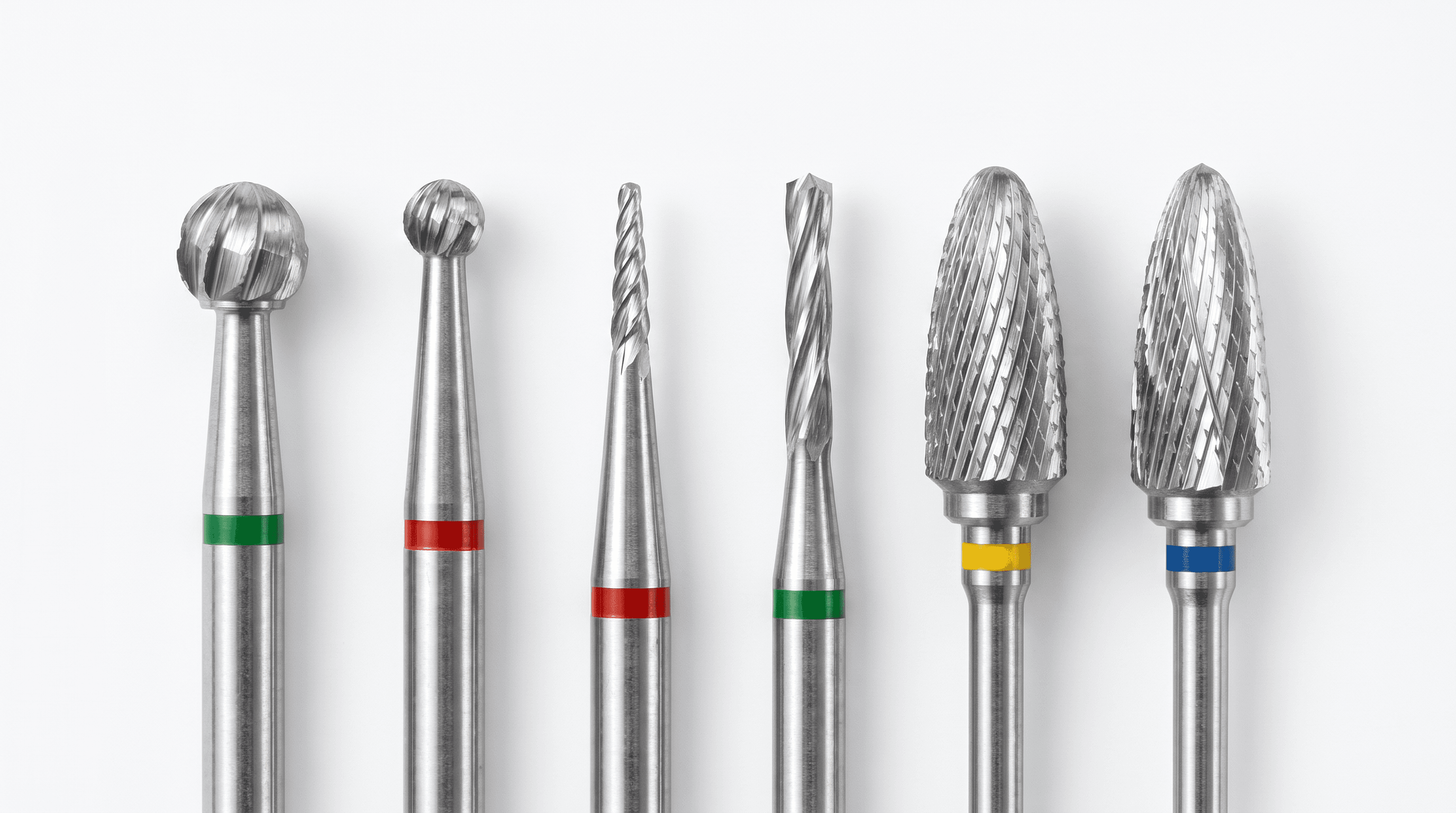
Speed for diamond and carbide burs: red, blue and green contra-angle, plus the maximum speed per head diameter from 450,000 down to 95,000 min⁻¹.

Anwendung
Tangential preparation, chamfer or shoulder?
Tangential preparation, chamfer or shoulder: which preparation margin suits each material, and which of 187 diamond burs in 8 shapes produce it.

Produkt
Ceramic polishers for zirconia and lithium disilicate
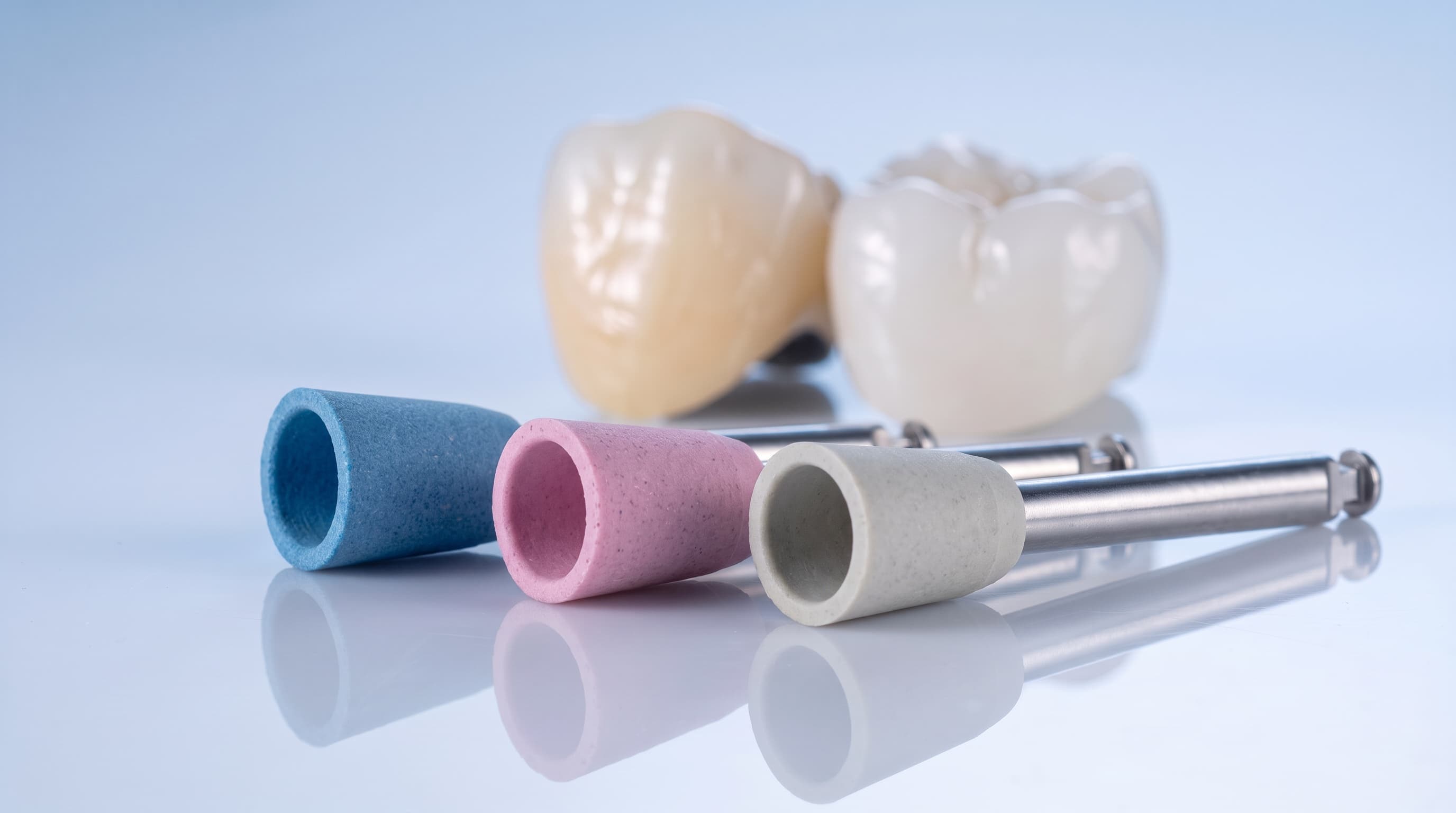
Ceramic polishers for practice and laboratory: cerdia polishes zirconia, lithium disilicate and feldspathic ceramic in 3 stages without paste, up to 12,000 min⁻¹. Shapes, speed.