Anwendung26 November 20269 min readby rotatec
Black's classes: cavity preparation by class
Black's Classes I to VI: the location of each cavity class and the right instruments, from diamonds and fissure burs to finishing burs.

Wird geladen …
2'413 items in stock, ready to ship in 48 hours.
Black's Classes I to VI: the location of each cavity class and the right instruments, from diamonds and fissure burs to finishing burs.
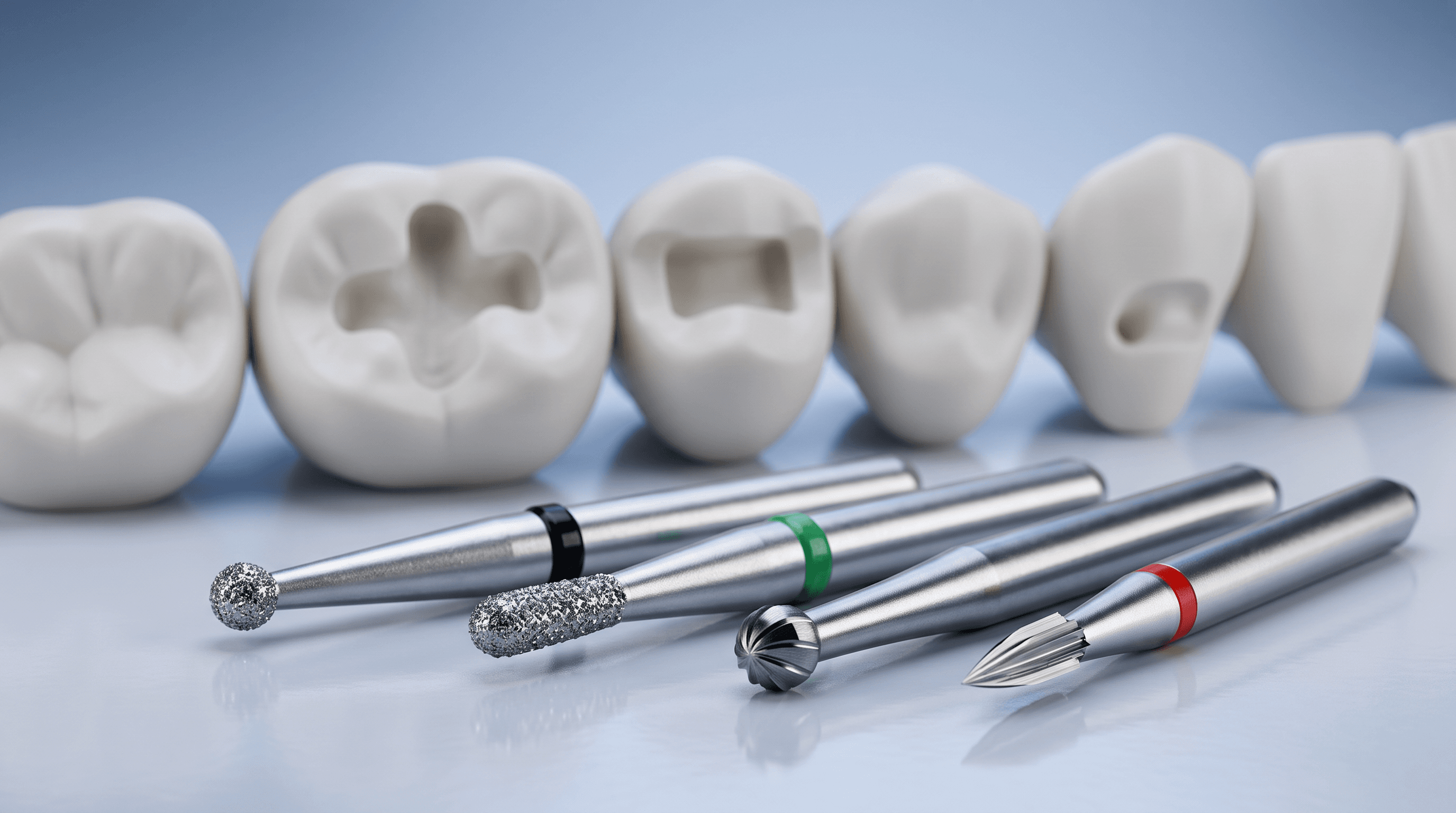
Black's classes divide cavities into five classes according to their location on the tooth, supplemented by a sixth class introduced later. The classification goes back to the dentist G. V. Black and remains the common language for diagnosis, preparation and documentation today. This article assigns the appropriate instruments from the rotatec catalogue to each class, from the diamond for opening to the finisher for the margin.
According to Black, there are five cavity classes, which are based solely on location, not on the size or depth of the lesion. Class VI for cusp tips and incisal edges was added later, attributed to a textbook by Simon from 1956, and does not originate from Black himself.
The table shows the location and affected teeth for each class.
| Class | Location | Teeth |
|---|---|---|
| I | Pits and fissures, foramina caeca | Occlusal surfaces of premolars and molars, buccal and oral pits, palatal on upper incisors |
| II | Proximal surfaces | Premolars and molars |
| III | Proximal surfaces without incisal edge | Incisors and canines |
| IV | Proximal surfaces with incisal edge | Incisors |
| V | Cervical third, vestibular or oral | All teeth |
| VI | Cusp tips and incisal edges | All teeth (addition) |
Each Black class requires a different instrument shape, because access, wall configuration and margin position differ. In enamel, work is carried out at high speed with water cooling, in dentine at low speed, and finally the enamel margins are smoothed. In the range, opening is performed by a diamond, shaping in dentine by a carbide bur and smoothing the margin by a finisher.
The table assigns a possible sequence from the range to each class.
| Class | Opening (diamond) | Shaping (carbide) | Finishing the margin |
|---|---|---|---|
| I | Round 801, pear 830 | Pear H7, fissure bur H23R | Bud H46, egg H379 |
| II | Needle 859, flame 862 | Cylinder 835, fissure bur H23R | Flame H246, H48L, H59 |
| III | Round 801 from oral | Round H1, pear H7 | Flame H246, needle H134 |
| IV | Round 801, flame 862 | Round H1 | Torpedo H282, egg H379 palatal |
| V | Round 801 | Rose head bur H1 RA | Flame H48L, torpedo H283 |
| VI | Round 801 small | Pear H7 | Egg H379 |
The size depends on the lesion, not on the class. The round 801 is available from 0.8 to 3.5 mm, the pear H7 from 0.6 to 1.2 mm. You will find all shapes among the clinical diamond burs, the carbide burs and the finishers.
A Class I cavity is opened occlusally via the carious fissure and follows the course of the fissure only as far as the lesion extends. A small diamond round or pear, which reliably penetrates the enamel, is used for opening. In dentine, the carbide pear H7 takes over: its rounded shape produces rounded internal line angles; a specific box form is not required for adhesive restorations. For a box-shaped cavity with parallel walls, the fissure bur is used, just as Black used the fissure bur and the inverted cone for the box form.
A Class II cavity is located on the proximal surface of a premolar or molar and is usually accessed occlusally via the marginal ridge. The adjacent tooth is critical: follow-up studies found iatrogenic damage on around half of the adjacent surfaces of Class II preparations, so protecting the adjacent enamel takes priority. A slender needle 859 or flame 862 breaks the contact point, and the proximal box is created with a cylinder or taper. Slender finishers such as the flame H48L smooth the margin.
Classes III and IV are located proximally on anterior teeth and differ only in whether the incisal edge is involved. Class III is preferably opened from the oral side so that the vestibular enamel wall, and with it the aesthetics, is preserved; if the caries is located vestibularly or the teeth are unfavourably positioned, vestibular access is indicated. In Class IV, the incisal corner is missing; the restoration is built up with composite, and the enamel margin is bevelled, which improves adhesion and aesthetics.
Class V is located in the cervical third, often close to the gingiva and partly on root dentine. Work is carried out with small round burs and light pressure; according to the instructions for use, excessive pressure leads to undesirable heat generation. The caries is removed with the rose head bur in the contra-angle handpiece; sizes and speed are described in Rose head burs: sizes, shank and excavation. Class VI involves cusp tips and incisal edges, frequently following abrasion or attrition, and usually requires only small round and pear burs.
A fissure bur is a cylindrical or tapered carbide bur that shapes cavity walls straight and parallel and sections old restorations. Black counted the fissure bur, alongside the inverted cone, among the most useful bur shapes for preparation.
The table shows the fissure burs in the rotatec range, 90 articles in total.
| Code | Shape (ISO) | Cut | Diameter |
|---|---|---|---|
| H21, H21L, H21R | Cylinder 107, 110, 137 | Spiral 006 | 0.8 to 1.4 mm |
| H31, H31L, H31R | Cylinder 107, 110, 137 | Cross-cut 007 | 1.0 to 1.4 mm |
| H23, H23L, H23R | Taper 168, 171, 194 | Spiral 006 | 0.9 to 1.6 mm |
| H33, H33L, H33R | Taper 169, 171, 194 | Cross-cut 007 | 0.9 to 1.6 mm |
With the cross-cut, a second, transverse toothing interrupts the cutting edges. According to the article data, both spiral and cross-cut versions are equally indicated for cavity preparation and the removal of old amalgam and composite restorations. The suffix L stands for the long working part, R for the rounded end, which leaves no sharp internal line angles, for example with the H23R.314.012x006.
Today's preparation for adhesive restorations is lesion-oriented: healthy and remineralisable tissue is preserved, and caries is only removed to the extent necessary for a tight and durable restoration. Black, by contrast, extended the cavity into zones that remain clean during chewing, and called this principle extension for prevention. His cavity forms were designed for mechanically retained metal restorations.
The table shows the differences and their consequences for the instrument.
| Feature | Preparation according to Black | Adhesive preparation |
|---|---|---|
| Outline | Extension into self-cleansing zones | Only as far as the caries |
| Retention | Mechanical, undercut with inverted cone H2 | Adhesion to enamel and dentine |
| Internal line angles | Box-shaped, sharp | No predetermined form |
| Typical instruments | Cylinder, taper, inverted cone | Small round, pear, flame |
For the instrument, this means smaller heads and rounded shapes. Black's classes nevertheless remain valid, as they describe the location, not the preparation technique.
Every cavity preparation follows the same basic sequence, regardless of the class: opening, excavating, shaping, finishing. Black described seven steps for this: outline form, resistance form, retention form, convenience form, removal of remaining caries, finishing of the enamel margins and cleaning of the cavity.
The maximum speed of each instrument is given in the instructions for use and reprocessing for burs. The finishing of margins is covered in depth in the article "Finishers: finishing and smoothing restorations", and the material and shapes of carbide burs in the article "Carbide burs in the dental practice: shapes and applications".
Black distinguished five classes: I for pits and fissures, II for proximal surfaces of posterior teeth, III and IV for proximal surfaces of anterior teeth without and with involvement of the incisal edge, V for the cervical area. Class VI, for cusp tips and incisal edges, was added later.
A classification of defects according to their location on the tooth. It serves as a brief, unambiguous designation in the findings and the treatment plan. The class says nothing about depth, size or filling material.
A carbide bur with a cylindrical or tapered working part. It shapes straight cavity walls; according to the product data, the fissure burs are also indicated for removing old amalgam and composite fillings. At rotatec, the shapes are called H21, H31 (cylinder) and H23, H33 (taper).
Diamond instruments for the enamel, round burs and excavators for the caries, carbide burs for the dentine and finishing burs for the margin. The shape depends on the class, the size on the defect. In enamel, work is carried out at high speed with water cooling.
A defect on the mesial or distal surface of a premolar or molar. Because the adjacent tooth blocks access, it is usually prepared from the occlusal aspect through the marginal ridge. If only one surface is affected, it is referred to as a single-surface cavity, otherwise as a multi-surface cavity.
Yes, as a later addition to the original classification. It describes defects on cusp tips and incisal edges, for example following abrasion. Not every textbook includes it.
A cavity is a hollow space in the tooth. The term refers both to the defect caused by caries and to the prepared form that receives a filling. Black's classes describe where this hollow space is located.
Anwendung
Tangential preparation, chamfer or shoulder?
Tangential preparation, chamfer or shoulder: which preparation margin suits each material, and which of 187 diamond burs in 8 shapes produce it.
Anwendung
Crown preparation: procedure and instrument sequence
Crown preparation in 5 steps: which diamond shape and grit for each step, depth marking from 0.5 to 0.9 mm and maximum permissible speed of up to 450,000 min⁻¹.
Anwendung
Polishers and prophylaxis: why polishing works in stages
179 instruments for polishing and prophylaxis. Why a fine polisher achieves nothing on a coarse surface, and which polisher suits composite or ceramic.