Wird geladen …

EURLogin
Wird geladen …
2'414 items in stock, ready to ship in 48 hours.


3 materials · 202 items
Carbide burs made of tungsten carbide cut by chip removal rather than grinding. They suit preparation, the removal of old amalgam and composite fillings, and working composite, metal and acrylic in clinic and laboratory.
The defined blade geometry ensures low-vibration, precise work and leaves smooth cut surfaces. Available with FG, RA/WST and HP shanks.
Direct from the Swiss manufacturer in Appenzell. Swiss made to ISO 13485, CE-MDR, stock items ready to ship within 48 hours.

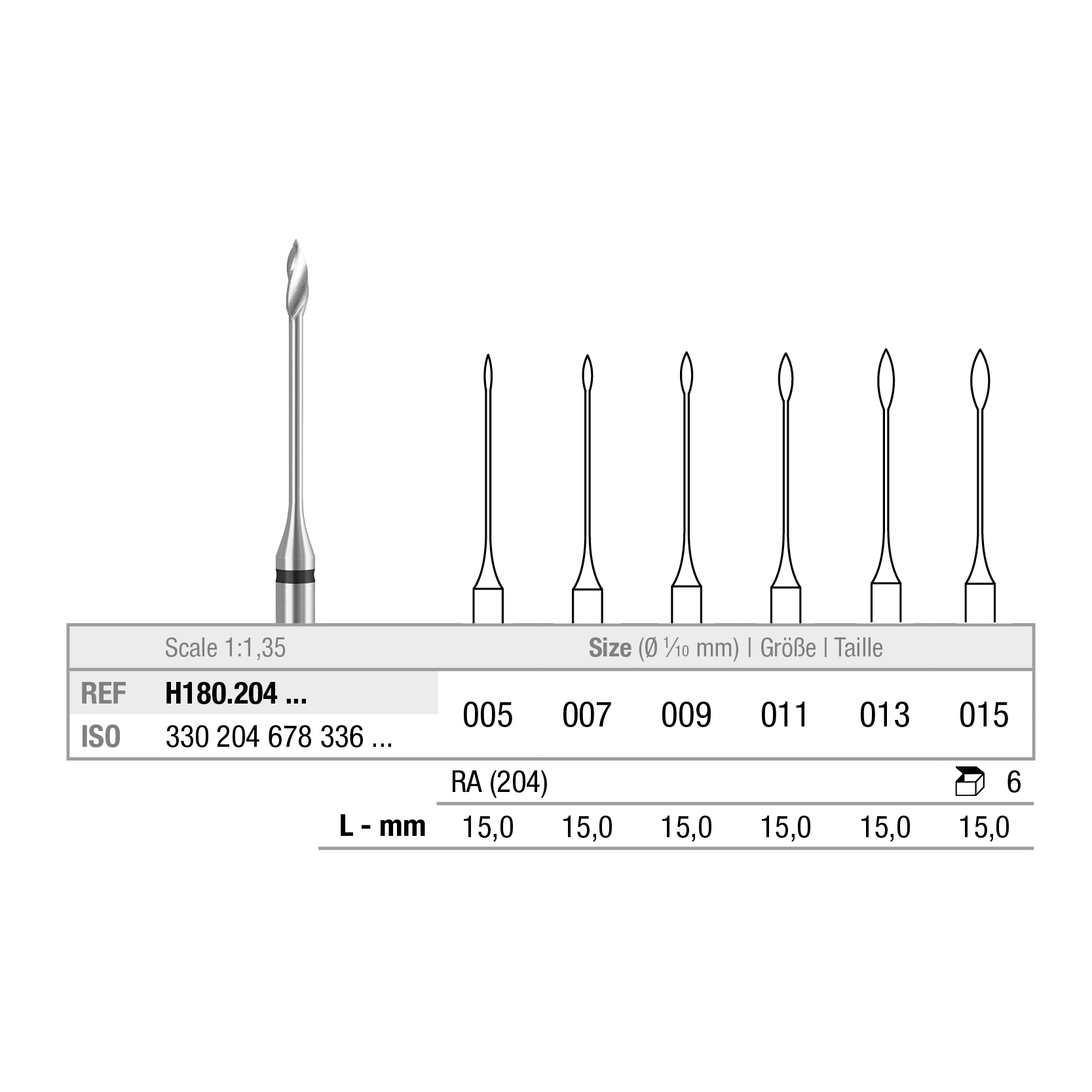
Carbide cuts, diamond grinds. Wherever a smooth cut surface and tactile control matter, carbide is the first choice.
| Task | Material | Why |
|---|---|---|
| Sectioning amalgam | Carbide | Cuts the metal instead of smearing it |
| Removing composite | Carbide | Clean cut without smearing |
| Reducing enamel | Diamond | Enamel is too hard for a blade |
| Working ceramics | Diamond | Brittle material, abrasive removal |
| Bone | Carbide | Chip transport, low heat |
| Acrylic in the laboratory | Carbide, coarse fluting | Large chip space, clogs less |
Section it out in large pieces rather than grinding it away. This generates less heat, less fine dust and less vapour than drilling out the whole surface.
The standard protocol includes rubber dam for isolation, high-volume suction directly at the tooth, and continuous water cooling, which limits temperature and therefore mercury vapour. The instrument cuts channels along which the amalgam can be removed in segments. A coarsely fluted carbide bur works faster than a diamond for this and does not smear the metal.
No. Zirconium oxide is harder than the cutting material and carbide blunts immediately. Diamond-coated instruments are used for zirconia.
Immediately after use, while residues have not dried on. Ultrasound and a brush clear the chip spaces where acrylic and cement accumulate.
Coarse cross-cut fluting removes material quickly, fine fluting leaves smooth surfaces. The blade count determines the balance between speed and surface quality.
For opening and removal, a coarse fluting with a large chip space is sufficient. For contouring composite margins, reach for finishing burs with a high blade count, which remove less but work considerably more smoothly.
Usually because of excessive contact pressure or incorrect speed, less often because of genuine wear. Dried-on residues also make an intact instrument appear blunt.
Check the cleaning first: acrylic and cement residues in the chip spaces prevent cutting. If performance is still absent after reprocessing, the blades are rounded and the instrument should be replaced. More pressure does not compensate, it only generates heat.
FG for the turbine, RA and WST for the contra-angle handpiece, HP for the straight handpiece in the laboratory and in surgery.
This page can be filtered by shank type. For caries excavation we offer round burs and excavators, and for surgical procedures surgical instruments.
Yes. rotatec has manufactured in Appenzell since 1980, certified to ISO 13485 and CE-MDR. You buy directly from the manufacturer, with no depot in between.